Version tested: Xbox 360
Is it possible to exhaust a genre's potential? There may be only seven stories to be told in the world, but in the multitudinous hues of character and scenario it's possible to dress them in infinite ways - and so keep our bookstores stocked with novelty.
Not so game systems, which in their stark mathematical and tactile nature are near impossible to disguise. Tetris is Tetris, no matter what colour the blocks or which imagery is used for the background. And so it seems feasible that some genres can be exhausted, mined of potential permutations to the extent that there are simply no truly new games to be made in that particular form.
It's an argument given credibility by the story of the strategy RPG, that Japanese sub-genre that marries chess with Tolkien and anime eyes. From its origins in the Shining Force series through Yasumi Matsuno's Ogre Battle games up to his masterpiece, Final Fantasy Tactics, the genre quickly pressed up against its self-imposed boundaries, leaving precious little room for any newcomer to manoeuvre.
More recently Nippon Ichi smashed through these constraints with its dazzling Disgaea series, opening up dizzying potential for customisation and pushing the conservative framework in new and interesting directions. But as a result the strategy RPG arguably became something else. Even if it was evolution rather than revolution, a great many players were left disorientated and disenfranchised by the complexities it introduced.
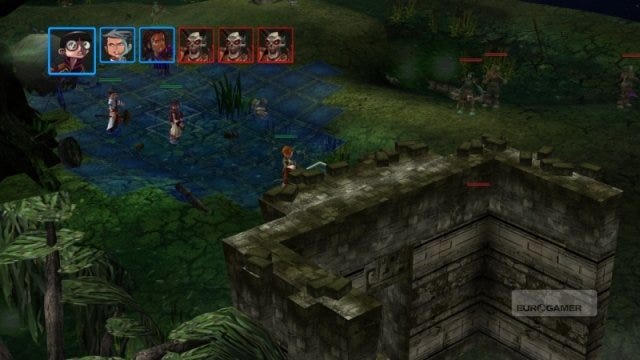
Every unit in the game has a 100 per cent counter rate, providing it's using the same weapon as its attacker.
In the face of Nippon Ichi's bold innovation most Japanese developers walked away from the genre, and those who didn't consigned their creations to orthodoxy and handheld formats. The genre, it seemed, had been exhausted.
It's into this landscape that Konami steps - resurrecting its SRPG property from the genre's PlayStation heyday, handing development over to a Western studio and choosing to publish to PlayStation Network and Xbox Live Arcade, where Vandal Hearts: Flames of Judgment joins Band of Bugs as just the second grid-based tactics game on the service. And while there's a lot of expectation on the game's shoulders, both for fans of the original duo of Vandal Hearts titles (to which this is a narrative prequel) and for fans of the genre, poorly-served for so long, this is a game that does little to refute the argument.
The signs ahead of release have been worrying. The game was originally scheduled for release last autumn and a six-month delay for a downloadable title is never a good sign. Then there's the divisive art style, which in discarding the super-deformed appearance of the original games has been poorly received. There's no denying that while these visuals are idiosyncratic - a sort of 3D Braid-alike, both functional and awkwardly pretty, they exhibit few of the defining characteristics of their forebears. But once you get your hands on it you discover the developer has stuck more closely to formula, a wise decision that ensures that, while the game's innovations are meagre, it remains solid and serviceable as an SRPG.
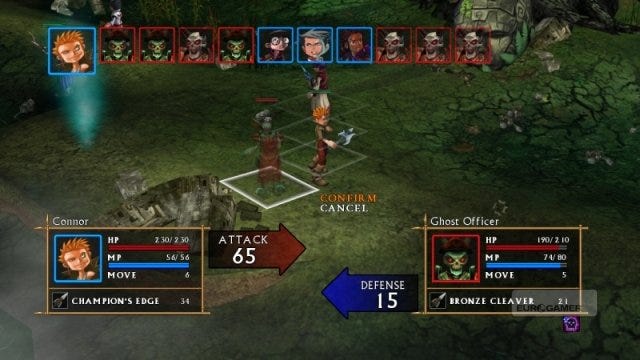
Enemy character models lack the variety of the former Vandal Hearts titles, not to mention some of the arresting gore.
You control soldiers fighting battles on gridded 3D environments, taking it in turns to move units, attack and defend. As you play you must consider the environment and your unit's position in relation to an enemy, ensuring that you're within striking distance if you want to attack or that you're far enough away from their ranged weapons to defend. In general, you'll clear a stage if a member of your team is the last man standing on the battlefield.
The RPG element of the game comes from the character leveling, which is comfortably the most interesting aspect to an otherwise a fiercely traditional proposition. In the original Vandal Hearts units would earn experience points for kills, levelling up as they progressed through the game. Then, every 10 levels you’d have the option to specialise with a unique upgrade for the character, customising your team to suit your play style.
Flames of Judgment has a far more flexible and immediate system. Each character carries two weapons which can be switched without 'using up' an action turn. This means that you can change between a bow and an axe on the fly, turning your warrior into an archer in direct response to the lay of the battlefield.
Each weapon has its own proficiency level so kills made with a bow and arrow will advance the ranged skill level of that character, while eliminating a foe with a spell will make them a better mage. As such every action you take on the battlefield advances a particular trait of that unit, giving a conscientious player ample scope for micromanaging her team's abilities.
Some weapons have area effects and will damage friendly units if they catch them in range.
The system is somewhat buried in the game, only hinted at by on-screen readouts (presumably so as not to overwhelm the more casual audience that Konami hopes to reach via digital download). But once you realise how it works the whole experience becomes far more engaging.
As with Final Fantasy Tactics, Puzzle Quest et al there is a boardgame-style world-map screen to navigate around, with new areas opening up as you advance along its paths. Destinations on the map are either cities (which amount to little more than an awkwardly-implemented shop screen), free-play combat areas (where you can level your team outside of the main thrust of the storyline) or key story destinations.
After completing a stage you are given a score for your performance calculated from the number of enemies you defeated, but which doesn't take into account the proficiency of your performance. There are no bonuses for ensuring your team-mates survive, or for completing a stage within a set number of turns. This neglecting of details makes it harder to feel like you can excel at the game rather than simply progress through it.
The promise of multiple endings adds to the illusion that your choices are meaningful, but few players will bother to collect each endgame.
The story centres around Tobias Martin, a war orphan and ward of the Church of Restoration, driven to defend his homeland from invaders. Players hoping for a Final Fantasy Tactics-style tussle between political and royal factions will be disappointed as, by contrast, Flames of Judgment's story is undernourished. This fact isn't helped by a cast of characters it's difficult to empathise with. They lack the gravity of, say, Valkyrie Profile: Covenant of the Plume or the levity of Disgaea's ensemble, instead settling into a vanilla, uninspiring middle ground.
The result is a serviceable tribute to strategy RPGs of 10 years ago, one that eschews recent developments to focus on a replication of what worked before. The game succeeds with this approach simply because it has so few contemporary rivals but it's a modest sort of success, one that proves the strategy RPG in its traditional form has run out of steam - but suggests that nevertheless, there's enjoyment to be had in revisiting old flames.
6 / 10
