Team Fortress 2 is shaping up to be one of the multiplayer PC games of the year (providing it comes out in this one, obviously). In and around our recent playtest, we were able to ask designer Robin Walker a bunch of questions about the decisions behind it, and the plan going forward beyond release. What follows is a selection of topics raised during the hours we spent in Robin's company, all knitted together fancily so it looks neat and tidy and you can read through it easily. You wouldn't want the raw transcript - it's epic, and we said a lot of stupid things. We're not very clever really. Enjoy.
Eurogamer: Why only six maps? (For example, we didn't really ask this - it just ties in neatly to something Robin said.)
Robin Walker: In the multiplayer space, you're obviously going to retrace your steps a lot, that's what multiplayer's about. Content you're consuming is generated for you by other players; that's what multiplayer is. And so we were thinking about how many maps we should build and so on, and one of the things that anyone who's played online PC games for some time has noticed is that if we build 100 maps it won't matter; the community's going to choose five or six they want to play and play them to death.
Eurogamer: Moreover if you've got 100 maps it makes it impossible to get your head round them all.
Robin Walker: Exactly yes, so I think the community's making a good decision there, because if you play 100 maps equally it's really hard for new players to come in and learn 100 maps. If we pick five, new players can come in and really get to know them, so it's just a natural... From our perspective thinking about how we make TF2 more replayable than our previous products, what we thought about was instead of trying to make 100 maps or something, what do we get if we focus on making one map that's more replayable? So we sat down and we tried to design a map that was more replayable. What we came up with is a map called Hydro.
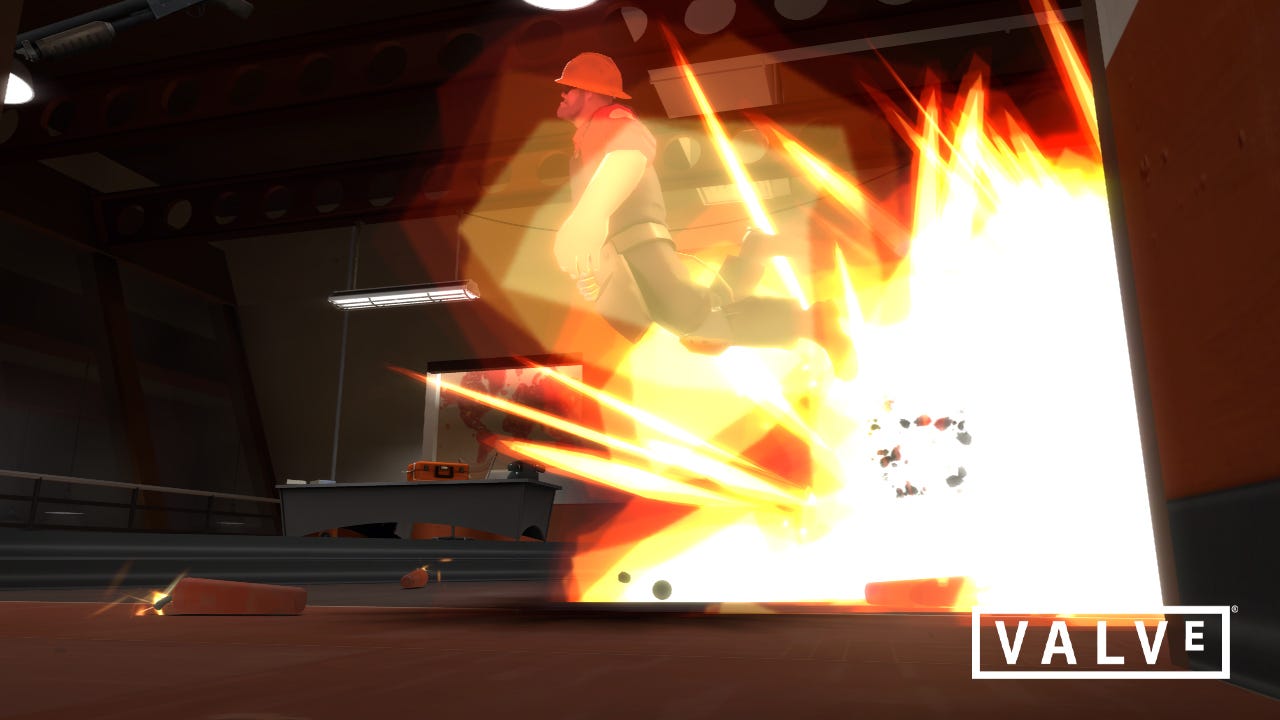
This isn't a shot of us, but it might as well be. We averaged about 20 seconds per life.
The gist of it is there's four control points out in the middle. Each team has a base, and then there's four points out there in the central area between them. When a map first loads up, these four are randomly distributed; each team gets two of them, but it's not a specific starting set-up, and then the game picks two points that are owned by opposing teams, and carves them out and it spawns everyone in these areas and you can't get out of them. And you fight a short, five-or-six-minute fight over these two points until one team caps the other point, and then that switches those up, and then it picks another round to play from what's available - if blue only has one left they defend that, but the reds could be defending any of the other three.
The game deliberately tries to avoid repetition, so if we've just played two it's more likely to pick two others. Although one other thing it does is, if you were attacking a point it often lets you defend it, because it's often fun to be inside the base you were just attacking. And so this keeps going on until one team owns all the central points, and then they attack the final base, and if the defending team holds out long enough they can get the other point back and it goes on for a while.
Eurogamer: The individual control areas are presumably quite varied.
Robin Walker: They're all completely unique. One's got a large open water area, with bridges. One has a height advantage. This one's all an internal area. This one's like a big satellite and you're fighting inside the dish. This one's half interior half open space. And the way that these connect are all really different too. Here's got a bunch of winding vents, this one has one path through, this one has multiple canyons of high and low. That of course means that if a game can't be resolved in one area, if we switch to this one it has a higher chance of happening because there's a dramatic change in space.
We got snowed in here over Christmas and we played it for about six or seven hours straight, with about 10 of us who couldn't go home, and at the end of it I don't think anyone was saying 'I'm done' or anything. We're pretty damn optimistic about this - we think it's one of the most interesting things we've done in multiplayer maps for years.
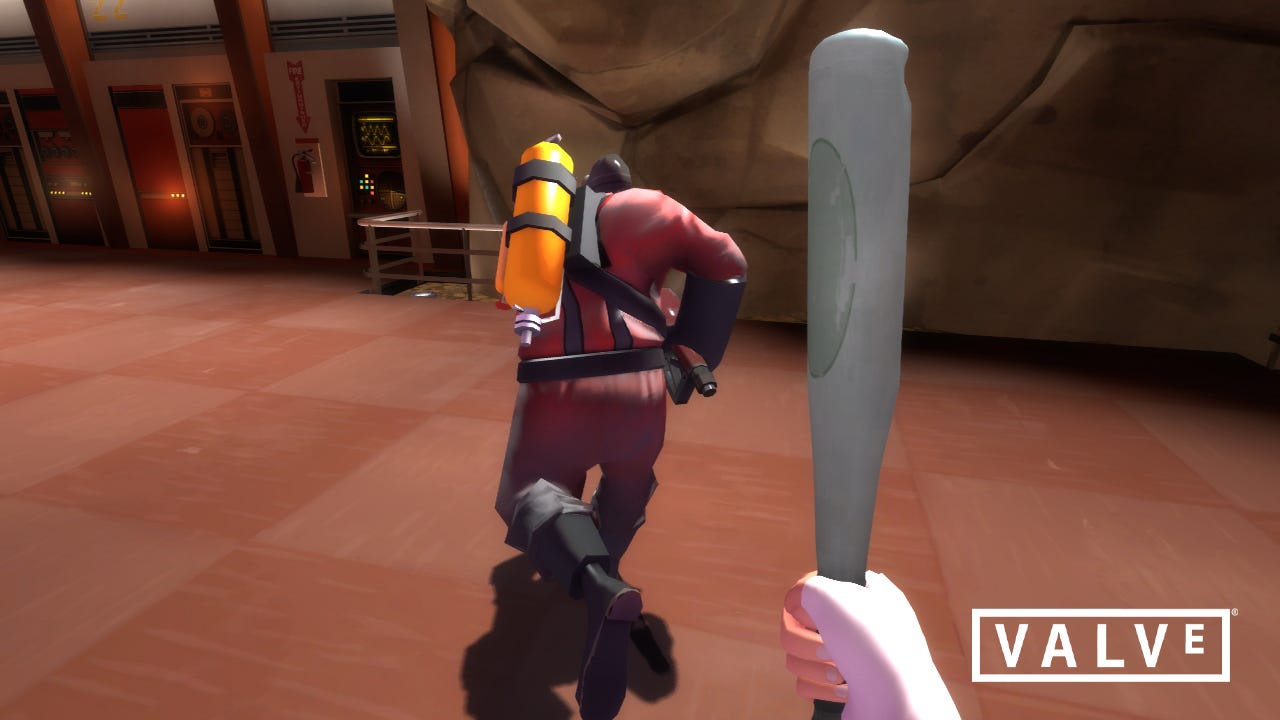
Just hope he doesn't turn around - the Pyro's flamethrower is pretty fearsome up close.
Eurogamer: How trusting will your netcode be of the client player? Because in Counter-Strike there were times when lagged players achieved things that shouldn't be possible.
Robin Walker: We use the same networking system that we've used in the past. TF doesn't really have the same problems that you could have with CS because we're nowhere near as reliant on the scan weapons that CS has; we're more projectile-based. That said, it's sort of a fallacy - the lag thing is actually a fallacy, it's not true at all. The lagged player has no extra ability over...
Eurogamer: I think it was more where they'd see a shot where they shouldn't be able to.
Robin Walker: From the player's perspective of that client, he still had the exact same condition. For example if you run across a gap and run behind the wall, the lagged player may shoot you when you've passed behind the wall. From his perspective, he saw you for the same amount of time a normal player would have seen you, and he made the shot in the same amount of time, and the game's rewarding him as it should, taking lag out of the equation. So it's actually not really true.
Eurogamer: Any scope for customising things like armpatches and flags? Friends of mine were saying they'd really get off on defending their own flag.
Robin Walker: We've always wanted to do that. We're not going to support that out of the box. The Steam Community stuff we're doing is pushing a lot more customisation in - like everyone on the scoreboard in TF has a little avatar, and that's all player-set - and we're pushing more and more of that stuff in, so I think it'll be a long time before we run out of stuff we'll let players control in the game. I think we'd want to do that for sure.
Eurogamer: What kind of stuff have you learned from more ambitious interfaces like Ghost Recon Advanced Warfighter or Rainbow Six Vegas?
Sentry guns can be upgraded until they fire rockets.
Robin Walker: This is a good question because it sort of goes back to our philosophy. We have this philosophy that putting more stuff on the screen is bad actually, not better, in that the more and more the game starts to talk to you through interface the less you look at the world and the more you look at the interface. And a really perfect example of this is the Spy. As I said, if we're on the same team and you're disguised, I still see you as a Spy because it's confusing if you look like an enemy. Our earliest versions, we put an icon above your head to show that you're disguised as a Heavy or something, and what we found is that if you solve all your interface problems that way, you start looking at the icons above everyone's heads instead of the characters, and so what we did instead is we put the mask on the guy and it's much more interesting and solves the same problem.
What we've found is that every time we've said to ourselves, 'no, you don't just get to add a HUD element, you don't just get to put a bracket around that, you don't get to put a logo above everyone's head,' we tend to solve the problem in a more interesting way. The game's more fun for it. So in general our focus has been how do we convey that information in the world, on the characters, not in overlaid HUD elements.
Eurogamer: Are you going to do anything to try and stimulate map creators in your community?
Robin Walker: There's a lot of different factors in there. The thing we're trying to solve that we've tried to solve in the past and are continuing to solve better is this problem of distribution. As a producer of content, way back before we even shipped Half-Life 1, if you made content for Quake, which I did, the problem was how do you get people who have Quake to even find it. In those days I tried to get PlanetQuake or someone to put a message up, so with Half-Life 1 we said, if I'm a customer and own Half-Life 1, I should be able to go and find Half-Life 1 mods - and so we built the mod-browser, and that was aimed at solving that problem of distribution. And the Half-Life 1 mod scene is larger than anything anyone had ever seen, and we think that was part of that.
So what we're trying to do with the new Steam stuff is trying to get to the point where that point-of-distribution problem gets solved for other people, not just mods. Steam already links Garry's Mod and so on and can solve mod-distribution better, but we're still not doing a good job of... if you just made a map, or maybe you just made a sound pack, or maybe you made a new model pack. The distribution system for those is the same today as it was for mods in Quake. We always try to look at the problems that are facing someone producing content and try and solve them, and right now we think that the biggest problem for those guys is distribution. How do you get people to find your map? And if your map's one of the best Counter-Strike maps, how do people know that? How do we help people find the best pieces of third-party-produced content? And that's part of the new Steam Community thing.
The Scout, busily nicking our treasure. We hate him.
Eurogamer: Is there a timeline for new classes or maps post-release?
Robin Walker: Like any Valve product you buy it and you're gonna get plenty of stuff after you ship it. We already have some plans for what we'll be working on afterward, but I don't think we're going to talk about it just yet, but yes, like any Valve product I think you can be confident you'll get plenty of free stuff after we ship.
Eurogamer: Do you have a hitlist of post-launch maps and stuff?
Robin Walker: We're always pushing the technology, the engine, etc. In terms of extra content, we have a few things we're messing around with already. Our plan is that each map should have some new facet, some new experience. If you look at the TF maps, the six maps we're shipping, every one is actually unique. There's common building blocks - like control points are in multiple maps - but the way that different maps use control points... like Hydro uses control points and so does Well, but the mechanics are totally different, and so each map is unique in terms of how they use the building blocks, and I think that whatever maps we produce afterwards will similarly be doing something interesting.
Team Fortress 2 will form part of The Orange Box bundle with Half-Life 2: Episode Two and Portal, and is due out on PC, PlayStation 3 and Xbox 360. All three are targeting October.