Version tested: PC
The marketing motto for Unreal Tournament III seems to have been something like "simplify and improve", at least if you listen to Epic's bossmen speak their brains. They've told us that they wanted to take the best features from all the previous games and make it faster, tighter and (presumably) more macho. Or maybe that's just fallout from the enormous success of Gears Of War...
Anyway, does this approach work? Is the heaviest of the heavyweight arena shooters still boxing spectacular? And has the actual formula for play really been simplified and improved, or simply dragged from the crypt of yesteryear bolted on to a new graphical superstructure?
Okay, let's start with something fundamental to shooters: the "feel". Oh, holy crap that's subjective: I could have started with the gametypes, or the number of weapons, but no, I have to go and pick this unreasonably impressionistic topic. The reason why I want to start with that is that no matter what ideas you throw into a game, if the feedback loop of player to controller, to screen and back again isn't satisfactory, then it's not going to be any fun to play. It was this very confluence of input and output that meant I preferred Quake III to Unreal Tournament in the original 2000AD battle for FPS dominance. UT3 seems to have done little to alter the overall acrobatic feeling from previous games, but it doesn't seem much faster than 2004. Does it? It's at this point that I have to go back and playing UT2004 to check... Erm... hmm. Hard to say really - it's very similar. After playing months of Team Fortress 2 and ETQW both games seem fast and responsive. What is obvious is that things like the rockets fly faster, and the pace of the vehicular game has been pumped up enormously. You die a hell of a lot easier in UT3, but at the same time so do your enemies...
In fact what also seems lacking in UT3 is the feedback from damage. I've not always been able to instantly tell where an attack is coming from (perhaps because the visual hints on the screen aren't clear enough, perhaps because it's a new game and I'm not quite tuned into it yet), but also I want the Team Fortress 2 deathcam to appear in pretty much every game now. It's the kind of feedback that really improves your game quickly, rather than through the guesswork and practice we're so used to.
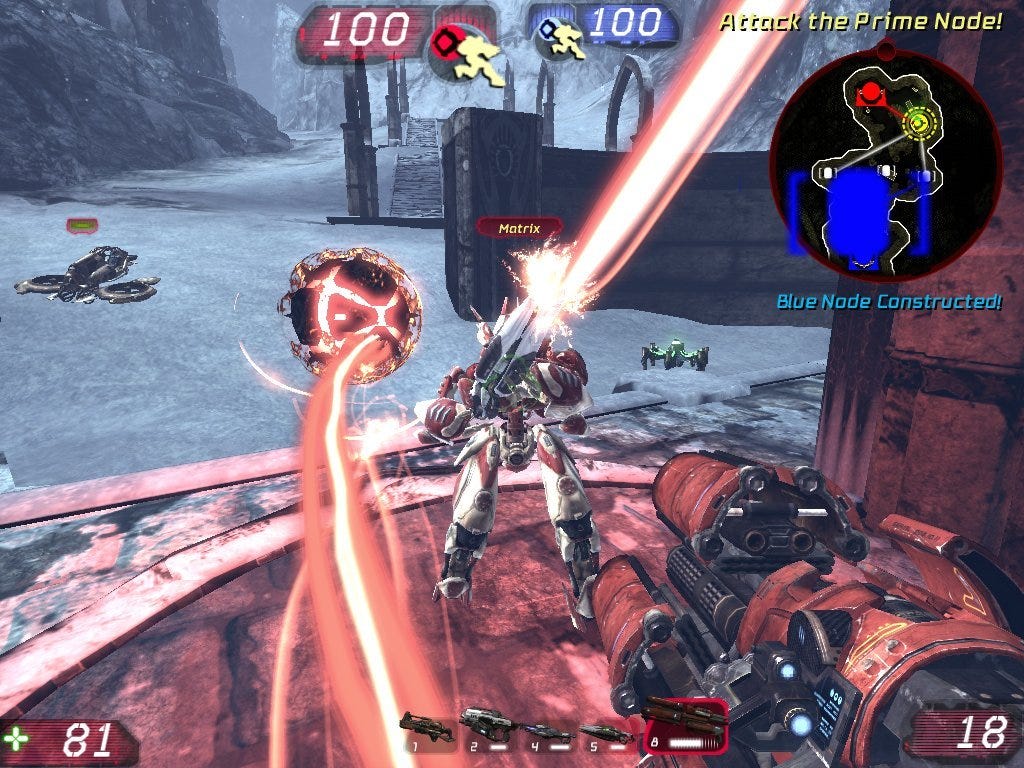
This robo chap is using the orb to defend a node in Warfare.
Despite this I've found UT3 incredibly intuitive to control. I mean I play FPS games pretty much every day so I'm not exactly one of those people who run along staring at the floor, but it still feels right every step of the way - the double tap dodges and jumps arrive instinctively, while the maps never get me lost or turned around, despite their visual complexity. The transition from being on foot, to being on a hoverboard, to being in a tank, is all seamless and obvious. I've heard a few people complain that the weapons are all a bit vague: that you can't necessarily tell what does what, and I can partially agree with that. I've always felt that UT's weapons were needlessly ostentatious compared to the minimalist set of Quake III, but here they are nevertheless solid, beefy and quite welcome. It's so similar to UT2004 that it's like the familiar positioning of instruments in a car that you drive on a regular basis. UT3 doesn't take much getting used to: we're motoring from the first moment. The feel, we might therefore conclude, is good. But you knew that from playing the demo, right? And that wasn't all that impressive.
So there's more: secondary to the feel is the particular recipe of features that make up this third Unreal iteration (Epic are calling UT2003 and UT2004 instalments of the same iteration, so they collectively represent Unreal Tournament 2.) The game modes are each classical (if they can be so-called) and instantly comprehensible.
Deathmatch comes with a bunch of exquisite maps, each one delivering the tenets of the old game perfectly: the maps are always circular so that fleeing and chasing never truly lands us at dead ends, while the distribution of items over the environment has been carefully studied. No spawn lands you too far from a decent weapon, and no powerful power-up is placed anywhere that isn't dangerous to get to. This consistency wobbles a bit in the other maps, but generally it's entirely well judged and playtested to the smoothest of rides.
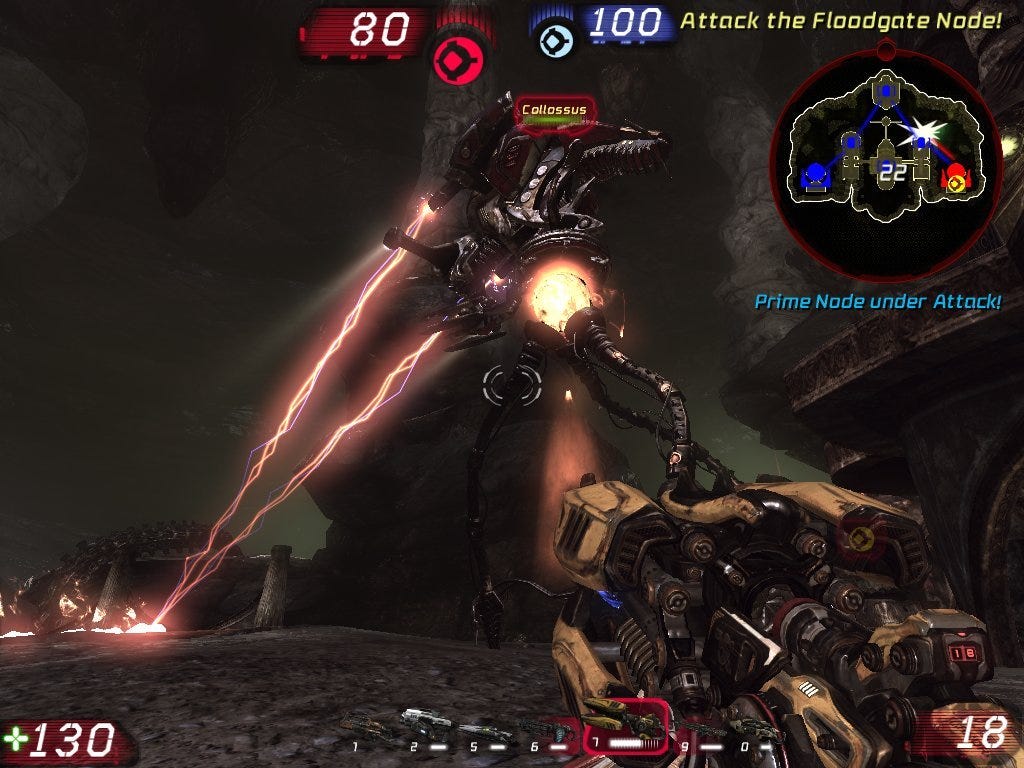
The noise it makes isn't exactly 'pew-pew'.
Aside from the assault maps in earlier UT games, Capture The Flag is probably what I've played most of. It's not true this time. Not because I don't enjoy it, or because I've not got on with the maps, but because I've actually found "Vehicle CTF" far more entertaining. Vehicular flag borrowing entertains me more because, well, UT3's vehicles are spectacularly apeshit. While half the automotive repertoire has resurrected from previous games in the form of the Axon vehicles (the original tanks and hovercraft stuff, henceforth to be know as "The Boring Vehicles") the other half boasts the Necris vehicles. With these you get to drive a spider, pilot a snaketank, and ride a rocket-bat missile thing. There's a cloaking tank too. The Necris vehicles are exactly what I wanted from a game like UT. It makes me cackle like a cardboard villain to see my team roll out on tentacle legs. It's as if Epic suddenly realised this was a videogame. Not only can they have insane vehicles, they should have them. They must have them. They're ludicrous and look incredible: you will probably already have seen the walker, which dominates the maps complete with its War Of The Worlds space-cred. This is exactly the kind of spirit of game design we should be encouraging: the more outlandish the better.
All of which feeds into what has basically made UT3 fun for me: the Warfare game mode. It's a sort of territory-based game where nodes have to be captured to take over a grid across the map. It's a kind of refinement of the Onslaught mode that we saw previously. The refinements are that there are secondary nodes which can be captured to produce useful vehicles - often of the awesome Necris variety - and an energy orb which can be carried across the map and used to capture nodes instantly. I suspect this mode will be too obscure and complex to really take off online, but that doesn't dislodge the fact that I spent much of this afternoon failing to write this review and playing Warfare alternately on a laggy American server or against a dozen bots. I really like it.
One of UT3's weird foibles is that all this stuff, old and new, is tied into a single-player campaign in which a story of sorts wriggles and blasts. Events are awkwardly wrapped around the deathmatch, warfare and CTF arenas, as if they were each military actions, rather than sports competitions. The characters in this tale of intergalactic revenge and mercenary alien-bashing explain away that they're playing tournament arena games with an occasionally verbal wink. The "Field Lattice Generator" that must be destroyed is the flag of capture the flag and as the characters observe "it looks like a flag... it's a flag." Yet the fiction persists. It's quite odd. A few people have expressed disbelief that UT3's single-player would be anything other than macho nonsense, and it largely is, but I think there's a sense of humour about it too. Deep down they know that placing the world of respawning and power-ups inside a classical science fiction story is, well, absurd.
The opening level sees you duelling with your sister. That means your character gets to see what his sister's guts look like. Ten times. There's something wrong with that.
I know people will say I should talk more about this, but I really don't think there's much to talk about. There's a bunch of cinematics that are very pretty, but totally inconsequential, and there's sort of a story wobbling its way between them. But it's really just the multiplayer stuff strung together, should you want to play it like that. Single-player conclusion: stark raving, but the bots can play CTF pretty good. Not only that but the co-op campaign isn't a bad idea for just a couple of people to play through, perhaps on a home network when the internet is out of reach. It's very silly, and horribly engrossing once you get into the guttural croak of things.
Chaingun to the face: permanent solution for acne.
Lets move go back to where we started: the problem with the 'simplify' part of Epic's overall intentions for sequel is that Unreal Tournament is inexorably tied into the ongoing complexities of the Unreal engine. The fact is that UT3 is so ludicrously pretty that it's often hard to see what's going on - you're simply overwhelmed by bump-mapped crenelations, glittering stone textures and warping particle effects. They've worked hard to highlight things of consequence, but at close range indoors it's chaotic in the extreme.
Of course it's stupidly pretty too, and on a high end machine you'll find yourself stopping to examine architecture, staring off into the tendrilous distance, or muttering over decals like some kind of absent-minded tourist. The performance is fairly well scaled too, so that sorting things out to work smoothly in a lesser machine isn't too much of a challenge. Nevertheless it does feel less solid across a range of machines than UT2004. I'm not quite sure why this is, but you sort of felt as UT2004 would work okay no matter the condition of your machine. You could always scale things back. With UT3 I'm more worried about the age of my graphics card and the temporal spacetime dilation of my RAM, or something like that.
This is all hung up with something that gamers don't like to think about: the existence of Unreal Tournament III as a showcase for the Unreal engine as a commercial tool. It's less of an issue in this case, since we've already seen a bunch of games using the most recent tech, including Bioshock and Gears Of War, but there's still something of a feeling that this is like a giant, throbbing techno-brochure for demonstrating what can be done with the Unreal engine. The game comes with the editing suite and will immediately give rise to an astonishment of player-made arenas, and they're going to struggle to be as outlandish as the maps delivered by Epic themselves. These boys are just showing off.
It never looks anything less than faultlessly beautiful.
All of which analysis leaves us at kind of a critical impasse. The problems with Unreal Tournament seem like the 'problems' with a competently constructed bridge or skyscraper. You can say "well, it doesn't do X or Y, and it's not presented like This or That", but it was engineered for a very specific purpose. In this case it's to be the next arena-based shooter. As the multiplayer FPS genre spreads incrementally outwards from its deathmatch origins so UT3 has fewer and fewer competitors in this niche. You might say that Quake Wars has taken away UT's assault-mode thrills (scrapped during development), but UT3 didn't bother to contest it, and you won't miss it. Despite the family resemblance between these kinds of games it's actually pretty tricky to compare UT3 to its peers. We end up talking about how they "feel" and whether we're comfortable with a spawn timer, or whether we want a class-based system in our game. I'm learning to loathe notion of 'innovation' when it comes to this kind of game development, and in this case UT3 isn't really innovative, but it is playful, really playful. It's packed with big, mad ideas, without ever breaking the game in its over-excitement. They'd added things, without really changing things. It's not really been simplified, but nor has it been made too complicated.
Having played the demo I was all ready to brand UT3's mighty flank with a hissing 7 out of 10, but it's better than that. At the most insane moments of vehicular evisceration I was ready to plump for a nine. I can't honestly see anyone really caring about the eccentric single-player stuff, or the overly busy environments: if you've an ounce of competitive deathmatching in you it's difficult not to click into the zone and start pumping out flak and rockets. Drop into servers, start killing people, it's so natural to habitual gamers these days that it's hard to quantify how familiar and welcome these experiences are. With the sheer range of death-mongering that UT3 provides, it's hard not to get into the spirit of things. So yeah, Unreal Tournament pretty much remains The Daddy: consistent, meaty, and just weird enough to survive.
"KILLING SPREE!" That's the stuff.
8 / 10
