Tournament of Legends
Maximus pain.

So often in history it has fallen to the 3D fighting game to establish the appeal and capability of a console in its formative days. Tekken communicated the pace, pluck and glowering J-cool of Sony's PlayStation; Virtua Fighter bespoke the sometimes finicky technical prowess of Sega's Saturn; Dead or Alive 2 the weight and wobble of the Xbox; while Soul Calibur, in its jaw-dropping polish and elegance, secured Dreamcast's legacy even before SEGA had a chance to secure its demise.
Why should a relatively niche genre so often be responsible for defining hardware in its earliest days? In part it's visual: the language of one-on-one combat is universal, allowing the viewer to focus on the showboating flamboyance of the characters, without being distracted by having to interpret what's going on. Then, in the speed of battles, the split-second combo windows that allow players to link together chains of rock paper suckerpunch, the fighting game reveals how good a console is at speed maths, in parsing the causes and effects that fire any videogame.
And they can do all of this at the start of a console's life-cycle because the fighting game's straightforward structure - pitting one character against another in a linear string of discrete battles - provides tight scope and focus, yielding the most visually impressive results in the shortest space of time. 3D fighters allow a skilled developer to say: this is what this machine is capable of. They are a shorthand account of competence.
On the evidence of Tournament of Legends, Nintendo's Wii is a decrepit appliance capable of little more than some awkward, shuffling, cat-swipe animations interrupted by impromptu quick time events.
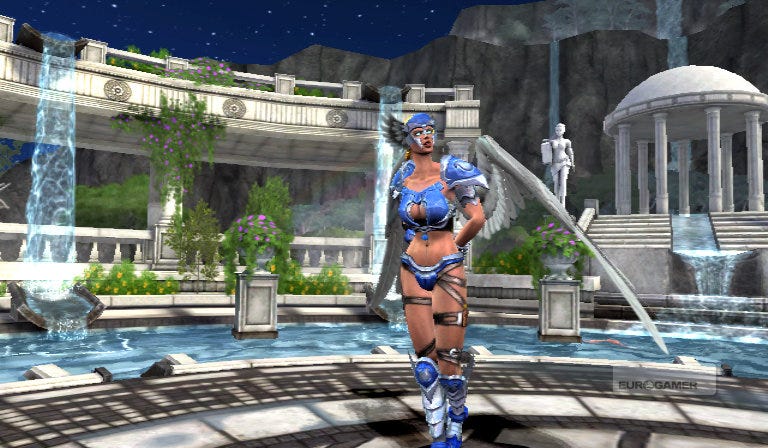
Tournament of Legends' archaic visuals clothe a lacklustre fighting system that is heavy on shallow gimmicks that fail to combine into a competent whole. The paltry character roster consists of mythological stereotypes - the gladiator, the Valkyrie, the Medusa, the birdman - each so generic they could have been pulled from a stock library of 3D objects.
A substandard, under-featured one-on-one fighting game, the game pushes not one of its host hardware's technical boundaries. The high point of its creative endeavour is the inclusion of Volcanus (Roman slang for Vesuvius' gluteus maximus, perhaps?), a gold-plated robotic golem controlled by a bespectacled professor who drives around in a hyperactive, malfunctioning electric wheelchair. Without him, the game would be entirely devoid of flourish.
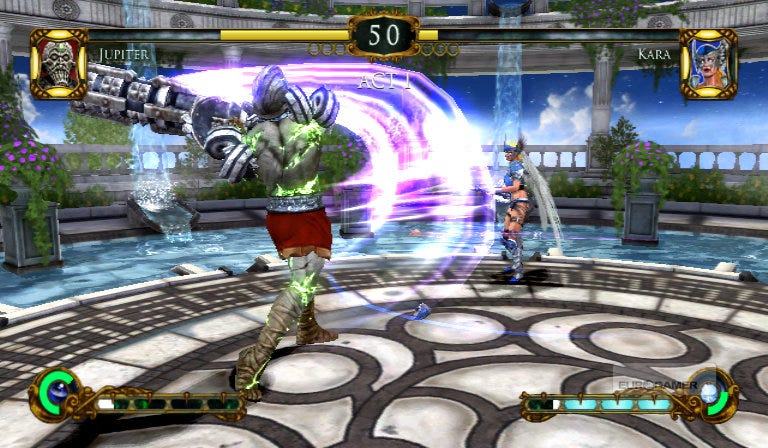
That is not to say the developer High Voltage was without ambition. Efforts have been made to bolt unusual systems together in an effort to create something distinct. Before each fight you are free to choose which weapon you'd like your character to wield and which performance-enhancing orb you would like to equip it with. As you work your way through the nine battles that make up Story Mode (the only combative mode available for the single player), you claim the weapons and orbs or your foes, building up your arsenal and options one by one.
Each character has two unique special moves, which use up one piece of a segmented move gauge. These are based around the mythological theme: setting a tiger on your foe, for example, or trapping them momentarily in a bear trap. Added to this, each weapon has its own attached special move, so there's some scope to mix and match offensive abilities as you progress.