Through the 3D stereoscopic looking glass
Blitz games boss Andrew Oliver on 3DTV.
After HDTV comes 3DTV. At least, that's according to Andrew Oliver, whose company, Blitz Games, has a proprietary engine that produces 3D images on PS3 and Xbox 360. You need a 3DTV to display them, obviously, and without many of them around there's not a huge amount of excitement yet, but Blitz hopes to change that with its upcoming downloadable 3D game, Invincible Tiger: The Legend of Han Tao for PlayStation Network and Xbox Live Arcade.
It's a side-scrolling kung-fu game with the pace and punch of an old Hong Kong film. Your ninja hero can punch, kick, roll and jump, and how he navigates platforms and controls the crowd will determine his level of success. Visual detail may have been sacrificed to reach the crucial-for-3D 1080p/60fps benchmark, but the result still packs personality and means gameplay is as smooth and fluid as a Bruce Lee roundhouse.
Of the 15 arenas Invincible Tiger packs, I've seen a blossom-strewn level with bamboo-topped huts, and a cave level, and both transformed when the 3D option was selected and glasses donned. It's the box-within-the-screen effect, rather than images pouring out of the TV, and ledges are given convincing depth. Punch one off the screen and they fly out at you. Wait for another wave and they run from the bottom of a tunnel rather than a circle on a wall. The TV takes a while to warm to the two images that eventually made my head and eyes hurt, but the effect is one I'd be interested in going back to. Intrigued, I sat down with Oliver at the recent Develop Conference in Brighton to find out more.
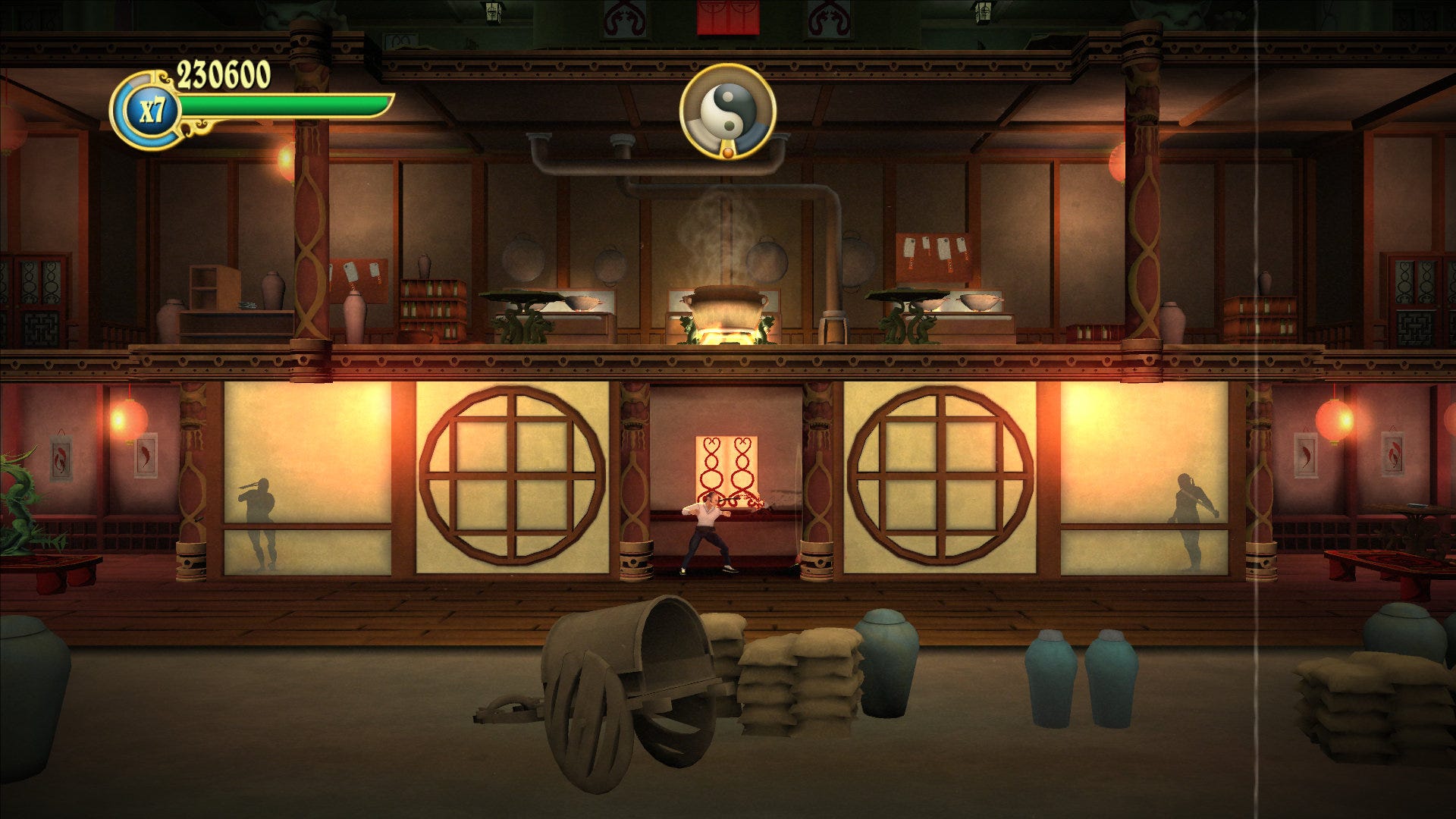
Invincible Tiger: The Legend of Han Tao. Simple visually, but fast and fluid. Oh, and 3D.
Eurogamer: Can you explain this crazy concept of 3DTV and stereoscopic vision to our readers?
Andrew Oliver: Games are 3D but they're about to go more 3D. You've probably seen that movies - computer-generated movies - have started to go 3D. Live action is coming, albeit a bit slower. The TV companies have realised that we're going to be watching 3D movies and that really, in a year or so, they're going to come into the home. So they're all saying, "Right, we've been doing HDTVs for a while, so let's make sure they can run 3D movies." So Samsung and Mitsubishi particularly have started to put 3D functionality into their top-end TVs ready for the movies. The movies are taking a little bit of time to come because you need to work out formats - cable, satellite, Blu-ray - but these TVs are sitting there capable of 3D. So we had a play and saw consoles working and actually displaying 3D images, which last year people were saying was impossible to do. And we thought, "It's only graphics, it can't be that difficult," so we did some playing around and we got it working.
I took it round to various publishers, our demo, and people were really sceptical: sceptical that you could do a full game and sceptical that there was really a market. So we've gone ahead and written our own game and we're just about finished. It's called Invincible Tiger: The Legend of Han Tao for PlayStation 3 and Xbox 360.
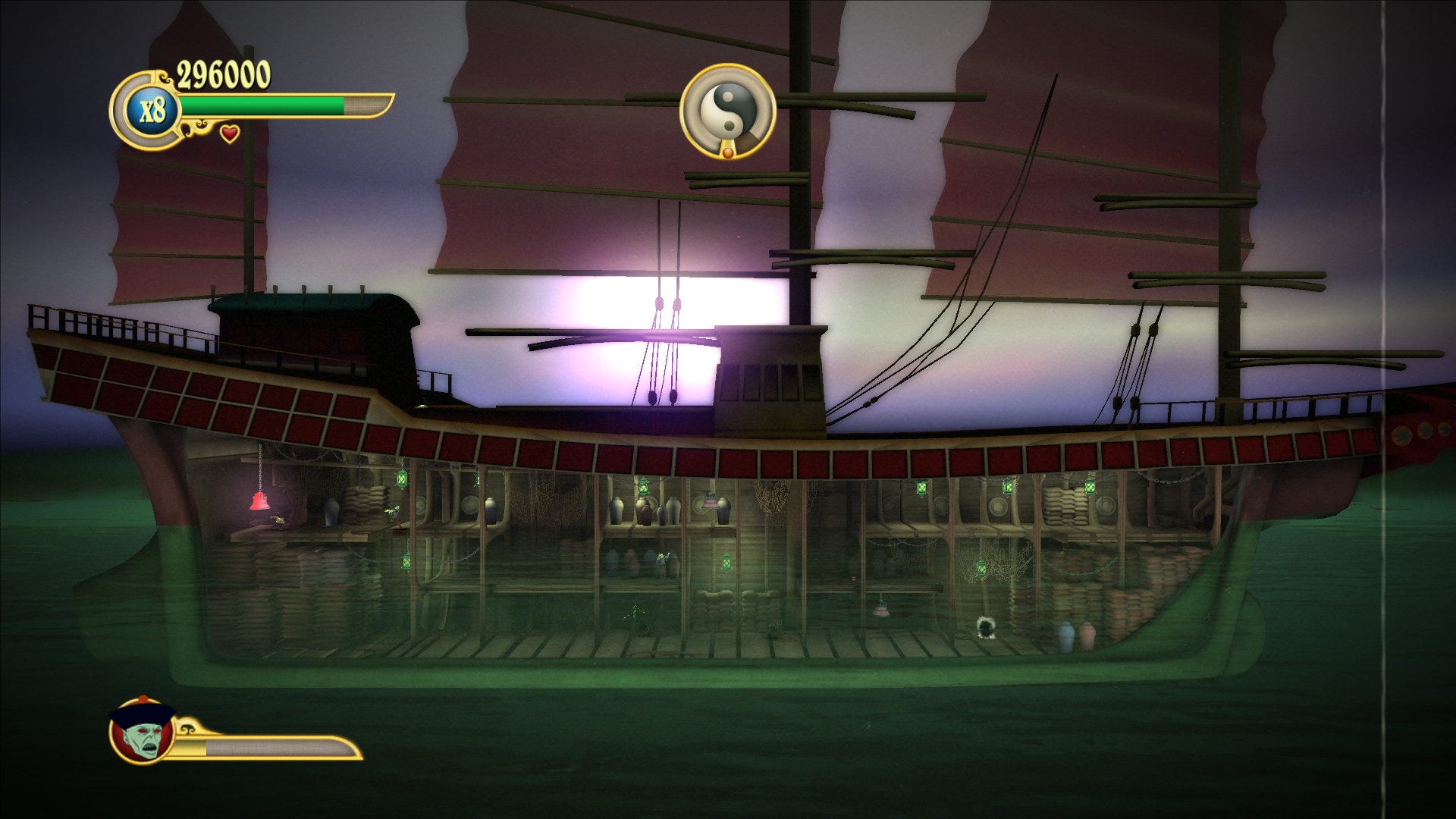
Levels can be zoomed out to great effect.
Eurogamer: And that's for PSN and Xbox Live Arcade - a downloadable title?
Andrew Oliver: Yes it's downloadable, and that's because it is difficult doing 3D and we didn't get funding from any big publisher when we started it. Big games nowadays cost millions to make and we just thought, "Well, in a way this is a test and experiment, we've kind of got to get it working to prove it ourselves," so it was a smaller project that we thought we're going to put onto [the download services]. Although now it's been bought by Namco and will be published by Namco on Xbox Live Arcade and PSN. But we very much had to get it fully working before we got a publisher on board.
Eurogamer: So the actual 3D technology, is it just producing that two-colour image...
Andrew Oliver: EURGH! Two-colour image! I want to hit you! No! It's not the red/blue glasses. Have you seen a 3D movie?
Eurogamer: No, not a new one.
Andrew Oliver: Oh! Old movies: crap. We're in a new, digital age. We invented computers a few years ago...
Eurogamer: Oh!
Andrew Oliver: The red and blue glasses were invented in 1922, and they were s*** then and they're even worse now. They give you headaches and they're awful and they destroy the colours. We are not talking about that.
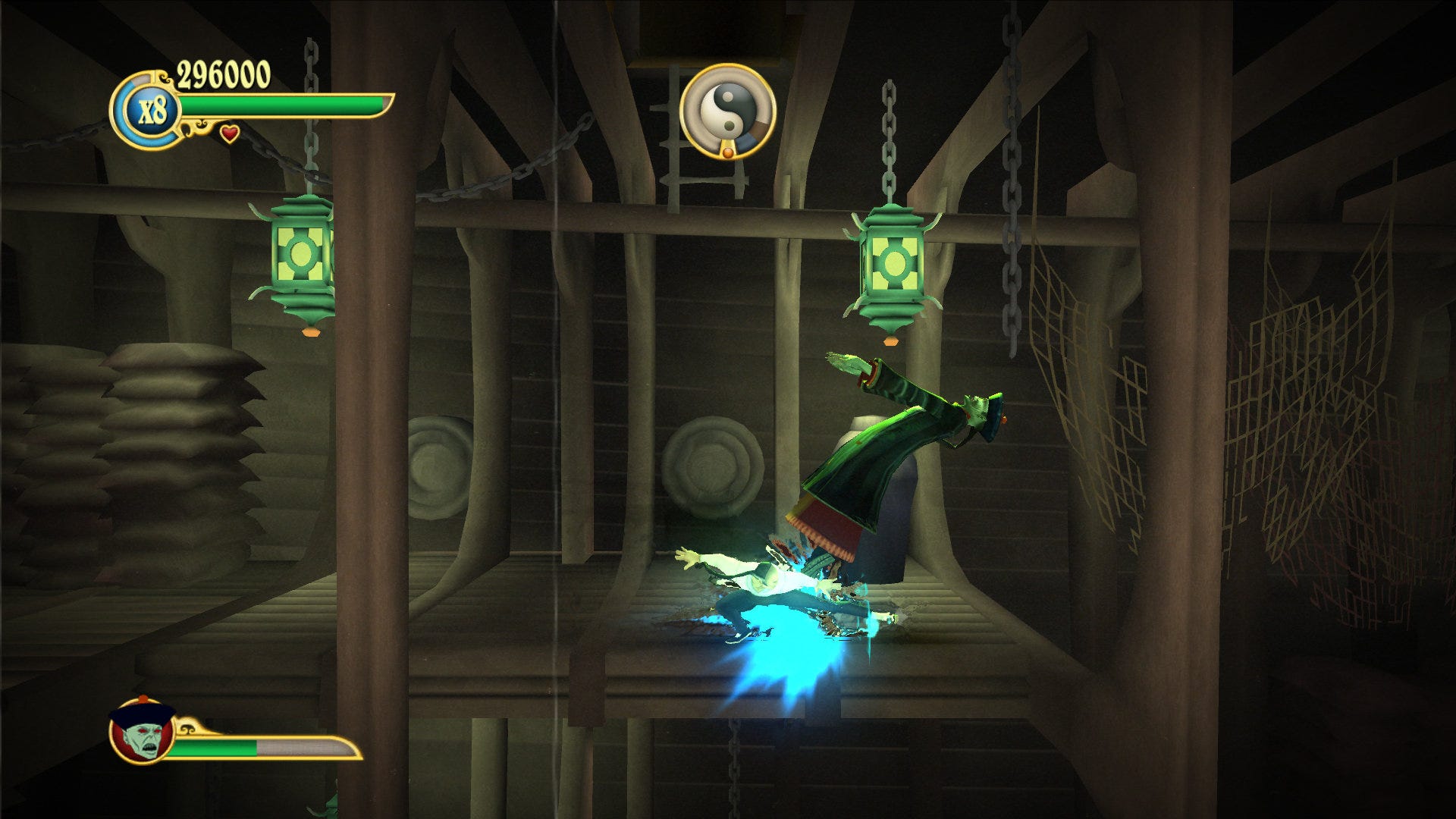
And then zoomed back in for some Kung-Fu acrobatics.
Eurogamer: Will you have to wear glasses?
Andrew Oliver: You will have... Yes and no. With the Mitsubishi and Samsung yes you do have to wear glasses. But if you come through to the other room we have a prototype [which later blew up] where you don't wear glasses.
I was a fan of Star Wars and we've all seen that holographic Princess Leia, and people think that would be a really difficult thing to do, that you'd need holographic technology. But you don't, because you've only got two eyes, and both of them see flat images. So if you close one eye, you see a flat image. So all you've got to do is get two flat images to your eyes and your brain will put it together in 3D. Now they tried to do that with colour filters, but obviously that destroys colour. Completely. But nowadays you can use 120Hz TV - so a TV running at twice the refresh rate - and put glasses on that effectively shut out your eyes alternately, and you look at the TV your left eye will see one image, your right eye will see the other, and if you can get the graphics printed right the illusion works in your brain. That's the trick.
Eurogamer: Won't this be useless without the appropriate TV?
Andrew Oliver: Yes. Yes. The game [Invincible Tiger] will work on regular TVs: old-style 1080p HDTVs. You know, one of the old ones. And it will work and look beautiful and it's a great game, and for 99 per cent of the market that's how they will see that game. But for some, who have started to buy these new TVs, they'll be able to see it in 3D with real depth, and it starts to look holographic, which is so cool - it's really, really cool.
Eurogamer: Why did people think this was impossible before?
Andrew Oliver: These televisions are 120Hz, but Xbox 360 and PlayStation 3 only put out 60Hz. You have to run your game at full HD - it has to be 1080p - and it has to run at 60 frames-per-second and you have to send a double image, so render everything twice. How many games do you know that run at 1080p at 60 frames-per-second?
Eurogamer: Er, WipEout...
Andrew Oliver: Right: everybody knows WipEout HD. So you have to render it twice as fast as that to get it working. So that's why people said the computers are just not powerful enough. And I can't deny it's not difficult, and that's why our game is more simplistic than Call of Duty. It is a smaller game, and we did that deliberately to make sure that it works. We've learned a lot of tricks along the way, and now we're pretty confident we can do anything.
Eurogamer: So you could do maybe a Call of Duty-sized game?
Andrew Oliver: Actually... It doesn't matter how big the universe is, it's all about view distance and the amount you can render. So Call of Duty would actually be really difficult because you've got long view distance with realistic graphics. But a CG movie would work quite well, within reason. You could actually render those sort of things quite nicely.
Eurogamer: And your engine does all of this?
Andrew Oliver: Yeah. And we're now licensing our engine so we are going up against the Unreals and Cryteks of this world.

These old people are terrified of the future.
Eurogamer: But isn't your engine slightly different?
Andrew Oliver: No, ours is a full games engine. We've written lots of games over 10 or so years on this engine and we've written them on multi-platforms. Our technology works on the Wii and on the PlayStation 3 and on the Xbox 360.
But the point is that the Xbox 360 and the PlayStation 3 were capable of 3D and we believe that when somebody said to us, "It's not possible to render 3D on these TVs because you need a really fast rendering engine," we thought, "Well, BlitzTech has the fastest rendering engine in the industry," so if anyone can do it, we thought we can do it. That's kind of why we decided to do it, because we thought we stand a chance at it. And actually, through doing it, we've optimised and optimised and optimised, and our engine is so bloody fast now, and that's why we feel it's quite exciting.
Eurogamer: But your engine's key feature is that it supports 3D, stereoscopic images, isn't it?
Andrew Oliver: That's not the key feature. I mean the key feature is that it's probably a more powerful engine than Unreal. You have to see the games we've created on it. You have to be careful what you print next - I don't want to fall out with Mark Rein or anyone - but we do like-for-like and we have had independent developers looking at it and being very, very impressed. And if you look at our games, they run in 60 frames-per-second. How many Unreal games run in 60 frames-per-second?

Perhaps they have seen a future-shark.
Eurogamer: How long until stereoscopic-capable tellies flood the market? It took us a while to adopt HDTV.
Andrew Oliver: That's the big question; that is the big question. It's going to be slow; it's going to be really, really slow. But when we started looking into this and I started talking to TV manufacturers they said it's really difficult to sell [3D televisions] because there's no content that people can see. Nobody knows that they're available. You can actually buy a Samsung plasma 3D on the high street today in Britain. But you wouldn't know it and the shops wouldn't tell you, because somebody might go, "Prove it!"
Eurogamer: Is it a big technology leap for TVs?
Andrew Oliver: There's different ways that they're tackling it. Some use polarisation and that is significantly more costly. It's exactly the same as cinema - you can actually use the glasses that you get from the cinema on your TV. They are significantly more expensive but they are beautiful TVs, and if it hadn't broken I'd have one here to show you.
The other technology is just having a double refresh rate and synchronising with 3D glasses. That's not much more expensive for the TVs go to 120Hz because they give you a smoother picture anyway, so it's a little bit more tech but it gives you two side effects: in 2D it gives you a smoother picture, and you've got 3D. So it will be built in, but they're going to put it on the high-end and they will charge a bit of a premium, just because they can. But it's not significantly more expensive.

Vroom! The BlitzTech engine claims to be the fastest around.
Eurogamer: Is there a danger that we'll be waiting until the next generation of consoles for this to take hold. This generation the talk was of HDTV pictures, for instance - will next generation be about stereoscopic 3D images, among other things?
Andrew Oliver: For mass, I think, yes.
Eurogamer: When will that be?
Andrew Oliver: I don't know when the next console generation is - you can't ask me things like that! No idea, and I wouldn't tell you if I did! [laughs]
The point is, we're going to spend the next few years with people waking up to [3D]. There are people now who might be interested that can now actually get a product off the shelf - or download - and try it out and go, "Bloody hell, that is actually pretty cool." If I put a website up to explain 3DTV, nobody would even look at the website. But if they download [Invincible Tiger], play the game and ask, "What is all this 3D stuff it's talking about?" They'll look at it and it will say, "If you have a 3D-ready TV then you can do this. Check this website and it lists all the TVs that will work." So people will start to go in shops soon and ask for 3DTVs, which will be quite funny.
Eurogamer: Are you making 3D games other than Invincible Tiger?
Andrew Oliver: Clearly; we're clearly carrying on into other stuff, yes. Big stuff, big games. If it works. I mean, we're doing Dead to Rights...
Eurogamer: Oh! What about a 3D dog?
Andrew Oliver: Er, no. It doesn't really suit it and the game's nearly done, so we're not putting it into that, but we are looking at putting it into other games we're doing.
And we're not alone; we may be first.
Eurogamer: Who else is doing 3D?
Andrew Oliver: Ubisoft are putting a lot into it with Avatar. We get the first game out that will tease people and they'll come out with the big product, which will look really, really nice.
Eurogamer: Have you seen it?
Andrew Oliver: I have actually. But I'm not supposed to have seen it, but I did.
Ubisoft and James Cameron's Avatar, which Oliver isn't supposed to have seen. But he has. And he likes the Jungles.
Eurogamer: What did you think of it?
Andrew Oliver: I thought it was really nice. How does it compare? It's interesting, actually, and I think that's the thing with a new artform: they've taken it in a different way to us. Theirs looks significantly different, even though it's 3D. They're trying to render a jungle and jungles look pretty cool in 3D. It's different is all I'm going to say.
It's like looking at 3D films. Compare Coraline to a CG movie: one is stop-motion and one is CG. I suppose it's that kind of difference.
Eurogamer: Does your engine incorporate all this now?
Andrew Oliver: It does it now.
Eurogamer: Who is working with your technology?
Andrew Oliver: There are some developers but I'd rather not go into who. I think everyone's a bit nervous.
Eurogamer: Does it cost a lot to make 3D games?
Andrew Oliver: Yeah, I mean, that's the problem: there's only one or two per cent of the market that will actually see it and frankly it's hard work - the amount of work you have to do to get 3D working. And cameras in games are tricky at the best of times, but 3D cameras add an extra layer of complexity.
We're saying to publishers when they ask us that we're probably adding 10 to 15 per cent to the budget to make it 3D. You can easily say that at one per cent of the market being able to play it that it's not worth it, and so that's why there's been a reticence. But when you see the game and think, "Oh that is cool, that is worth buying," in a way that's worth it. Rather than be the same as every other game, suddenly we're bringing something completely new to the field.
I'm absolutely convinced it's the future, so we just want to be in it at the beginning, learn the lessons - I mean we've already learned quite a lot of lessons in the last year doing a small game, that we're now ready to take on a big game that will be really, really good. OK, so that's going to be out in a year-or-so's time, by which time there may be five per cent of people that have those [3D] TVs. And it will slowly grow.
At some point they will announce Blu-ray 3D, they will have Sky 3D, and suddenly the floodgates will open and our games will be there.

Pixar and Hollywood lead the 3D revolution with films like Up!
Eurogamer: How significant a technical leap will 3DTV be compared with something like Project Natal?
Andrew Oliver: I would like to think it is of similar scale, in a way. But can you imagine Project Natal with 3D? Jesus! And you might not have to imagine it soon [laughs]...
Eurogamer: Oh! Are you working with Project Natal then?
Andrew Oliver: Not saying anything!
Eurogamer: You've mentioned before that the videogames industry has some new lessons to learn when 3D tech arrives. What are they?
Andrew Oliver: I went to a CG conference and the whole of the CG community is all over 3D. All of the lectures were about new techniques people have found to make things look really good. So I lapped that up, I've done a lot of research on the internet and we've obviously experienced a lot of things ourselves when writing our game about what works and doesn't work - a whole load of lessons.
But, for instance, in games, we billboard things. We put a flat tree in the distance because you can't tell: it's a flat TV. The moment you put that into 3D you say, "What's that flat tree doing over there?!" Immediately you realise you can't get halfway through a project and decide to do it in 3D because you would have to redo all your assets. We found that bump-mapping doesn't work because in 3D it's just a flat-looking thing - you actually have to build geometry because you will render from two different camera angles. So there are certain techniques you will have to wave goodbye to, as they won't work any more, those tricks you used to use. That does change how you build your world. We know those lessons now so when we build our next [game] like we are now, we're building under new rules.
Another interesting thing we found is that because it's fooling the brain into believing it's 3D, you have to be really careful with lighting and shadows. We've put lighting and shadow in for years because it makes it feel like a character and objects are in the scene. It was really funny because we had shadows in our game, but as soon as we start putting it into 3D and putting the glasses on, we're looking at it going, "Those shadows are miles out!" Your brain is picking up more information about lighting and shadow and you immediately have these glaring things that are out of place. So we actually now fix things like shadows in 3D and put the image back in 2D. So it actually makes 2D games look slightly more realistic, but you couldn't tell before.

That 3D future can be seen in London's IMAX. And soon, hopes Oliver, your home.
Eurogamer: And now you've gone 3D, would you ever go back?
Andrew Oliver: Well it would be easier to write games that weren't 3D - I can't deny it. But that is a really interesting question, because once you see a 3D movie, if there's another movie that comes out and you have the choice to see it in 2D or 3D, I absolutely guarantee that every time you will ask to see it in 3D. Why would I see it in 2D? Coraline, which is a 3D movie, has a ratio of 6:1 in the takings of 3D cinemas against 2D ones. Everyone wants to see it in 3D because it was made as a 3D film. But one-out-of-six: the chances are they just didn't realise how cool it would look in 3D, or their cinema just didn't run it. But once you've seen it and you appreciate how good 3D looks, then you never want to go back. It's like giving someone a colour TV and going, "You can watch it in black and white if you like."
But I guarantee that anyone who sees our game will want to play it in 3D. I don't think anyone who has seen it can deny that it doesn't add a lot to it. We then get the problem of people going, "Yeah, but hardly anyone's got the TV," or, "Oh it's really difficult to do," or, "Oh it's going to be more expensive." Yes, yes, yes it is all of those things, and it would be easier to go back and make normal games. But we don't want to.
Andrew Oliver is co-founder of Blitz Game Studios. Invincible Tiger: The Legend of Han Tao is due out in August for 1200 Microsoft Points (£10.20 / €14.40).
You may also like...
-
Why Can't Games Do Sex?
-
Dear Esther Review
-
UFC Undisputed 3 Review
-
Eurogamer.net Podcast #100: Ellie returns! And we filmed it!
-
Girl Vader stars in Kinect Star Wars trailer
-
Remedy discusses Alan Wake 2
-
Will there be a PS3 version of The Witcher 2?
-
Darksiders 2 release date announced
-
Mojang won't sue FortressCraft dev, "bored" by Minecraft clones
-
Assassin's Creed 3, Splinter Cell: Retribution coming this year?
-
Mass Effect 3 teaser trailer invades Earth
-
Metal Gear Online to be switched off in June
-
Only Modern Warfare 3 made more money than Skyrim in 2011
-
If I Were in a Sealed Room With a Girl, I'd Probably XXX trailer
-
Total War: Shogun 2: Fall of the Samurai gameplay
-
Happy Action Theater Review
-
App of the Day: Candy Train
-
Motorola Xoom 2 Tablet Reviews
-
Who Killed Rare?
-
PlayStation Vita trailer launches new Sony campaign
-
Why Devs Owe You Nothing
-
Dead Island dev's Haste becomes Mad Riders
-
Skullgirls trailer features Nurse Valentine
-
Digital Foundry: PS3 Skyrim Lag Fixed?
-
Wii RPG Pandora's Tower release date


Comments (49) Latest comment 3 years ago
Comments threads automatically close after 30 days, but please feel free to continue chatting on the forum!
Comment below viewing threshold Show
That’s a good analogy actually. After i saw Coraline in 3D, if I had the option I would opt for 3D every time. It really does add a new dimension to a film - makes it even more involving, even if the film isn't very good (Not true for Coraline thankfully
Seeing as i have yet to buy a HDTV (still on standard def
I would love to be able to watch the 3D version of Coraline (or any other subsequent 3D release) at home as well.
Comment below viewing threshold Show
No, sorry, 3D is still a fad, like motion sensing controllers.
Comment below viewing threshold Show
Back in the day I had the old shutter glasses for the Master System, they were far from perfect, but they did the job and they were fun. I can`t remember exactly how much they cost (and I got mine cheap from the computer shop I used to work in as they had cosmetic damage) but I don`t recall them being overly expensive even back in the 80s, which would suggest that cheaper, and more importantly, better shutter glasses could be released to the market now. As a guess, I would imagine that you could get mass produced shutter glasses down 50 quid or so. They could even be a loss leader, with some costs recouped through game sales.
As I say, I`m not suggesting this is a perfect implementation of the tech, but it really does feel to me as though manufacturers are attempting to jump straight to the end point, whereas a more gradual shift in tech would probably get them in to the mass market a lot more quickly.
Comment below viewing threshold Show
True 3d without glasses, that's where it'll be at.
Comment below viewing threshold Show
Suppose it's got them some extra free marketing for their new game and 3D engine though.
Comment below viewing threshold Show
The best 3d still comes from having two constant images shown for each eye (as in vr headsets/good old viewmasters).
Comment below viewing threshold Show
However, I'm not very enthusiastic about wearing glasses. I thought Philips made 3dtvs that didn't require them, was that the one that blew up?
Edit- I see that the Philips WOWvx business plan apparently blew up, they closed down their 3d division due to the worldwide recession just a month ago. Oh well.
Comment below viewing threshold Show
When you think about it - we have up to 7.1 surround sound these days, which is fantastic given the right set up. I still listen to films and games through the crappy speakers on my HDTV. Some things are just not worth spending too much time on, lots of speakers is one of them,I imagine 3D TV will be another.
Comment below viewing threshold Show
Yeah I figured that would be the problem of glasses-free 3d tv. In that case probably no 3dtv for me, unless they find a way to actually project holograms.
Comment below viewing threshold Show
Forget what I said about no 3dtv for me.
Comment below viewing threshold Show
*Edit* forgot the link
Comment below viewing threshold Show
Unfortunately that system makes people sick, literally virtual sickness!
Comment below viewing threshold Show
I don't believe there is any possible way that can work!
It takes a 2d image and makes it 3D? PAH!
Comment below viewing threshold Show
it's not 100% perfect because it is sourced from a 2D image, but it does work pretty well. Matrix was cool (especially the scene in the lobby), Star Wars wasn't too bad either. Lord of the Rings went on for too long for comfort.
It also works on general programmes or sporting events as well. They have (or had, not checked in ages) some trial software that allowed you to run a photo or video file through it and then output it in various formats. I rendered it in red/blue anaglyph before I convinced the wife to buy it for me. She thought we looked a pair of geeks though.
Comment below viewing threshold Show
Even though the effect was fairly impressve at times, I'm pretty sure I and many other glasses wearers are missing out on the full effect because of a lack of good stereoscopic vision in the first place. I certainly started to get eyestrain towards the end of the movie and wouldn't necessarily choose to see a movie in 3D again. That right there is a fairly large chunk of the market that would get left behind.
Comment below viewing threshold Show
Can every cinema show "Up" in 3D, and has anybody seen it in 3D?
I have yet to see it in 2D, what with Pixar screwing over Europe with their ridiculous release schedule.
Comment below viewing threshold Show
Of course, I have not seen a 3D movie for 20 odd years, so the recent crop may be different. I dread to imagine how George Lucas will remix the Star Wars movies when he releases them in 3D, though.
Comment below viewing threshold Show
We should probably blame it on all the voicework for european countries...
Comment below viewing threshold Show
I assume the way your gadget works on motion picture is by taking two seperate frames and combining them to form a single frame making a kind of hybrid two viewpoint image, i.e. you kind of get two views of one object but it's not real 3D as they're seperated by time. Whereas proper 3D footage is created by filming using two seperate cameras from two different viewpoints, usually next to eachother in a rig.
Which also means that you are safe from a shitty re-release of Star Wars as it was only filmed on one camera. There's no way they can use the orginal footage to generate the additional camera angle needed for proper 3D.
Unless they use your gadget and produce what I imagine is some pseudo-3D blurry mess.
Also, film makers have grown up a bit from the 'pointing a spear at the screen' scene which you probably remember from Jaws.
Comment below viewing threshold Show
As long as the 3D goggles are light and comfortable it shouldn't be a problem.
Comment below viewing threshold Show
]http://ww w.nvidia.co.uk/object/GeForce_3...[/link]
Nvidia are already doing quite a bit with 3D. Bought one of the kits but not had chance to set it up yet as I'm away from my main PC.
Comment below viewing threshold Show
Well if 50% still have SDTV's, thats probably as there current TV's either have not broken or HDTV's are too costly. When these people look to upgrade, what is stopping them going straight to 3DTV's if the pricing is right? In fact I'd have thought these are going to be the people who get 3DTV's first as the people who own a HDTV already are going to be more reluctant to upgrade again so soon.
Comment below viewing threshold Show
I think you'll find it's probably more like 70%.. But regardless, if they DID upgrade and they bought a tv capable - then surely it's worth it?
Or maybe those late adopters will leapfrog hd altogether and buy proper 3d displays in a year or 2.
EDIT: Damn must read entire thread before posting.. firemonkey was there first.. doh!
PS, displays which do 3d already exist.. check out:
[link url=http://www.holografika.co m
]http://www.holografika.co m
[/link]
Comment below viewing threshold Show
If I'm not mistaken, the biggests 3dTV is 22" right now. For the same price, you can get a 24" LCD or a 27" TV. So for "geeks" it's not the logical choice. And non-geeks will find it too expensive for the size.
Comment below viewing threshold Show
You are very much mistaken. You can get a Samsung 42" and 50" that are 3DTV and they've been available since 2008. LG are about to release a 42" one as well.
Comment below viewing threshold Show
Strongly recommend anyone to try it though. As a glasses wearer it was a bit weird to put them on over the top, but I ignored it after a while and just got into the film. Pain in the ass if you're watching something that brings a tear to the eye though.....
Comment below viewing threshold Show
So these CRT owners will all of a sudden pony up a grand or more for a top of the range HDTV? Methinks not.
It's going to be 5 or more years away before you start seeing reasonable amounts of gamers with the right equipment hence my point about it not being the right time for the developers to be bothering.
Comment below viewing threshold Show
Its funny.. before the 360/ps3 were launched - i was saying the EXACT same thing about hdtv.
I'm personally very certain the by the next generation - screens which do 3d without glasses will be the norm, sony and microsoft will support them.. and everyone will upgrade.
Comment below viewing threshold Show
Edit: "spill my bleach" is not a euphemism. Its a witty satire of tadays news.
Oh well.....
Comment below viewing threshold Show
Source: Sky News