The Whispered World Review

What?

Version tested: PC

There's a sensation familiar to anyone who knows adventure gaming well. It's that moment when you've cracked a puzzle, and the game opens up. Suddenly there are two or three new locations to explore, new objects to find, and new puzzles to solve. Those mysterious inventory items make more sense in this new context, and previous unsolved puzzles receive that vital clue.

They're fantastic moments, stepping out of dark rooms into bright light. It's probably the very hardest thing to get right in an adventure game. The Whispered World demonstrates one of the more frustrating ways to get it wrong.

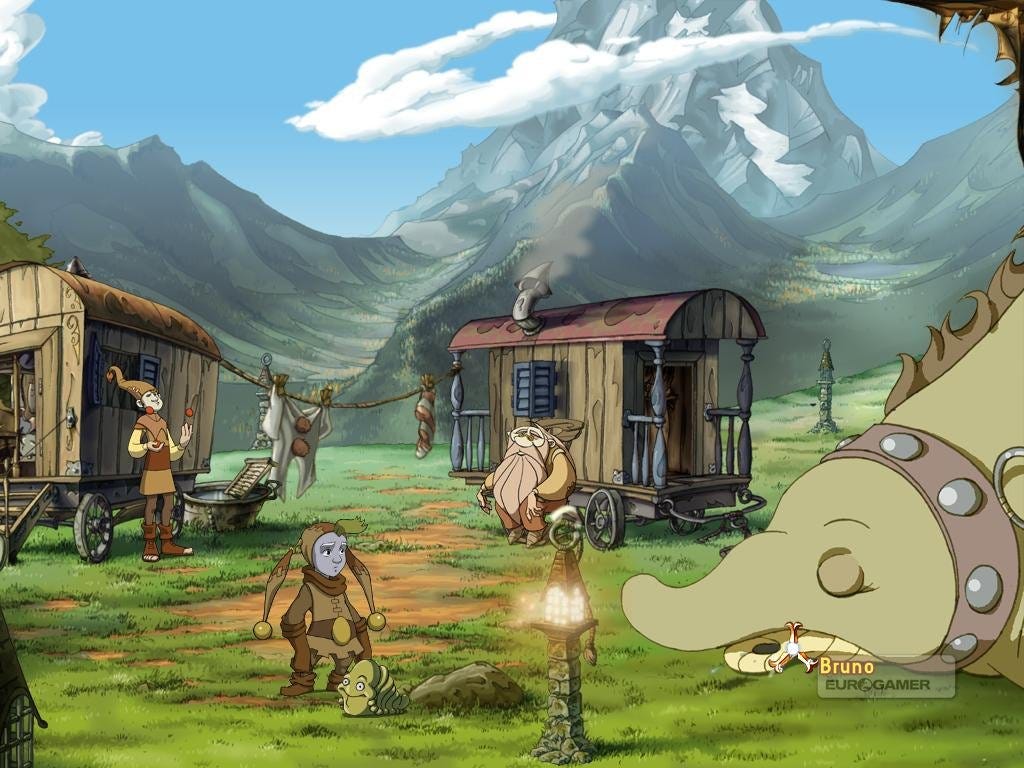
Absolutely beautiful, this German adventure's world is a remarkable one. Not only is it so exquisitely painted and drawn, but it's bursting with imaginative flourishes. There are moments throughout that capture the same magic as a Studio Ghibli film. Vast, surprising creatures, strange, amorphic pets, and a maniac nature.

You play Sadwick, a misery-guts child living in a miniscule travelling circus with his mean older brother and senile grandfather. Forced to be a clown, he wishes for a better, freer life, preferably in the company of his pet caterpillar-thing, Spot.

Determined to find adventure, Sadwick's first goal is to explore the woods. And from here you might imagine you have quite a traditional fairytale beginning. Except one of The Whispered World's finest features is its defiance of such traditions.
1

Sadwick's meagre circus home, along with Bruno, a vast and never-explained behemoth who pulls the trailers.

Sadwick is an irredeemable pessimist. His absolute certainty that all is going to go wrong makes him almost disappointed when something works out. But little does. This is a story, we're told from the start, of a little clown boy who brings about the end of the world. We begin in doom.

Early on, Sadwick meets an oracle whose prophecies confirm the worst - he is to be the cause of the world's destruction. But in a beautifully told moment, he lies about this once the oracle leaves her trance. He claims to be the saviour, and sets off to rescue a world we're told he can only destroy.

These extremely bleak beginnings do not dominate the moment-by-moment game, perhaps thankfully. Generally your tasks are finding ways to open doors and gates, escape prisons, operate machinery - typical point-and-click adventure fare. Of course all of this is narrated by Sadwick, from his miserable perspective. But the world around him can be cheerful enough.

This contrast could have been one of the most splendid features, especially with the strength of the writing. Revolution's Steve Ince worked on the script ensuring its humour translated well into English. And the jokes are often fantastic, Sadwick's remarks inventively downbeat. The problem is the delivery.

The actor providing our hero's voice needs to have his vocal chords removed, sealed in a lead box and fired into space. You know that hateful baby voice Adam Sandler insists on doing in half his films? Times it by 20. It's excruciating to the point where I taught myself to speed-read just to skip his voice as quickly as possible. It's like having your favourite poem read out by Joe Pasquale.

There's another significant dialogue issue. There's no pause between multiple lines. If a character is saying a series of sentences, each clips the end of the last in a very distracting manner.

Sadwick finds himself on a quest to find the King, return the Whispered Stone, and prevent the end of the world he's prophesised to cause. Which, by the way, is a compelling reason to want to reach the end.

Accompanying Sadwick for most of the game is Spot, the strange green grub. He's capable, the game introduces to us without any explanation at all, of eventually shape-shifting into five different shapes.

You begin with his regular chompy self, and a heavier, rounder ball-shaped version. Later comes a fire-breathing form, and two more that shall remain surprises. Shape-shifting forms the basis for some of the puzzles, either changing Spot to fit a task or sometimes changing from one form to another in a particular circumstance.

Bizarrely though, these abilities are rarely used, especially in the first three of four chapters. Rather than thinking of inventive ways to apply this novel inclusion, most of the time you're performing standard inventory puzzles that range from ordinary to abysmal. Chalk and water - that makes white paint right? Wrong. And how else would you recover clothing out of your reach than by dangling a mouse over it?

3

Oddly the cut-scenes are more poorly animated than the main game. But Spot remains cute throughout.

Perhaps more demoralising are the absolute hoariest of adventuring stalwarts appearing without a glimmer of irony. So yes, there is a sliding tile puzzle. And yes, slap your forehead, there's a locked-door-with-a-key-on-the-other-side puzzle. But rather than just letting you poke it out onto the tray that fits under the door, you have to attach a needle to a wooden spoon (making a "spoodle", which forgives some of the crime) to be able to reach. How thick is this door exactly?

Most annoying are the impossibly random moments. You need to catch a fly from a kitchen. You have a wooden board covered in sticky rotting food. Surely? But no - that has nothing to do with it. Of course you're meant to catch the fly by using the chopsticks you have in your inventory. What? And it's not a punchline to a Karate Kid setup - it's completely out of the blue. It's daft.

When you finally discover the solution to a bad puzzle (perhaps by translating a German walkthrough) you can see how the designers had got there in reverse. Working backward the logic they were seeing becomes apparent. The problem here is a lack of perspective for the player approaching it forward.

You interact in the style of LucasArt's Full Throttle: hold down the mouse on something and move it slightly, and a menu pops up letting you choose from an eye, hand or mouth. Clearly the first two mostly translate to 'look at' and 'use' or 'pick up'. The third is more open to interpretation. On a person it will talk to them, on food it will eat it, on a candle it will blow it out. And for each there's a line of dialogue, often with a great joke.

Then comes the inventory. Inappropriately or incorrectly using objects on other objects in the world is so often met with a unique response. It's staggering how much effort has been put into this. Of course, this is somewhat spoilt by it all being said by Sadwick, but the feat remains.

Back to those darkness-into-light moments I mentioned at the start. The Whispered World is packed with them. Suddenly you've got a completely new room packed with interactive items (and you'll absolutely need to use the Spacebar to reveal them, or you'll be pixel hunting until the day you die), with loads to explore.

But so often, oh so very often, this moment of freedom is squished by once again having absolutely no idea what you should be doing next. In the first chapter a great number of areas open up at once, with almost nothing to do in any of them. It's like picking at a roll of Sellotape, trying to find the end and then gradually picking at it to let it unspool.

4

It's painful to mark down a game as pretty as this.

The lack of prompts is probably the greatest failing. You can even use the correct item on the correct object too early, but the game rarely gives you an "I should try that later" message - most of the time you're met with the implication that it was simply wrong. There's so little attempt to guide you that you often feel abandoned by the narrative, and with that comes disinterest. This only gets worse by the game's final chapter.

Of course, you don't put this much effort into unpicking what's wrong with a simply dreadful adventure game. With those you just laugh, and move on. The Whispered World gets as much right as it does wrong, and for that it becomes sad for the wrong reasons. It's so achingly pretty, and clearly so much love has gone into it. But the crappy puzzles and painful voices (not all are bad, most are dull, Sadwick's is agony) do a huge disservice to a lovely world and some splendid writing.

Absolutely enormous, endlessly gorgeous, but maddening (especially in its final moment), The Whispered World is a muddled shame.

6 / 10

Read the Eurogamer.net scoring policy

Comments (46)

Comments for this article are now closed, but please feel free to continue chatting on the forum!

  • Loading...hold tight!