The Misadventures of P. B. Winterbottom Review

Yes we flan.

Version tested: Xbox 360

Precision platforming, devious level design, and a time control mechanism with some fascinating ramifications - it's clear within seconds that The Misadventures of P. B. Winterbottom is going to be one of those games that hurts your brain.

You won't mind at first, however, because it's simply so beautiful to take in. Its wheezing, sinister squeezebox soundtrack exists somewhere between the Nutcracker Suite and the piano music you got when films were mostly about men in top hats lashing ladies to train tracks. And its grainy, silent-era visuals call to mind Edward Gorey one minute and Dark City the next.

There's far more for even a spectator to sit back and enjoy here than you can usually count on from an XBLA game. Levels play out across misty Victorian cityscapes built from girders, water towers, and huge, skeletal clock faces. Stars twinkle sharply, Winterbottom's own animations are a restrained series of beautiful captured waddles and pompous smacks of the umbrella, and few moments are allowed to pass without the intrusion of something delightful like a mechanical claw or the juddery lapping of cardboard waves.

Like Henry Hatsworth on the DS, another busy-headed platformer with a quirky sense of priorities, this is 1890s Britain redesigned by enthusiastic anglophile Americans; even after hours of staring at the same puzzle, Winterbottom simply refuses to get old.
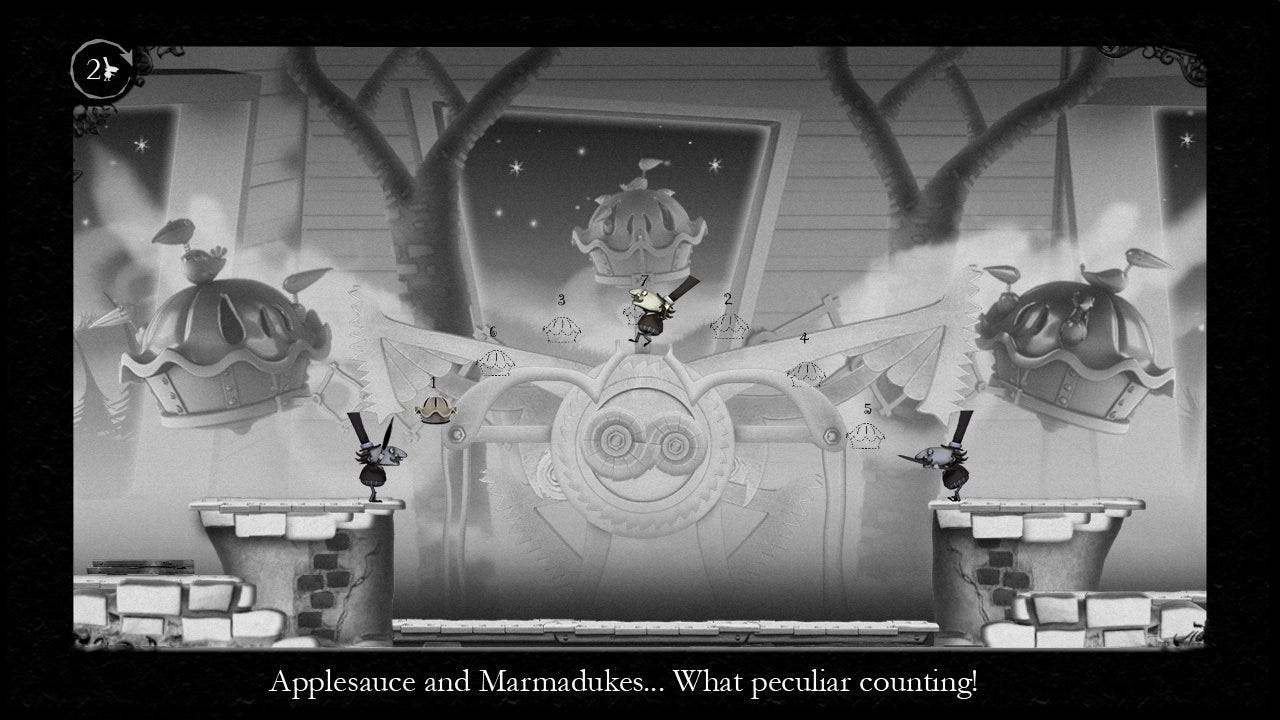
'The Misadventures of P. B. Winterbottom' Screenshot 1

The opening cinematic makes it abundantly clear that Winterbottom is both a cad and a bounder. Expect similar stuff in the next iteration of Tetris.

Even when it does start to make your brain ache, you still won't really care, because developer The Odd Gentlemen's game does such a good job of explaining itself. Winterbottom's ceaseless quest for pies is too smugly self-aware for its own good, but as motivations go it means every level has a distinct objective from the start: collect anything with a crust, no matter how impossible it seems. It also ensures that the pastry-covered delights can be, like Mario's coins, a kind of constant subtextural prompt, giving you a gentle subconscious nudge towards the solution when you need it most.

On top of that, the nursery rhyme tutorial introduces Winterbottom's smart collection of powers in the least threatening of manners. It's a one-two combo: the first beat introducing you to an idea in as simple a means as possible, the second making you realise the potential implications.

At the most basic level, then, Winterbottom can do everything a natty Victorian chap should be able to do. He can podge around levels in a sweaty wobble, leap from one chimneypot to the next with well-bred sprightliness, and either unfurl his brolly for a dreamy downward glide or use it as a gentlemanly cudgel on switches, recalcitrant machinery, or other annoyances.

With a squeeze of the right trigger, however, you can record the platforming antics you put him through before releasing it to replay the action with a clone. The clone loops endlessly, while a simple counter in the corner tells you how many copies you're allowed to have running about at any one time. You can get rid of them with a sharp smack from your umbrella, or even boot them around the environment with comic and often useful results.

Winterbottom is surprisingly imaginative with its clones. In early puzzles you might clone yourself standing on a pressure switch to act as a paperweight while you sneak past a spring-loaded door, as in every game ever. But then you might clone yourself lashing out with the umbrella, and subsequently use your clone to smack you across an unjumpable gap, like a tubby home run.

You can clone yourself to power the other half of seesaws, or to activate distant switches while you linger elsewhere, and you can even jump up on top of stacked clones, using Winterbottom's dandy topper as a makeshift platform.

Alongside all of this, the game piles up dozens of smart complications. There are levels where switches, springs and levers mean that Winterbottom reaches a Lemmings-like complexity, and sparse levels where pies hover impossibly out of reach until you crack the design's devious secret.

'The Misadventures of P. B. Winterbottom' Screenshot 2

The emptier levels are often the hardest to get your head around.

There are levels where the pies appear only briefly, after the flick of a switch, levels where they must be collected in sequence, levels where only clones can interact with the environment, levels which spawn nasty red evil Winterbottoms, and long gauntlet levels where dozens of clones spill out over rivers and steep drops, with only a limited amount of recording time available.

Despite the care lavished on the learning curve, there are moments when Winterbottom will simply stop you dead, with no means of progression. Often the key to a puzzle is finding just the right spot to place a clone and, at times, the austere logic lurking behind the pretty stylings can make the whole thing seem daunting. There's even the odd level where you work out what to do fairly early on, but subsequently implementing it all can seem like a bit of a faff and a chore.

Yet the thrill of getting the most elegant solution to a tricky problem will power you through in the end. And while the finely-minted challenges mean that there isn't a huge degree of replayability in the central campaign unless you're some kind of lateral-thinking genius, there's a range of bonus stages to tackle: knockabout arenas that dramatically up the pie quotient before grading you for time taken and number of clones used.

What's perhaps most astonishing about the whole thing is the fact that, despite the game's fierce indie credibility and time-twisting preoccupations, the ghost of Braid refuses to haunt Winterbottom. This is, above all else, a supremely confident game: confident in its charm, in its challenges, and in its unique identity. If you thought Braid gave puzzle-platformers a soul, this one is all about personality.

8 / 10

Read the Eurogamer.net scoring policy

Comments (35) Latest comment 2 years ago

Comments threads automatically close after 30 days, but please feel free to continue chatting on the forum!