The Legend of Zelda: Spirit Tracks Review

Toot sweet.

Version tested: DS

It would be easy to use the railroad theme of this latest DS Zelda as a metaphor for how precisely formulaic Nintendo's adventures have become: shuttling their young hero along pre-ordained paths from one faithfully-observed tradition to the next, keeping to a strict timetable, unfolding like an engineering schematic as much as a fairytale. There'd be some truth to it, too. Never in the series' self-referential history has one instalment followed the structure and style of its predecessor so closely (and seldom so quickly) as Spirit Tracks does those of 2007's Phantom Hourglass.

But if you were to interpret Spirit Tracks' train as a sign of weary creative emptiness, you'd be dead wrong. It's the heart and soul of a delightful, irrepressible game. The train's urgent puffing sets the brisk rhythm and breezy tone, and jumping into it inspires the simple, stirring excitement of setting out on a journey that Zelda games have always done so well. Being a train driver is a childish fantasy for sure, but that's just it - it's evoked with such infectious joy as to keep this ageing series (not to mention its players) young at heart.

It helps that hero Link is reborn each time as a wide-eyed pup in a brand new land that just happens to have a Princess Zelda and a Hyrule Castle - although in Spirit Tracks, there are a few veiled references suggesting that it's set in the same world as Phantom Hourglass, a couple of generations down the road. That's as close as any Zelda game gets to admitting it's a sequel. This Link is off to see this Zelda so she can officially induct him as a train engineer, a heroic job in a society that revolves around magical train tracks that, the tales say, are chains created by the spirits to bind a great demon in his underground prison.

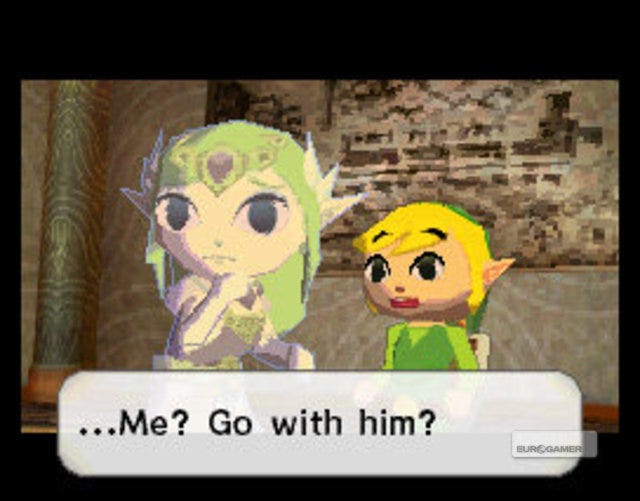
Needless to say, there's a plot to release the demon, the tracks start disappearing, the Princess is kidnapped, and Link somehow ends up with a sword and shield in his hands and a green sock on his head, travelling the world and unpicking the mechanical mysteries of a series of dungeons in order to restore the Spirit Tracks and save the Princess. Or rather, to save the Princess' body - it's been taken as a vessel for the demon, but her spirit has been left behind. So Zelda accompanies Link on his whole adventure for the first time, if only as a ghost.
1

It's like Brief Encounter, only with less crying and you get to drive the train.

In practical terms, that's no major departure. For most of the game, she serves much the same role as a Navi or a Midna, a voice in your ear who giggles, nags, hints, comments and lays out your options. Sometimes, however, Zelda takes your side for real - more on that in a second - and her impact on the tone of the game is something else again.

Link's usually a lonely hero and Zelda a distant ideal, but in Spirit Tracks they're inseparable, engaged in an adorable, innocent childhood romance straight out of a Hayao Miyazaki film. It's eloquently spelled out in the exchanged looks and gestures of the animation and in the simple zest of the script (even though Link, as ever, doesn't say a word). They even high-five at one point, one of many moments in which the game's youthful exuberance runs away with it (you respond to questions with "Yep" or "NO WAY!"; one character actually says "Woot!"), but it's so charming it always pulls it off. It's a long way from the melancholy lyricism of Ocarina of Time or Twilight Princess; Spirit Tracks must be the happiest, most heart-warming Zelda to date.

In gameplay terms, Zelda only comes into her own when she comes into someone else's. She can possess Phantoms, the invincible patrolling suits of armour in the Tower of Spirits, the 30-floor über-dungeon you need to return to and inch through in between each of the game's regular temples. It's a reprise of Phantom Hourglass's central Temple of the Ocean King, and also something of a Metal Gear tribute as Link sneaks around, avoiding the guards' gaze by diving into safe zones, while solving some of the game's trickier puzzles.

The Temple of the Ocean King's less popular features - its maddening time limit, and the need to start from the beginning on each visit (albeit with shortcuts) - have thankfully been ditched. You're even allowed to best Phantoms eventually, at which point Zelda can possess them and you can control her and Link simultaneously by drawing a path for her to follow, and pointing out things for her to interact with, with the stylus.

This is occasionally fiddly, but also exploited for some marvellous bifurcated puzzles and fights that contrast Link's agility with the Phantom suit's durability, as well as some cute role-reversal horseplay between the two romantic leads. There are even several variants of Phantom suit with clever powers. The Tower of Spirits still does odd things to the time-honoured pacing of a Zelda game - generally, the last thing you want to do when you step out of a temple is dive straight into another one - but it's a huge improvement on its predecessor, feels a lot less like filler, and supplies many of Spirit Tracks' standout moments.

2

Scrawling on maps with a pen is something that should be in every Zelda game.

The regular dungeons don't have such strong identities. Suspicions that Nintendo's designers are going through the motions somewhat aren't helped by the unprepossessing names (it's hardly a spoiler, I hope, to reveal that Wooded Temple is in Forest Land and Blizzard Temple in Snow Land) - and truth be told, beyond their rote elemental themes, they do blend into each other a bit. But that's partly because top-down Zelda dungeons have become so abstract over the last 23 years, which is precisely what allows them to be so densely packed with ideas. Un-knotting their secretly linear tangle of traps and riddles and boss fights is as satisfying and stimulating as it ever was, and in Spirit Tracks the difficulty is paced to absolute perfection. There are a few proper posers, but nothing completely obtuse, and that blissful Eureka moment always feels within your grasp.

It would be more of a spoiler than any plot revelation to tell you about the new toys for Link's toolbox of delights, since discovering these surreal Swiss Army weapons is a sacred moment for any Zelda fan. It's a mixed bag: one is a cute idea but a chore to use, one is rather limited in its application although it makes inspired use of the DS stylus, and one is a cracking instant classic that blends the utility of some old favourites with (the internet tells me) a tip of the hat to another, more obscure Nintendo series. I'll let you figure out which is which.

It's no surprise that the traditional bombs, bow and boomerang are back, enjoying the same pinpoint stylus control as in Phantom Hourglass, and the latter is put to some extremely imaginative uses. This year's magical musical instrument is the Spirit Pipes, a set of pan pipes you slide left and right while blowing into the microphone to sound; embarrassing in public, but more like playing an actual instrument than anything in Wii Music.

Spirit Tracks uses exactly the same all-stylus control scheme as Phantom Hourglass - Link follows where you point, faster if it's further away, with taps, swipes and circles executing sword attacks. It proved divisive two years ago, and for the life of me, I still can't imagine why. It's swift, snappy and unfailingly precise. It's the best non-traditional control scheme for a traditional game anywhere, and one of the most transparent and intuitive in Nintendo's long (and glorious) history of making great videogame controls. However, if you didn't like it then, you won't like it now.

Also divisive, longer ago, was the bold, bright cartooning of the Wind Waker art style. Few would dispute its suitability for these top-down DS games, though, especially with the portable really starting to show its age. The geometry and texturing in the environments are sometimes shockingly basic, but that's surely because the important things - the characters, the enemies, the train - are so detailed, so expressive, so exquisitely animated. Sound is magnificent too, with the trademark tinkles, smacks and booms, and the squeal and hiss and chuff of the train, popping out of the DS' speakers over catchy, rollicking folk music.

3

Boss fights and a few other moments use both screens to majestic effect.

Spirit Tracks' world simply hops and hums with life, bursting out of the tiny confines of the console. And, unlike Phantom Hourglass, it's at its best away from the dungeon crawl. True, the locations are a little basic and clichéd; the strict separation between on-foot exploration and open-world navigation is still a trifle forced by the series' organic standards. But the web of characters and collectables and secrets and side-quests and errand-runs, etched out in the Spirit Tracks themselves, proves more compelling.

Perhaps it's just that the train is more fun, more involved and more inviting than Phantom Hourglass's paddle steamer. Freight and passenger runs are absorbing games in themselves - with a premium on a smooth or speedy ride as well as blasting away at hazards with your cannon - and there's a tactile joy in tugging at the whistle and cranking the levers that made this grown man feel about eight years old. On that note, it's worth pointing out that Spirit Tracks is probably the best game for children released this year - deep yet upbeat, without a whiff of condescension and with plenty of longevity.

It is, in other words, vintage Nintendo. Maybe a bit too vintage - Spirit Tracks is, like New Super Mario Bros. Wii, a straight rehash, a derivative sequel of the kind the company used not to make, and based on a decades-old template. You could easily mark it down for that. But that would belie the fact that it's also a tighter and more rounded game, crafted with more care, than not just Phantom Hourglass but most modern games for grown-up consoles. As an all-ages adventure with a spring in its step and a twinkle in its eye, it's hard to beat. All aboard!

9 / 10

Read the Eurogamer.net scoring policy

Comments (122)

Comments for this article are now closed, but please feel free to continue chatting on the forum!

  • Loading...hold tight!