Jagex employs over 350 people and claims not only to be the UK's biggest developer and publisher, but to be second only to World of Warcraft in the MMO genre with browser-based fantasy adventure RuneScape.
Mark Gerhard, a man who owns two APC vehicles [apparently these belong to the company -Ed] - one of which we're sitting in for this interview, is the man in charge of Jagex. He's certainly outspoken. We talked in Brighton this month about his new world-beater MMO Stellar Dawn and everything besides.
Eurogamer: Jagex has the arrogance of a company doing well. Million-pound failures are shrugged off. What happens when the golden RuneScape carpet is pulled from under you? What happens when the money stops coming in?
Mark Gerhard: Well I mean, look: Jagex isn't about RuneScape and just RuneScape. We really a multi-product company. I can assure you that there's no arrogance anywhere within Jagex's fabric. I suppose with success comes a certain confidence. Very often it's in the early days of any studio where you doubt yourself a lot: it's fun for me but will it resonate, will other people want this?
We've had years and years and years of trying things, and some work and some don't. Our precision when we make a decision on content, gameplay, mechanics, aesthetics, is more assured. But I certainly don't think there's any arrogance.
We know the reality is that games come into and go out of fashion. While I certainly have a great deal of confidence and great expectations for what RuneScape will do in the future, at the same time we're innovating by making massive investments in products and things like that.
Eurogamer: How much money does RuneScape make?
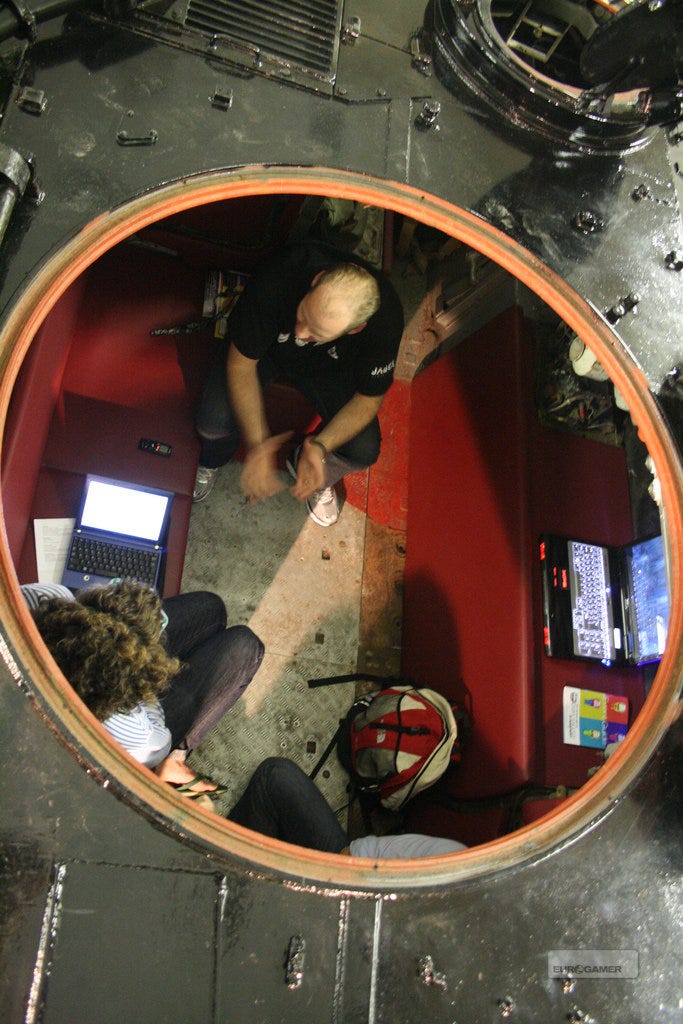
Me, in one of Gerhard's two APCs, doing the questioning. Picture taken by Dan Griliopoulos.
Mark Gerhard: I'm not going to comment on that.
Eurogamer: Does it make hundreds of millions a year?
Mark Gerhard: No, it doesn't. It does well; we've been very blessed with it. People like to focus on the revenues but the most important thing is that profits are the side effect of a great game, and that's going to be true of anything we do. It's never the reason for doing it.
Eurogamer: You say "a great game", but Eurogamer wasn't bowled over by RuneScape - certainly not to the 10/10 degree of World of Warcraft. Are we gamers a bit snobbish towards browser games?
Mark Gerhard: You're right, there might be a residual prejudice, because the standard of browser-based games is actually s***, in terms of aesthetics and complexity and everything else. We deliberately don't refer to browser-based games; we stick with online games. A big thing for us is we offer RuneScape as an applet in a browser and as a client to download now. It's still tiny, 5MB or something like that.
There is a certain snobbery about online games and the possibility that they can't be as good as downloaded games. RuneScape certainly bucked that trend.
Another point on World of Warcraft is that they came out four years after us. They had the benefit of hindsight. With Stellar Dawn we have the same benefits. Stellar Dawn will set a higher marker and be more comparable, if not better.
Eurogamer: You've called Free Realms "insipid". It's got over 10 million users...
Mark Gerhard: Registrations. [Grins, laughs]
Eurogamer: Do all of those people have no soul?
Mark Gerhard: No, no. I'm an avid gamer, I play most games. Perhaps because I consume so much game content I'm overly direct. Having played Free Realms there's very little I get out of it. To me it just screams design by committee: 20 different people from 20 different focus groups to say, "Let's have a little bit of this for the girls, let's have a little bit of that for the boys, let's get the six-year-olds, let's get the 16-year-olds." If you want a game for a six year-old you've got it, it's called Club Penguin.
If you take a brand that accentuates its own identity, it's going to resonate with the target demographic really well. Free Realms tries to be all things to all men and women and ends up being nothing.
Eurogamer: You talked about being a maverick a lot in your Brighton Develop speech - have you seen Top Gun?
Mark Gerhard: [Laughs] I have! [Snorts] That wasn't the comparison I was drawing!
Eurogamer: The way you talked about Jagex and its long-term investment in staff - recruiting from college and training over multiple years - was inspiring. It sounds like an ideal environment. Given you're the leader of all that, what do you think when hear about Activision marching out its top talent?
Mark Gerhard: I think it's shameful. And if they want to come work for us, we'll hire them tomorrow.
More on RuneScape
-
News: Jagex hopes to have RuneScape on tablets by the end of the year
"Would easily be the most ambitious game ever put on tablet, right?"
-
News: RuneScape's got a novel new way of dealing with bots
It's Botany Bay.
-
News: MMO RuneScape being developed for tablets, smart TVs and other platforms
Being transposed from Java to HTML5.
-
Video: RuneScape Clan Citadels video
Build a giant flying fortress.
-
Screenshots: RuneScape now and then comparison gallery
Eurogamer: Would you give them their own studio?
Mark Gerhard: Well, you know what, the one thing that Jagex doesn't have - and we pride ourselves on this massively - is egos. We don't have a rock star culture. If there's talent that wants to be part of the family we'd welcome them with open arms tomorrow. If there's a team that wants to dictate terms and wants the celeb lifestyle, that's not what we're about: that's not in our DNA. It's a shame, but we'd never compromise on that.
Eurogamer: What was wrong with MechScape?
Mark Gerhard: That's a tough question. We had a whole lot of laudable aims about what the game would be, how it would be a real evolution from what we currently have. And, to a degree, what we had was very much the same but without the secret ingredient that makes it fun. We had a gorgeous-looking and sounding game but the content was shallow. Five or six years of content - it wasn't shallow in terms of input, there's probably millions of words in real terms. But it wasn't cohesive: it was a cacophony of ideas and ambitious. The glue that would have bound the whole game together wasn't quite there, wasn't quite right.
We spent two or three months asking how we could make it better, how we could fix it, but we kept coming back to the conclusion that we could make everything OK, but very little of it great. In the end, we never wanted to settle for a mediocre game. With all the smithing in the world, perhaps months more, perhaps we would have got out a game that was like everything out there. OK works at retail, OK doesn't work online.
Eurogamer: How much money did you effectively lose canning MechScape?
Mark Gerhard: Tens of millions. A large sum: an eye-watering amount. We weren't cavalier about it. That really focused our minds. There's years of salary in there. Nevertheless, would we put our reputation at stake for tens of millions? Never.
Eurogamer: So you went back to the drawing-board and Stellar Dawn was born. Can you afford to lose another "eye-watering" amount should it not turn out right?
Mark Gerhard: Absolutely. Whether we can afford it or not is academic. If it's not right, we won't launch it, simple as that. And again, that's not a decision we take lightly. We're not trivialising it nor are we being arrogant about our success, but our community has come to fondly regard us and respect us as a purveyor of high quality games. You can take on board that we haven't done a traditional new release now for 10 years. We rely on that good will, that trust, so they can play, take, buy our next product. It's crucial. Finances won't rule that decision.
Eurogamer: Are you being more cautious with Stellar Dawn as a result?
Mark Gerhard: No, no. The team size is as significant as previously. 75? Yep, 75 people.
Look, we are being more cautious. We're certainly not being more sparing. What we did this time is we had the wisdom of hindsight. We could look at MechScape and go, "What went wrong?" And on a lot of things we didn't ask the difficult questions first. "What is combat? How does the economy work? How will trade work?" These are very boring questions, but until you know exactly makes the game fun, raw fun, you can't actually put the game around it.
When we went back to the drawing board on this one, the design team spent literally months saying, "Ignore what we've got, ignore how we want to play, let's answer these difficult questions. Let's talk about balance." Infinitely balancing components of a game you've yet to build when everyone tends to do it the other way round. As a result of locking down that game design Bible, the team has been able to develop really, really rapidly. And crucially it's now fun. We've now got a game we're all enormously proud of.
Mark Gerhard unveils Stellar Dawn.
We're not finished, but we feel confident enough that it's coming together that actually we are going to be able to go into beta... We'll be able to go live when we think we will.
Eurogamer: When is that?
Mark Gerhard: Can't say. Internally, of course we have deadlines and everything else, but I wouldn't want to hamstring the team to that.
Eurogamer: So, how is Stellar Dawn "fun"?
Mark Gerhard: Can't say much about it without giving away the game itself.
Eurogamer: Can I fly my spaceship around planets like the concept art suggests?
Mark Gerhard: It does have multiple facets of gameplay. [The PR interjects: "We'll happily tell Eurogamer everything in due course."]
Eurogamer: Jagex told me last year that MechScape would have no XP, no skills, no levelling. Is Stellar Dawn trying to be as ambitious, as revolutionary?
Mark Gerhard: Yeah... That wasn't true. That was an ambition, it wasn't a reality.
Eurogamer: Stellar Dawn will welcome those MMO fundamentals, then?
Mark Gerhard: It will have an, er, accumulation mechanic.
Eurogamer: What's left of MechScape in Stellar Dawn?
Mark Gerhard: The game meta-view, story, concept remain the same. We still loved the story, it was just the implementation.
Eurogamer: Stellar Dawn's logo looks very similar to Mass Effect's logo.
Mark Gerhard: Ooh. [Cringes, giggles.]
Eurogamer: Is that a sign that you're going after a core audience with Stellar Dawn?
Mark Gerhard: Stellar Dawn will certainly be older than RuneScape, and play to a more core gamer audience. It'll still be casual, it'll still be accessible to most people.
Eurogamer: You say casual, but most MMOs require hundreds of hours of play before characters see significant results. Who's really going to play it?
Mark Gerhard: The same people playing World of Warcraft, I suspect.
Eurogamer: Ah! A head-to-head battle?
Mark Gerhard: Indeed. We'll park our tanks on their lawn.
Eurogamer: RunesCape's nearly 10 years old. How long has it got left?
Mark Gerhard: Our current business plan is another 10 years of slated game updates and content updates.
Eurogamer: When is there going to be another big visual overhaul?
Mark Gerhard: That will be much like we've done so far: iterative. The engine team's always pushing the tech and as soon as we're ready there will be another upgrade. But people don't need to pay for that, it just comes when it's ready.
A lot of what we've done to push the boundary for Stellar Dawn will benefit RuneScape and another MMO we're working on. We've got the advantage in that we share the same MMO tech platform. From there it's really down to the studios to decide how it's used.
Eurogamer: RuneScape is your fantasy MMO, Stellar Dawn is your sci-fi MMO. Is there a point when you'll want a new fantasy MMO?
Mark Gerhard: We do, we totally do. We're working on it as we speak.
Eurogamer: Jagex has taken on some third-party MMOs and you're, in a sense, publishing them. Are you aligning your self as a publisher?
Mark Gerhard: Well, "publisher" is a dirty word, or certainly the publishers today have made it a dirty word. We don't want comparisons to that. We know there's a lot of people like Jagex - indies who actually have great content - who don't know how to come to market. We really want to help those people. That goes beyond just the usual publishing relationship. It's really about passing on our 10 years of hard-learned lessons on every level: game design, content, story-arc, various other parts.
Even with War of Legends we spent a good six months and longer working on the game to localise it. That's not something we'll charge at a premium: that's us setting up a long-term investment. It's worth our effort to teach you all the things we know because you'll be making even better games in five years from now, and hopefully we'll still be your publisher of choice.
Eurogamer: Can those games be as big as RuneScape?
Mark Gerhard: It's really hard to know. We didn't know RuneScape would be as big as RuneScape.
Mark Gerhard is CEO of Jagex. Stellar Dawn has no release date. Front page image of Mark Gerhard taken By Dan Griliopoulos at Develop 2010.
