The House of the Dead 2&3 Return Review

I don't wanna die!

Version tested: Wii

You can either berate SEGA for blatantly cashing in on its tired old light-gun back catalogue, or continue to celebrate the fact that the Wii is the new spiritual home for all these old classics, with a control system that lends itself perfectly to the genre. It's little wonder we're currently experiencing a flood of old and new point-and-shoot blasters. Recently, SEGA got the ball rolling by belatedly treating us to a port of 2004 arcade title Ghost Squad, so it's only logical to service this peculiar niche by re-issuing something more renowned and familiar - in this case House of the Dead 2 and 3 in the same package. If you care enough about the genre, the chances are you'll already own one or the other (probably both), and will simply relish the chance to play them again using the Wii controllers - either the Wii Zapper or the similarly adept Wii Remote.

Don't come! Don't come!

Looking at HOTD 2 now is simultaneously heart-warming, hilarious and terrifying. One of the star releases in the early days of the ill-fated but much-loved Dreamcast, it came out in an era when routinely, unintentionally hilarious voice-acting was par for the course. Full of solid gold Japlish utterances and delivered with the kind of cold, stiltedmonotone that you only ever seem to hear in Western versions of Japanese videogames, it has a peculiar charm that's far greater than the sum of its parts. Hearing it again all these years later is a strangely wonderful thing, with age only helping to enhance its kitsch status.
1

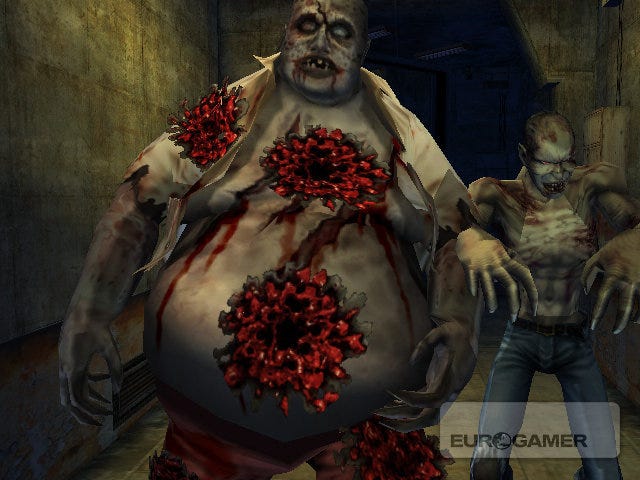
Hello, I am in fact a zombie jam roly poly. You may recognise me from school canteens in the late 1970s.

Even the angular late '90s visuals of HOTD 2 have a strangely perverse appeal. Far enough advanced from the embarrassing 3D visuals of the early '90s and sharp, detailed and well-animated enough to still be bearable by today's standards, this NAOMI-powered title still manages to hold a stylised nostalgic appeal. Although SEGA managed to create a pretty decent 3D engine for the time, and create a posse of still-terrifying zombies, its hilarious attempts to render realistic-looking humans is almost as unhinged as its approach to voice-overs, with stilted animation and wonderfully deranged faces guaranteed to raise a smile. And even with its occasional technical aberrations taken into account, in terms of out-and-out style and in pure playability terms HOTD 2 beats the squishy-looking sequel hands down.

As an example of the genre, there are few on-rails shooters that can claim to be as hardcore as HOTD 2. With absolutely zero concessions to notions of accessibility, the only way to get through its five stages was supreme dedication, memorising every part of every stage, and deploying cat-like reflexes with an epileptic trigger finger to back them up. That the game could still prove to be a huge challenge when set to Very Easy difficulty gives you some idea of where SEGA was pitching it. But, obviously, as an arcade game, its job was to entertain while extracting coins to encourage the inevitable Continues.

Dogs of the AMS
2

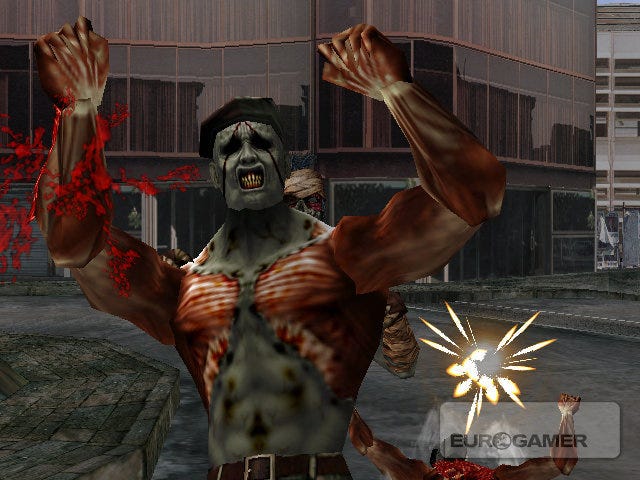
Nice to see the zombie Village People still getting work after all these years.

Playing it almost a decade on, it's hard not to feel slightly aggrieved by the challenge, but within a few goes the blow is softened by earning more credits, more lives, and, of course, unlocking the Very Easy mode. You'll also start to remember the stages with more clarity, and be able to play it like the old days. The fact that it's still an awful lot of fun is a testament to how strong the game was in the first place, with tons of branching paths based on various gameplay conditions lending it an incredible amount of replay value. It's also good to note how well SEGA has retooled the controls for the Wii remote. If anything, the game feels better than it did with the Dreamcast light-gun, so if you're an aficionado, you'll be extremely pleased at how it's turned out. The only slight negative point is the original 4:3 image has now been stretched, but it's not something that will trouble you for long.

All the original modes are present and correct, along with little bonuses such as training videos, and a ten-stage training mode, which is, incredibly, even more hardcore than the main game itself. Seemingly simple tasks, such as clearing all the baddies with 30 bullets, or blasting all the barrels within a strict time limit are unbelievably tough, but the kind of tasks that keep you coming back. As with the previous home versions, you also get to choose between Arcade and Original mode - the latter a variation based around weapon enhancements which you get to apply prior to starting the game.

Sir Gold...!

With all that taken into consideration, you'd imagine the supposedly technically superior HOTD 3, from 2002 would also live up to expectations. Sure, the game engine is far more capable, benefitting from the extra grunt of the SEGA Chihiro system (a memory-hungry Xbox, effectively), but the gameplay didn't quite hit the mark in the same way its predecessor did. Far more forgiving, blasting through the levels was a less taxing challenge, with a noticeably larger window of opportunity to get your shots in, not to mention less fearsome bosses, and less of an emphasis on skill-based branching paths; instead your route through the game was merely a question of pointing to which bit you'd like to head to next.

Perhaps more subjective was one relating to the game engine, monsters and level design. Personally, as much as I can appreciate the vastly more detailed environments and the improvements in character models and animation, there's something about the style I just never got on with. The almost TimeSplitters-esque look and feel of the characters and enemies just didn't fit in with the style the first two games favoured. Far from looking terrifying, they just looked like they were made of jelly and foam. Strangely, the fact that HOTD 3 also had normal voice acting just made it all feel a bit...wrong, while the actual gameplay environments were boring. So there isn't the same intrigue, and playing the two games side by side, the gulf in quality is even more apparent. Wow Entertainment tried to reinvent it, but also missed a lot of the charm of the first two in the process, and the fact that it sold very poorly on Xbox is hardly a great shock. The sooner SEGA can make amends and bundle 1 and 4 together, the better - or, better still, the whole set.

3

I'm so glad I still don't know what zombie nadgers look like.

In terms of extras, there's very little to report on. You have a Time Attack mode to wade through as usual, and the super hardcore players can eventually access an Extreme mode (where your shotgun has a smaller blast radius and enemies are harder), but that's about your lot. It's not a game you'll spend a tremendous amount of time playing through, but that was always the case, no? There have been a few suggestions elsewhere about slowdown blighting this particular port, but it's not something we experienced in the PAL version. Apparently both versions were based on the PC ports, but feel functionally identical to the old console editions you may have played in the past.

The question you really have to ask yourself is: do you fancy playing them again for old time's sake? Priced between GBP 25 and GBP 30, do they justify the asking price in today's market, how well have they aged, and has SEGA done enough to cater for the old school fans?

There was nothing we could do...

You might recall with Ghost Squad that we had a little wince at the idea of SEGA charging us GBP 30 for a game that, to put it politely, is several years past its sell-by date, and is available for almost half the price overseas. But, in its defence, it was a solid, enjoyable example of a genre we love to return to now and then, and had a semblance of novelty value in being 'new' in the sense that it had previously never been released on a home system. It also had online leaderboards to add a little bit extra.

4

Four years of World of Warcraft can do this to people.

The problem The House of the Dead 2&3 Return has is that it lacks many of the things that made Ghost Squad a tempting purchase. Firstly is one of over-familiarity - HOTD 2 was obviously a massive hit on Dreamcast back in the day, and also featured as an (easily) unlockable extra in the Xbox-exclusive release of the less well-received HOTD 3, which effectively makes this nothing more than a straight re-issue. Secondly, SEGA hasn't bothered with online leaderboards - odd, but something we can live with. Less easy to understand is why SEGA neglected to take the blindingly obvious opportunity to include the original 1996 HOTD, even as an unlockable. Apparently the argument was that HOTD's visuals look pretty terrible by today's standards, but if that's the case SEGA would never have released any of its aging back catalogue. Grrr.

To return to the original point, how much you want this package rests firmly on how much you want to play old light-gun games on the Wii. There's no doubting that this is the very best way to play either game outside of an arcade - mainly by virtue of the fantastic controls, and that you don't have to fork out for expensive extra hardware to play them. Out of the two, House of the Dead 2 is by far the best, but also technically impoverished by today's standards, although the inclusion of 3 will be of interest to the many who missed out last time. If the price doesn't bother you, then go ahead, but a weekend rental would be a far better way of getting that zombie blasting nostalgia fix.

6 / 10

Read the Eurogamer.net scoring policy

Comments (52)

Comments for this article are now closed, but please feel free to continue chatting on the forum!

  • Loading...hold tight!