Version tested: DS
A new generation of consoles is almost always seen as a good thing, upgrading our gaming experiences in previously unimagined ways. Sprites turn to polygons, full-motion video cut-scenes make way for in-game storytelling, and soundtracks once performed by Midi orchestras are now recorded by Philharmonics. But the cost of this evolution is absorbed by game-makers, whose task it is to realise the machines' vast but expensive potential. With such broad boundaries, their games now take ten times as long to make and cost a hundred times as much they once did. The knock-on effect is that, perhaps for the first time ever, some genres are simply no longer feasible for anyone but the biggest players.
So it is for the Japanese RPG. Today the sort of winding, 60-hour, world-touring epics that flooded the PlayStation's library are prohibitively expensive to make, certainly costing more than the genre's niche fanbase can support. Which series beyond the Final Fantasies and Sony-funded White Knight Chronicles of this world can afford the next-gen treatment? This has left JRPG developers with one of two choices: let their modestly-successful series continue to play out on last-generation hardware - as in the case of Persona, Grandia, Wild Arms and Valkyrie Profile - or, like Konami with Suikoden, head to the handhelds, where the technology is still sufficiently restricted to make a long-form epic affordable.
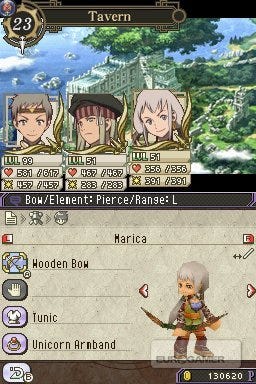
Konami's flagship RPG series has never been characterised by technological superiority, instead building its small but vociferous fanbase on gritty storytelling and a narrow, collect-'em-up focus. But despite the developer's best efforts to make the most of what they have here, ironically Suikoden Tierkreis is clearly a game made on a limited budget. As with the early PlayStation JRPGs, woefully basic 3D characters run about on still, flat CG background pictures. No matter how pretty these locations are - and the lush, green pastoral vistas have an inviting charm - pictures they remain, lending an anachronistic sense of disconnect between character and environment that never quite dissipates.
Journeys on the world map are measured by in-game days - the longer the journey, the higher the cost of taking it. As enemy type and strength is related to the in-game calendar, journeys should be carefully planned.
There's the odd treasure chest to be found as you move through the forests and ruins of the game world, but these discoveries are the full extent of interactivity when you're exploring. Many scenes are reused in multiple locations - inns always look identical, no matter which town you're in - and the squat 3D models that represent your characters are so basic that they're almost indistinguishable from one another. Navigation around towns is carried out via a straightforward menu system, as is exploration on the world map, reducing the game's locations to a list of disconnected scenes chosen from a drop-down menu. During battles the top screen is used to display your squad's vital statistics, but at all other times it displays nothing more than a rather lacklustre CG still of your current location. Despite the artistic flair that permeates the game, this is nonetheless a Tesco Value RPG.
And yet, despite this, Suikoden Tierkreis emerges as one of the better traditional RPGs for the DS. In part this is thanks to the game's central conceit, which has run through most of the series and continues in fine form here: army building. The series has always tried to take a more realistic approach to the business of world-saving. It supposes that, if a small band of youngsters really did band together to save the world from a common threat, they would be able to convince a least a few of the people they meet along the way of their quest's importance. In Suikoden Tierkreis there are 108 recruitable party members scattered throughout the world, characters just waiting to join the cause, and, as with Pokémon, much of the game's appeal comes from trying to gather them all.
Suitable recruits are not chosen on the basis of their strength or tactical savvy, but rather via the unorthodox ritual of touching an antique book and seeing if that makes them hallucinate. If the book glows when a character lays their hand on it, then they're in the gang, marked out as one of the 108 'Stars of Destiny' that inhabit the world. These characters then congregate in your giant fortress and it's enjoyable to watch its rooms and corridors fill up as you collect more team members. However, be warned, it's a good five hours before you receive the keys to the fortress, leaving a sizeable chunk of quest to follow before you get to embark on what's arguably the game's most compelling aspect.
Many of these characters can be incorporated into your party, lending their particular skills and magical attacks to battles. It can be fun mixing and matching different characters in the party, up to four at a time, and seeing the various combination-attacks these match-ups facilitate. However, you'll no doubt settle upon your favourite roster soon enough and stick with it therein, and what's more, the battle system is straightforward and turn-based. After each round of attacks you're given the option to let the AI take over the next round, which makes the business of getting through grunt fights painless. Indeed, the game's low difficulty level means that very few battles trouble you or the AI, and yet even so, the labyrinthine dungeons are littered with dead ends, and with a very high random-battle encounter rate and no dungeon map to guide you, progress can be painful.
The voice acting throughout the game is of mixed quality, but the large number of voiced lines are nevertheless welcome.
The story is ambitious but, despite reaching for mature themes, will appeal mainly to the younger gamer. The plot centres around an evangelical cult, which believes that whatever will be will be and that true happiness lies in an unquestioning acceptance of fate. While that might read like a sound mantra, taken to the extreme it's become an ideological nightmare for the world's inhabitants. For example, if a person gets sick, then society states that they require no medicine. After all, their sickness was predestinated, as will be their subsequent death or recovery. Themes of control and subjugation are ably handled, aided by a solid translation that communicates the nuances. But the Suikoden series is loved by fans for its hard-hitting, affecting storylines, and Tierkreis offers only glimpses of that serious commentary.
Overlaid on the core story are a couple of stock JRPG additions to provide extra content and consideration during play. A trade system allows objects bought and collected from defeated monsters to be sold for higher (or lower) prices at other cities. Similarly, a quest system provides a steady, readymade feed of sub-quests, which vary in length and importance, but which are essential for players looking to recruit all 108 characters. Finally, there is Wi-Fi functionality, allowing you to loan characters with friends but, as this element isn't unlocked until you find the appropriate character, it's hidden too deep to be of much use.
Ultimately Tierkreis is a simplification of the Suikoden template, with many of the deeper complexities of the original games diluted or removed. Equipment can no longer be upgraded or combined; duels are gone, as are the huge army vs. army battles of the first games; and the party has been reduced from six characters to four. The rune system that once brought depth to the battle system is also absent, with new magical attacks simply released at level-up thresholds. Indeed, the game's slight difficulty means that you rarely need to plumb what strategic depths there are.
Nevertheless, this is a largely enjoyable journey for series fans - a dilution of what has gone before, but one that suits the handheld and serves its audience well. As a result, Suikoden Tierkreis offers a blueprint for how developers of modest JRPG series can continue their lineage into the future.
7 / 10
