Stormrise Preview

"Faster than keyboard and mouse".

Creative Assembly PR Vispi Bhopti is a talkative bloke. He natters amicably throughout the two hour presentation for real-time strategy title Stormrise, dropping in anecdotes stories, technical details and expletives with ease. At one point, however, there's a pause. Bhopti scans the room to see if what he's just said has sunk in. He's just announced that Stormrise's Whip Select control system means using a control pad is even faster and more efficient than using a keyboard and mouse.

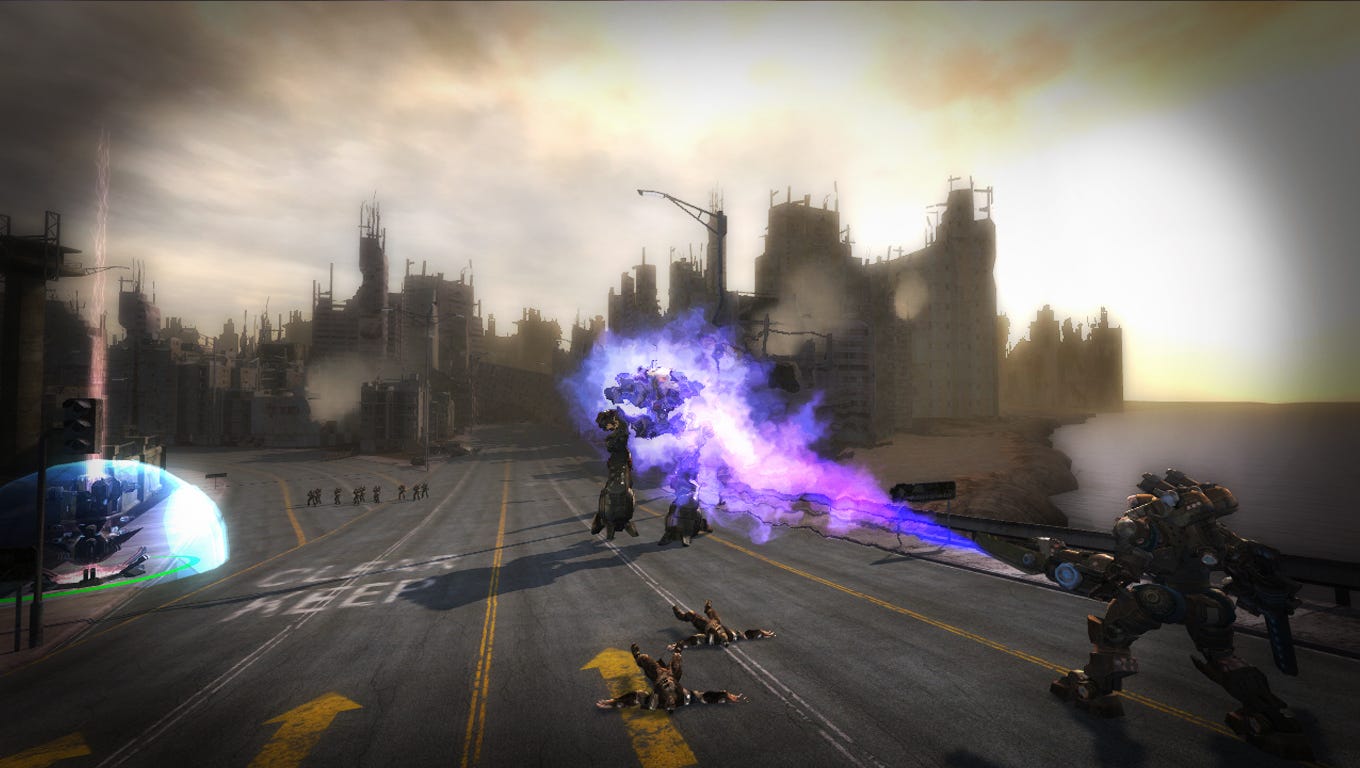
Having watched Bhopti zip around Stormrise's post-apocalyptic cityscapes with quick flicks of the right stick, it's something we're ready to believe. The system works like this: the camera settles naturally into a third-person view behind your current unit. Units and resource nodes are shown as white icons. Pressing the right stick produces a yellow beam. Direct that beam over one of white icons, let go and the camera will jump across the map to that point.

You can jump right from one side of the map to the other with one quick flick, or switch rapidly between all your units to keep track of events. In the PC version, holding right click and flicking the mouse will have exactly the same effect, which means less scrolling.

Initially, it all looks a bit bewildering. Identifying the small icons can be tricky and the rapid camera changes are disorientating. On top of that you need to have an awareness of where your units are on the map and how they relate to the camera position to navigate with accuracy.

We weren't allowed to go hands-on with the game, so we can only report that it all looks faster and more efficient than traditional control systems. However, speed and efficiency don't always equal ease of use, as so many developers who have produced console RTS games have discovered.
1

The environments we saw were all fairly dour post-apocalyptic cityscapes, but there was mention of potnential map-based DLC.

Originally, Stormrise wasn't meant to be a console title. In fact it was never meant to be a game at all. Whip Select was purely a conceptual idea, an answer to an engineering challenge which bored Creative Assembly statistician Ken Turner posed himself. But once the prototype was up and running, the idea was seen as having real potential. And Stormrise was born.

There were probably some other bits in-between, but that's the nub of it. They probably didn't spend a lot of time on the storyline, anyway. It's something to do with global warming and a weather control system which goes wrong and a giant storm which rips the world apart. Underground vaults are built just in time to host society's great and good, whilst the less fortunate are locked outside to fend for themselves.

This gives rise to the schism between Stormrise's two factions: the vault-dwelling, recently emerged Echelon and the surface-surviving, post-human Sai. It's a neat way of justifying the split between the Echelon's near-future technology and the Sai's more spiritual psychic powers and beast units, but we doubt it'll play a major part in most players' experience.

The two armies are relatively small, with only nine different units available to each commander: three each from the categories of infantry, mechs/beasts and air support. In addition, armies will be led by Hero units, tougher commanders with more customisation options. Lose your hero and it's all over. Heroes can be toughened up via the unusual research system, allowing access to body-part-specific items such as the fantastically named 'Twin Doom Capacitors'. This research system is an indication of how the game is as a whole appears to be moving away from the traditional aspects of the genre towards a more accessible, immediate take.
2

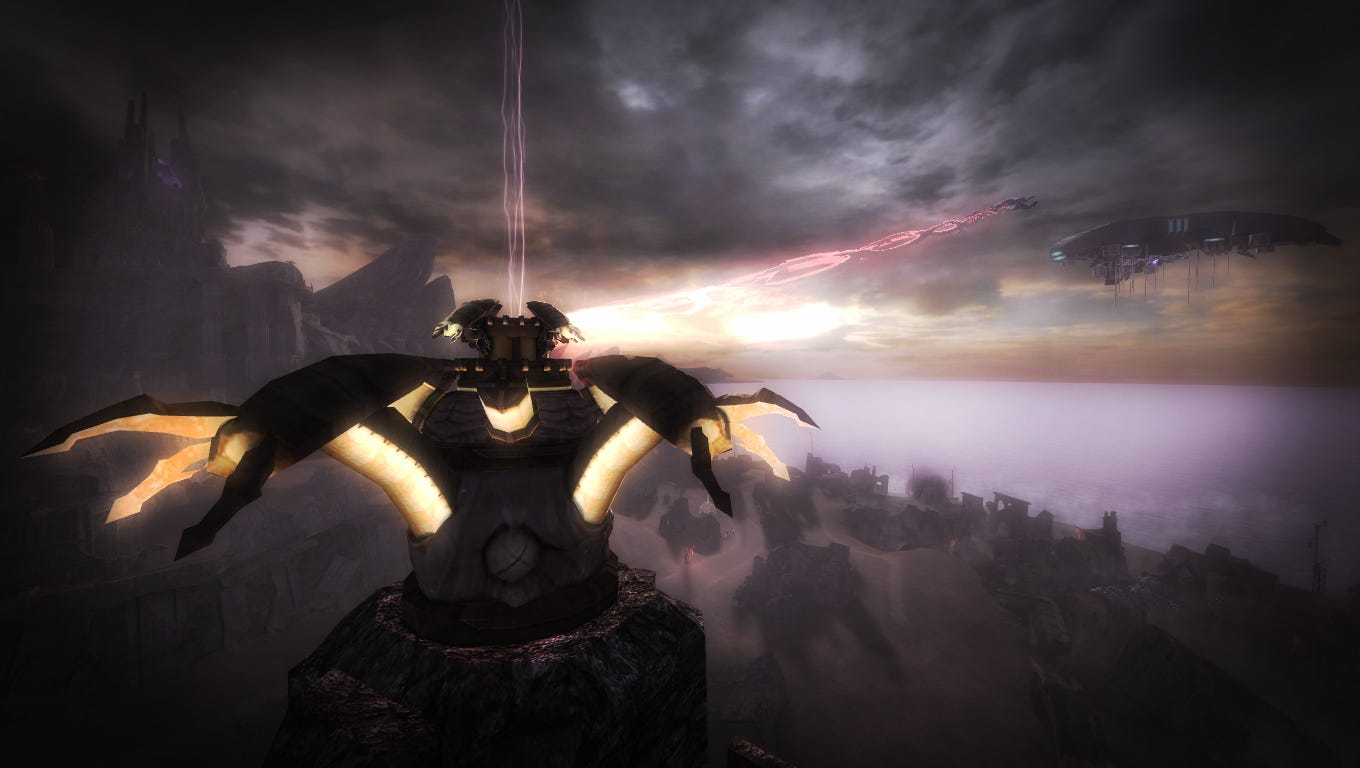
The larger vistas were undeniably pretty, though, with an impressive draw distance.

For a start, there's no unit research. Before each of the 12 single-player levels begins, the briefing screen will let you know which of your nine units are available. In multiplayer, the available troop types depend on the map. Unit upgrades occur individually and are purchased with combat experience. Creative Assembly sees the multiple upgrade paths available to heroes as a way of granting multiplayer armies a bit of individuality, and allowing players to hone their commander's skills to suit their playing style.

The resource aspect is also being pared-down. There's only one resource, in fact, and one simple node which can be built on command points. Nodes can be upgraded in various ways, usually so they improve the resource harvest or automated defences, but each one can only be set along one path. So, no bases either.

Units are called in at warp gates, another node upgrade option, and can be switched around your gates to relocate more expediently. The nodes also serve another purpose; once you own them they act like units, giving you another anchor point for the Whip Select system and allowing you to observe the immediate area.

You'll need to maintain a supply link between the nodes you control as they're all part of a grid displayed on the tactical map. If the enemy manages to cut one off, you'll lose all the associated resources and benefits.

This element was key to solving another problem which Creative Assembly foresaw. In most RTS games, there comes a point when your victory is a certainty and the enemy is on the run. Or, more annoyingly, vice-versa. It's at this point that the tension often flows out of the conflict. Once most commanders are beaten, they'll either fall back for a last stand, or - in CA's words - "hide a unit in a wood" to frustrate the victor.

The supply line rule means that a strike force can sneak behind enemy lines and assault the root of the supply network. Cutting the artery of resources helps to re-establish parity, and staging areas can be gained in the process. It's a simple premise, and will require only a basic strategic plan to overcome, but offers a last gasp to otherwise conquered generals.

Creative Assembly is also attempting to cater for the stroppy. There's nothing much more annoying than settling down for a large multiplayer game (Stormrise's will accommodate up to eight players) only for someone to drop out halfway, ending the game for everyone. The addition of drop-in, drop-out multiplayer means that when someone tries to take their ball home, or has to leave for an entirely justifiable reason, like Bargain Hunt, all that player's resources are redistributed amongst the other participants, and the game continues.

It makes sense for a game which has a multiplayer focus, and that certainly applies to Stormrise. During the presentation, the single-player campaign is described as "an extended tutorial" designed to familiarise players with the units and control system. A few maps will be available for multiplayer, but there will be a large number of multiplayer exclusives too.

3

You know what they say about men witth big hands. They just love gyrocopters.

Ah yes, the maps. If there's one thing that gets Bhopti more excited than Whip Select, it's the maps - or more specifically, something they're calling "verticality". All of Stormrise's maps are fully 3D environments. That doesn't mean just 3D models or the ability to use aircraft. These are full-on 3D environments, much like the deathmatch arenas you find in first-person shooters. There are building interiors, underground passages, bridges, subways, ruins, vantage points... And because of the way the camera and unit selection works, this has a huge tactical impact.

There's no fog of war in Stormrise, everything is done on line of sight. If you can flick to a unit and look at an area, you'll see any and all enemy forces gathered there. Take an aerial unit for a quick recce and much of the level will be revealed to you very quickly, as will enemy positions. However, if those forces are behind buildings, under flyovers or exploring one of the game's many large underground areas, you simply won't see them.

Should your air unit fly over a building full of troops, they'll stay hidden. That vulnerable group of soldiers out in the open might be protected by battalions of hidden troops, just waiting for the ambush. There will be no shortage of places to hide, either, with some levels as big below ground as they are above. Popping up behind enemy lines as you emerge from a storm drain or underground car-park which your foe has failed to notice should be immensely satisfying. The potential for sniper nests, ambushes and sneak attacks is huge.

Pathfinding for the environments seems solid. The addition of "indirect orders", where a unit in visual contact can be directed with a 'click and drag' of the X button, allows for relatively easy manoeuvring and the creation of cross-fires. It does have limitations, however. Moving a unit around a building is tricky; you can't see around the corner so it has to done in stages, peeking around each bend.

4

Romford, June 4th, 2230.

If you leave an area with no nodes or troops, the process must be repeated when you want to return. Learning to recognise all of the relatively small icons players will be flicking through via the Whip system looked tricky, too. Distinguishing between different half-centimetre high white shapes in the heat of battle might just kill some of the immediacy the system is intended to impart.

A great deal rests on that control system, as is always the case with console RTS games. If it's not good enough, the other clever ideas in Stormrise could amount to nothing. But for now, let's just applaud the innovation that's on display here and hope the execution matches the vision.

Stormrise is scheduled for release on PC, PS3 and Xbox 360 at the end of March.

Comments (25)

Comments for this article are now closed, but please feel free to continue chatting on the forum!

  • Loading...hold tight!