Spore: Galactic Adventures Review

Space invaders.

Version tested: PC

My first captain of infinite space got his oversized hat inextricably caught in a low-hanging tree. The second saviour of the known universe got atomised by an exploding custard pie he dropped on his foot. By the time I restarted the training mission, for the third attempt, I was prepared to give up the whole idea of user-generated content as a bad joke. After all, if the Maxis Illuminati couldn't make a mission, the first tutorial in the game, that didn't piss you off entirely, how could they expect anyone else to?

Galactic Adventures continues the overriding Spore theme of user-generated content, extending it to level-editing (though in Spore's case, it's more planet-editing). And hence turning the endless drab Gnosh-infested wastelands (oh, those blasted Gnosh. If one thing broke Spore, beyond the overly basic gameplay at every level, it was the endless depredations of tedious enemy races nicking your planets as your miniscule empire expanded, making progression more depressing than hitting 29 in Kudos) into a quest-packed paradise, replete with random missions generated by your fellow users. 

When they get there. At the moment there are a few Maxis missions, a bunch of confused journalists uploading bizarre half-hearted test pieces and a handful of Robot Chicken-created episodes. Including one about a war between bananas and monkeys which, apparently having been made in half a day, is the best advert for what you can do with the game if you put your mind to it. 

There are two halves to this expansion; the main thrust of the game is beaming down to a planet, sometimes accompanied by crewmates chosen from your allies, to take part in whatever fiendish plot some fellow gamer has conjured up. You create a captain by customising a member of your race (in the main space game) or by starting from scratch (when playing one-off missions). Then you're dropped into the saccharine tutorial mission which features pink bunnies sat on toadstools dancing to acid funk in front of a fairytale castle. It's certainly a good advert for the creativity of Maxis employees, if not their sanity. 

1

The mysterious "Steve" features in the training mission.

From that point on, GA reveals itself to be a classic role-playing game. In the main space phase, some of the missions from others races have become Galactic Adventures; alternatively, you can just play them as standalone adventures from the main Spore universe interface. Once in you can wander the planet, get Sim-babbled at by the natives (the curse of the silent protagonist strikes again, as these are mere monologues devoid of interaction), fight things, use things on things, and eventually complete the adventure. The missions are simple, often frustrating - because of the complexity of the simulation they've been dropped into - and sometimes uproariously funny.

Your captain gets a certain number of points from each mission completed. And what do points mean? Things that have position but not extension? No - prizes! You can trade these points in for increasingly-cool new upgrades that can then be equipped on the inventory (customisation) screen or used in the main galactic war. Yes, it's a bit like a Star Trek / Mass Effect RPG, with your bizarre avatar playing the square-jawed Kirk / Shepard role.
2

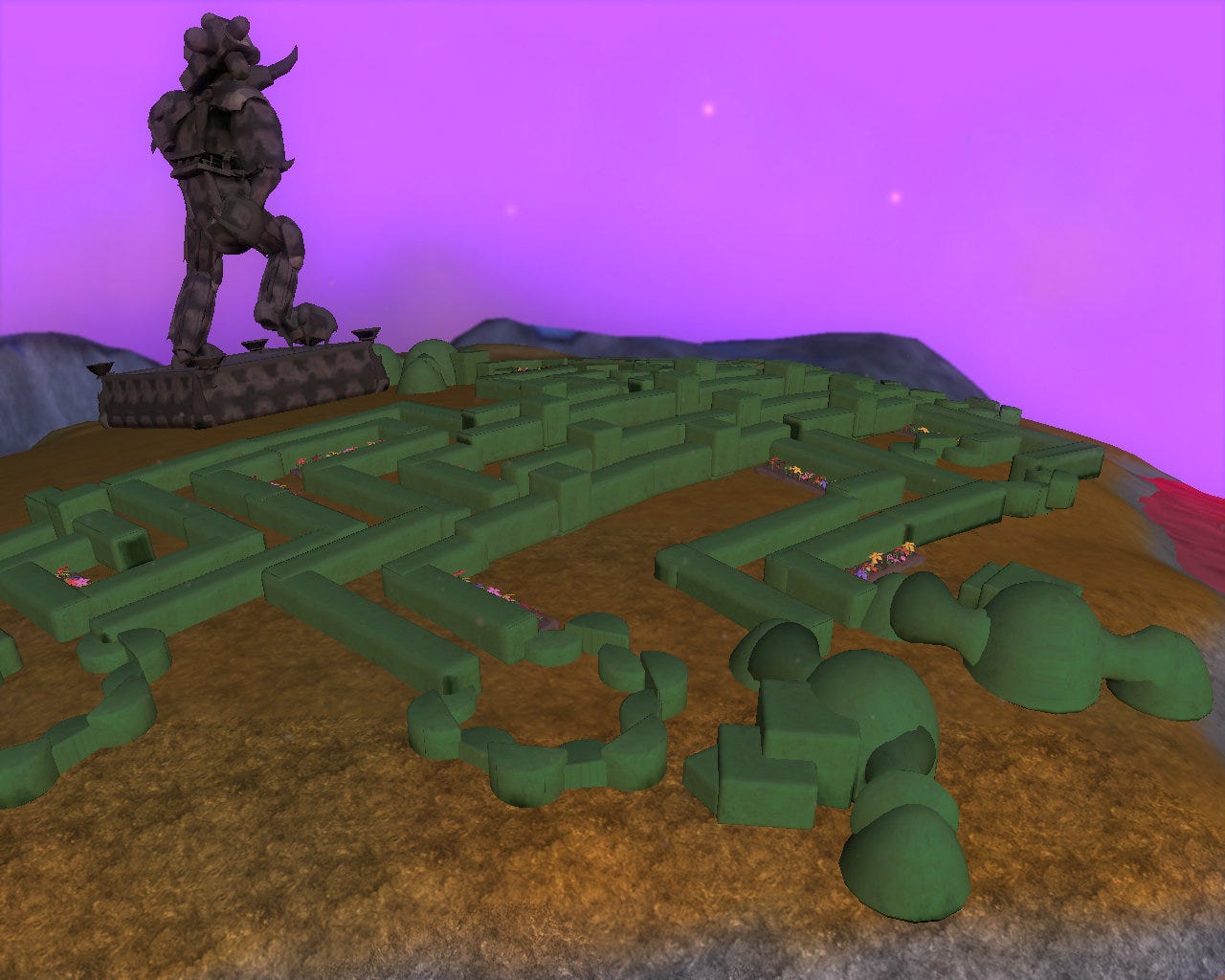
The flexibility is literally a-mazing. A-maze-ing. A-MAZ- oh dear fired.

The other part of the game is the lovely editor, and it's by far the most interesting element as well as the largest. The user interface for the mission editor is really well-explained, with a step-by-step tutorial that an eight year old could complete. I'm a veteran of many map-making packages and in-game editors, from Quake, The Movies and Starcraft to Neverwinter Nights and City of Heroes: Mission Architect, and this is the simplest I've encountered - though that's not to say it isn't powerful too.

The initial tutorial allows you to easily make a simple diplomacy mission, but there's a suprisingly large amount of flexibility to the tools and they can be used to make just about any adventure or RPG game going. We're expecting to see a world of remakes and parodies in there fairly soon.

The most important element in the game is your cast; you can select these from any creatures on your computer, go online to steal somebody else's (and let's face it, before we all abandoned Spore we created an awful variety of creatures) or create something specific and new. Likewise, plants, vehicles, and buildings can all be rejigged to fit in with your plot. Special effects and sounds can be dropped in, and have the same intensity/range sliders as everything else in the game. Then you can terraform your planet, raising and lowering the sea-level, carving out mountains and valleys, and selecting a range of plants to cover it, all to create the perfect backdrop to your plot. 

Once you've added an element you can rescale it, create duplicates of different sizes and set default behaviours, paths and teams for creatures and rely on the cleverly primitive AI to handle the rest. You can also add speech bubbles, dialogue and random thoughts, as well as editing all of their vital stats. Everything has the same user-friendly drag-and-drop interface as Spore, and the limits on level complexity are set very, very high.

Now you've got all the materials you can make your adventure. Your captain has to complete all the specified goals (simple things like "talking to Satan" or "befriending the Pig Bride") before an act is complete; once all the acts are done, the mission is over and the player is rewarded with their points. There's a somewhat arbitrary limitation imposed by only allowing you eight acts of three goals each, but that should still be plenty to make everything for the throwaway missions that Maxis seems to want. We think there's definitely the potential to make some interesting vignettes, but not enough elbow room to make a Telltale adventure or match something from the Adventure Game Studio

As people complete missions they get to rate them (a simple thumbs-up or down). This is the only element of the reward system that could be troublesome. As City of Heroes: Mission Architect showed, if you have a game-related reward system for players it provides an alternative rating system for those playing it to the actual quality of the mission - as in, I'll score your mission higher because it gives me rewards for doing nothing. Thankfully, Maxis has made the points system independent of the mission's score, but there's still an incentive to give shorter, easier missions higher scores.

At the time of writing there weren't enough missions to level yourself up very far, though you could make some yourself and grind them. Moreover, if you had decided to make your race deficient in any regard, certain of the goals of the missions might be impossible - most level-creators will assume you've rationally created a do-anything, go-anywhere Captain, rather than the possible legless polka-dotted blob you may have persistently advanced to unlikely galactic domination.

3

For the first time, you can place houses and characters how you want on the planet's surface.

Finally, though the Spore catalog is stuffed with useful creations, we still found it quite slow to load and not very easy to browse. Searching by tags is fine, but the mass of content (which includes a high proportion of mediocrity) means it can be hard and mind-numbing to find the best model for your job.

This game hasn't really been made yet. In its current state there are very few missions and you're going to get bored doing the same ones again, especially as you don't garner any rewards from them a second time through. However, once those millions of monkeys with typewriters start churning user-generated content, and people get to grips with the simple-but-powerful tools, we expect to see a lot more interesting stuff here. Once there are a gazillion X-rated ambulatory penis missions, this will be the natural conclusion of the original Spore game and, as Kieron said also the natural conclusion of its paralleling the history of mainstream videogames; welcome to the Little Big Planet stage. 

If this rational extension had been in Spore from launch, it may well have retained the lasting appeal that it obviously lacked. As it was, despite Will Wright's high concept glitz and glamour, the ultimate product was compromised. I've not seen anyone playing Spore on my Steam friends list since two weeks after launch and, with the Sims 3 in the wings, it's hard to be sure this will lure them back. Not until the World of Cocks videos start hitting Youtube, anyway. 

7 / 10

Read the Eurogamer.net scoring policy

Comments (44)

Comments for this article are now closed, but please feel free to continue chatting on the forum!

  • Loading...hold tight!