Soul Bubbles Review

Popped in souled out.

Version tested: DS

Ah, the herding sub-genre. Game developers' desire for us to chivvy things to a hazard-strewn destination knows no bounds, resulting in some of the quirkiest games of all time, including DMA's thoroughly evil Lemmings, Mind's Eye's super-cute (but completely overlooked) Sheep, and Core Design's curious Disney experiment Herdy Gerdy. Then, a couple of years back, LocoRoco's joyous tilt-based approach took the whole herding premise off on a rather squishy, cosmic tangent, where the life-forms were a gospel choir of space hoppers.

Soul Bubbles reprises LocoRoco's necessity to squish a gang of precious things down organic mazy environments, but appears to have removed lysergic acid diethylamide and the power of song from the development process. That's no bad thing, because this delightfully soothing puzzler has enough tricks of its own - like its excellent touch-screen controls - to deliver its own equally desirable take on the formula.

Despite the improbable premise of you being some sort of daft spirit-herder who can draw bubbles around your cargo and blow them along by sweeping the stylus across the screen, and despite perhaps being hampered by a too-gentle learning curve in the initial stages, Soul Bubbles is an effortlessly charming game right from the off, and keeps you coming back for more in bite-sized chunks, just as any handheld title worth its salt ought to do.

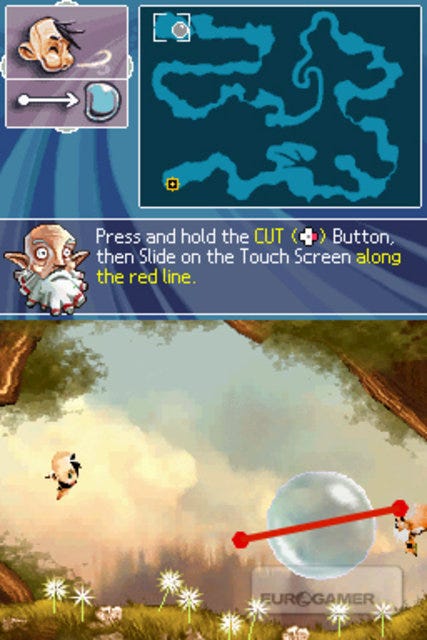
Each of the dozens of levels in the game kicks off the same way. You hold up on the d-pad (or use the face buttons if you're a leftie) to invoke the draw command, and then encircle the little gaggle of 'spirits' so that you can give them a vessel in which you can then blow them around the side-scrolling 2D environments.
'Soul Bubbles' Screenshot 1

Slice, deflate, pop, blow. All with a few stylus strokes.

Just like in LocoRoco, you'll find yourself squeezing them through narrow passages and trying to avoid all manner of hazards. In such circumstances, a combination of deft strokes and use of the other d-pad commands tends to see you through. You might, for example, simply want to deflate the bubble slightly, and that involves little more than pressing the d-pad left and pointing at the appropriate bubble. In other situations, though, the gap is simply too tight, and you have to slice through the bubble and split it up, then blow several smaller bubbles through the gap. Rejoining them is as simple as repeating the process.

En route to your goal, you'll gather up as much stardust as you can, and occasionally stumble across little yellow blobs in the further recesses of each level. Known as 'Calabash', these become important to gather up in order to unlock the final eighth world, and lend a vital element of replayability to the whole game.

Likewise, getting all seven of your spirits to the level exit is also important, as each world requires that you get at least 15 of them home safely before the next world unlocks. That said, it's not a foregone conclusion the further you progress, because the sheer volume and diversity of hazards ramps up exponentially as you go along. To begin with, you might simply have to avoid spikes, fire, pesky birds or nasty frogs with their flicky-sticky tongues. Dealing with them is as intuitive as you might imagine; swatting birds away is as simple as tapping them. Putting a fire out might involve drawing a bubble in a nearby pool, and blowing it to the fire itself, while stopping a pesky frog in its tracks will involve slicing its tongue off.

Later, the puzzle element of the game starts to come into its own, with swirling wind currents dragging you towards danger, and often prompting you to use previously bothersome 'hazards' to your advantage. Sticky trails might snag you from otherwise certain death; little lizards which drag you into holes can spit you out somewhere otherwise-inaccessible. Light and heavy gas vents enter the equation, giving you an opportunity to create bubbles which manipulate switches and break barriers that block your progress. Much of the game's latter levels become as much about pre-planning, trial and error and exploration as careful shepherding - and that means being able to check out the snaking trails you create with fluid ease.

Although the game allows you to quickly scroll around by touching the edges, it also offers a much slicker means of doing so by allowing you to instantly flip between the game screen and the map screen by holding down on the d-pad. At that point, the map switches to the touch-screen, enabling you, for example, to point to a gas vent instantly, draw a bubble and work your way down to where your spirit bubbles are hanging out. It's a system that works exceptionally well, and also gives you a chance to quickly go back over old ground in case you missed any Calabash on your way.

That said, as previously mentioned the game does take a while to get into its stride. For the first three or four worlds, there's no real sense that it's doing much to challenge you, and as soothing and pleasantly diverting as it feels to chip away at, it takes a good few hours before you find yourself having to really take your time. Beyond the rather perfunctory introduction though, it starts to come into its own, as more ambitious and more challenging level design starts to test your abilities to cope under pressure as your precious souls start coming under more frequent attack from more enemies. No longer will it be good enough to just swat things away. More often, the puzzles and hazards come hand it hand. Finding Calabash becomes increasingly fiendish, and getting to the level exit more of an achievement in itself.

'Soul Bubbles' Screenshot 3

SOS! Rescuing your endangered souls is as simple as drawing a bubble around them before they expire.

By the time you've sweated your way to the eighth world, the game really pulls no punches, delivering the kind of brutal challenge you expected all along. Occasionally it can even feel quite frustrating, but only ever in the sense that makes you want to come back for more. As a bite-sized commuter-friendly game, this fits the bill perfectly, with levels rarely extending beyond the 15-minute mark. Just when you might feel like you've had enough, it's either onto the next level, or a game you'll feel happy putting to one side for a while. If there's one slight criticism, it's that it's not a game that lends itself to extended play - a bit of an issue for reviewing purposes, but absolutely on the button as far as handheld, real-world play goes.

One facet of the game which is impossible to overlook are its visual charms. As far as DS titles go, this is up there with the very best, with a succession of beautifully rendered levels, which go some way towards keeping you going. Although it shares that same spongey organic, physical feel as LocoRoco, it's a world away it terms of its art style, and perhaps more along the same lines as the bright, stylised charm seen in WiiWare title LostWinds. And let's not forget the technical feat of being able to create a game which, ultimately, is a set of engaging, well-presented physics puzzles. With all this, Soul Bubbles definitely has enough distinct charm to override the inevitable LocoRoco comparisons, with a superb control system and delightful art style carrying you through for the entire game. Were it not for the slow start, it might have left a deeper impression sooner, but some wonderful level design and smart ideas later on eventually deliver on its obvious promise.

8 / 10

Read the Eurogamer.net scoring policy

Comments (24) Latest comment 4 years ago

Comments threads automatically close after 30 days, but please feel free to continue chatting on the forum!