Sony Online Entertainment is one of, if not the most experienced company in MMOs. It scored one of the genre's breakthrough successes with the first EverQuest, and to this day it operates the widest range of MMOs under a single roof anywhere, including Star Wars Galaxies, PlanetSide, Pirates of the Burning Sea, Vanguard, EverQuest and its sequel. In recent years, however, it has been overshadowed - not just by World of Warcraft, but also by the succession of eager, over-hyped pretenders that have attempted to grab WOW's coat-tails as Blizzard did EverQuest's.
SOE is now undergoing a transformation that began with it formally becoming part of Sony Computer Entertainment - it initially had closer links with Sony Pictures, the Japanese giant's Hollywood presence - last year. That change will see all its future games, including action MMOs The Agency and DC Universe Online, coming to PS3 as well as PC. It's also the first of the old guard to explore new ways to make money in MMOs, launching numerous trading-card spin-offs, introducing micro-transactions to its subscription stalwarts EverQuest and EverQuest II, and earlier this year launching Free Realms, an attempt to capture female and younger players with a free-to-play game that launches from a browser. Free Realms recently celebrated signing up five million registered players.
President John Smedley, who's been with SOE since it started life as Verant, has been instrumental in much of this change. We caught up with him to find out how things are going with the company's new direction.
Eurogamer: How have things at Sony Online changed now that it's directly under the control of Sony Computer Entertainment?
John Smedley: They really haven't; we work for a games company now, and the great thing is that it gives us more access to more people who play, make and love games. Things really haven't changed, and they're only getting better.
Eurogamer: How have MMOs changed, in your eyes, since Everquest got released?
John Smedley: Since 1999, things have gotten a lot bigger. There are bigger games supporting more players, with bigger budgets and much higher stakes for everybody involved - anyone releasing a new title today has a totally different playing field to the one we had.
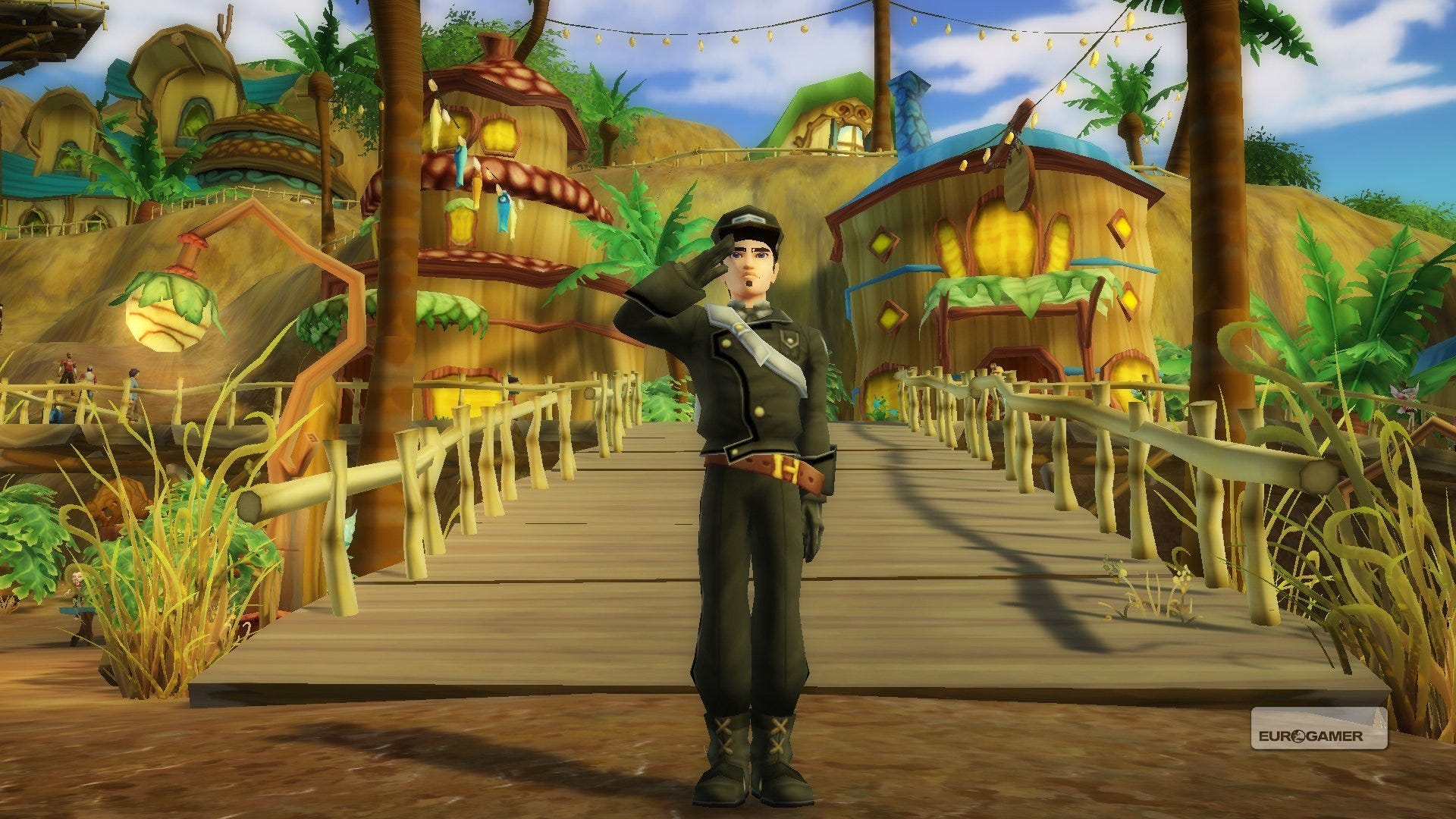
Eurogamer: Why the new direction for SOE with micro-payments, Free Realms, and so on?
Smedley is "pleasantly surprised" with Free Realms' commercial performance.
John Smedley: Well, things are changing. We feel that the gaming industry as a whole is reaching out to new consumers - games like Rock Band are a great example. It's not so much to do with casual gamers as it is to do with bringing in completely new gamers, it's broadening out. Currently, online games are played by a clear demographic: the 35-year-old male. In fact, they make up 85 per cent of all online gamers.
As a result, as a company we're working towards a few new goals, and trying to bring in a new audience as well as catering to our old ones. We have a lot of unannounced stuff that's working towards a variety of goals, rather than sticking us in one core demographic, large as it may be. We're trying and succeeding in being active in going after other genres - games like DC Universe Online are really part of that drive.
Eurogamer: Do you think that micro-transactions and real-money transactions are the future of MMOs?
John Smedley: I think that micro-transactions are part of our future. In fact, since we introduced them to EverQuest II, 40 per cent of our customers have invested in them. We see it as an increase in business by simply offering players what they want and giving it to them for a reasonable price.
We researched our own players in depth to find out how they'd like their micro-transactions, what they'd want from them, and even if they liked them. There were actually a lot that didn't. It took us over four years of research with our player-base over many titles to make the decision - we'd rather do that than rush into it - but after a gut-check about a year ago, the results were such that we felt it was the right time about a year ago. Ultimately it was an evolutionary process for Sony Online. Many of us were really against it, to be honest, and we really made the decision based on a great deal of consideration of both the company and the player-base.
To this day, we're really very careful that game balance is the first priority - while it's to make money, sure, we can't ruin the game in the process.
Eurogamer: What have you learned from Free Realms?
John Smedley: Well, the boldest one, first and foremost, is that kids are not adults. It seems obvious on paper, but if you think about it, their play-times are very different, the things they do in games are radically different, and the way you monetize them can't be the same as how you monetize, say, their parents. All of your assumptions go out the window when you finally see how kids actually play.
The most glaring example is this. When you register, in front of your screen are two questions: what country do you reside in, and what's your birthday - split into three separate fields for month, day, and year. What happens there? Well, it turns out that we lost a lot of customers during registration. Think about it. If you ask a 9-year-old that question, they'll probably be able to tell you their birthday, but it's doubtful that they'll know their birth year. It's pretty elementary to us: mine is [redacted - John Smedley is younger than my dad], but your average 9-year-old logging on for the first time really might not know it. We just assumed they would.
Furthermore, we built this elaborate tutorial to ease players into the game. As the test, we took the tutorial out, and just let the kids go in. Guess what? Exactly the same amount of people got to the same place in the game without the tutorial - to the percentage - the kids simply didn't care. We made these mistakes because we made assumptions based on an adult mindset.
Eurogamer: How profitable has Free Realms turned out to be?
John Smedley: As you'd expect, we don't discuss numbers, but I assure you we're very happy with the results; pleasantly surprised, in fact. I would say we're continuing to invest in the free-to-play and micro-transaction-funded MMORPG field with some unannounced products that we'll be announcing sometime next year.
DC Universe Online is an attempt to find a more diverse audience for MMOs, like GTA's or Killzone's.
Eurogamer: What do you think the impact of games like DC Universe Online and the Agency will be?
John Smedley: I think we're going to see a lot more variety in the kinds of MMOs out there. In fact, we're going to be creating some of the first of those games. You see, until recently, MMOs have been about men in tights. And while I truly believe that fantasy MMOs will be the staple of the industry, things are changing - and now we're getting men in tights other than Rangers and Dark Elves in games like DCUO.
Seriously, though, look at a strong franchise like GTA or Killzone. They're diverse, and permeate well beyond their target audience. We don't have that in online gaming, and that's what I believe games like The Agency and DCUO are doing.
I mean, do you see many sports MMOs? They're out there, but frankly, most of them suck. The job that EA has done with some of their online titles is good, but try and find a really great sports MMO out there. Why is it that one of the single largest gaming segments is almost completely unrepresented in the genre? I really think we have to move towards getting these gaps filled with quality titles - and that's where the industry will be moving.
Eurogamer: How committed to MMOs on the PS3 is Sony?
John Smedley: We're far more committed than any other company in the USA. We already have four titles in development, three of which we've already announced.
Eurogamer: Have you considered (or even tried to work with) Microsoft?
John Smedley: I don't get why people ask me this question [laughs] - we're a Sony company! We want Sony to win!
Eurogamer: How do you think MMOs on consoles should be approached?
John Smedley: It's like approaching Free Realms demographically - you have to think through how radically different they are, from the controller to the community. The controller is a very different beast to the keyboard. It's a totally different experience, centred around communication.
Most online console games use voice, and many PC games use [typed] chat as their medium of communication - though that's increasingly becoming voice-focused.
The first EverQuest celebrates its 10th anniversary this year and could go another round, its proud dad reckons.
Furthermore, the communities are radically different. For starters, on your computers you can open up forums, help sites - people on PCs keep them open at the same time as the game as a point of reference. The experience on a PC is so different, as people are so used to multitasking. A console player will predominantly be playing in their living room. We have to give them the time and energy to make sure that their experience works for them, and for the type of person that will play this game. We're not quite there yet, but we're getting there.
Eurogamer: Do you intend to have an identical business model for all of your MMOs on the console?
John Smedley: Fundamentally we'll be looking to stay the same. We're looking at one where we sell a product at retail or digitally, that you can buy a subscription and buy micro-transactions for. The only difference, for now, is that we'll most likely limit the console versions to retail at first, as the client will be so big. We will want to ultimately make these games available for digital download.
Eurogamer: How long has EverQuest got left in the tank?
John Smedley: It depends on what you consider EverQuest. As far as just the original game goes, If you'd asked me that ten years ago, I'd have said a year. Today my answer's very different - I'd think another 10 years would be definitely possible. We've still got a lot of players, and the EverQuest franchise itself is something we're hard at work on.
I mean, think of how long you played the game for. Many have for upwards of five years; in my mind I can't even think of how long I've played any other series. It's just EverQuest, the Civilization games, and Battlefield 2 for me. There are some series that just have that resonance and staying power, and I believe EverQuest is one of those franchises.