Version tested: PlayStation 3
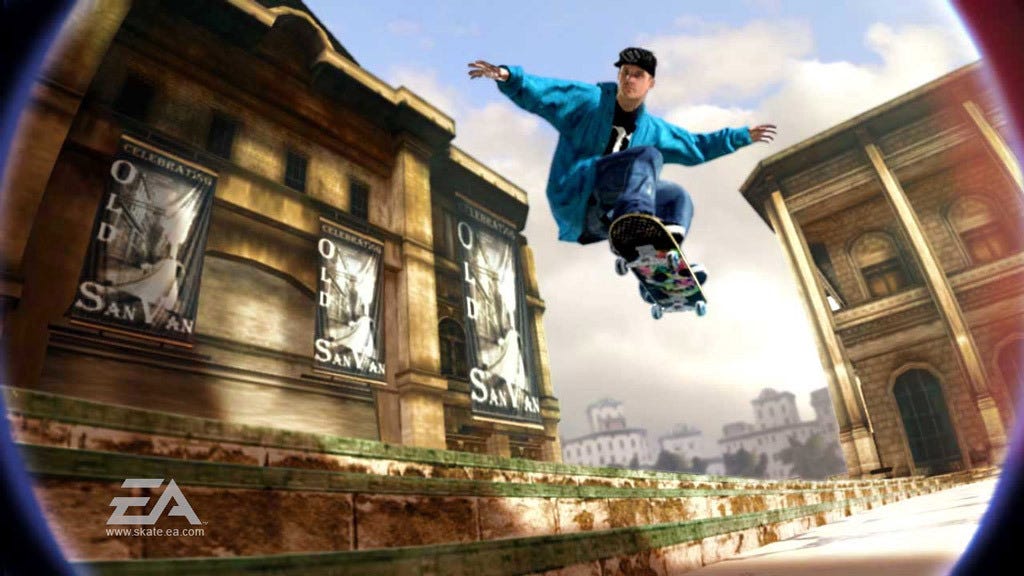
Despite the hipster soundtrack, the subculture-savvy dialogue, the pavement-level camera that distorts your view with fisheye cool and the 'edgy' protagonist who just got out of prison, Skate 2 is essentially a game about cold, hard physics. This much is obvious within minutes, when you're told to stop posing in your new Levi's and gold aviators, get off your skateboard and, by hand, rearrange some ramps to solve a puzzle. The challenge is to 'get some air' over two dumpster bins, the game leaving you to figure out whether your arrangement of triangles will provide enough momentum and height to clear both objects lengthways, or whether you need to rethink the problem.
Underneath the style and bombast Skate 2 is a fiercely traditional videogame, one that takes an unflinching 8-bit approach to game design of which most contemporary games steer clear. For example, in one challenge you must grind two sets of stair rails in sequence, a filmed stunt that, if 'nailed', will form part of your amateur showreel. This ostensibly simple challenge requires you to approach the stairs from the perfect angle, flicking the right stick up to olly at the optimum moment, then balancing your body on the deck as you slide down, before kickflipping off to land in the perfect spot to approach the next rail. It's a sequence of button inputs that must be perfected, as in the 2D platform games of yore: make a single mistake and you'll fall off the board, smacking your face into the concrete to the wincing empathy of your cameraman.
At this point there are only two options available to you: try again or give up. There is no progression of abilities in Skate 2. Nearly every move is available to you from the start. You can't toddle off to buy a better deck that will make the task slip down a little easier. You can't go and level up your character's jump stat, or save up for some more supportive sneakers. No, you just practice, building up the required muscle memory till you've increased your own out-of-game ability sufficiently to overcome the challenge. Skate 2, like the pastime it portrays, only grants long-term success to the skilled and dedicated. Everyone else can pretty much limp off back to Prince of Persia, Fable II and others that turn a blind eye to the fact you totally suck at videogames.
Most events have an entry fee paid for from your previous winnings, but the cost is only made real if you quit out of the event, as you can retry as many times as you like till you succeed.
All of this is not to say that Skate 2 isn't an impeccably presented contemporary package, stuffed with brilliant, modern ideas of convenience that considerably smooth the ride. Want to hop to your next challenge without having to skitch a ride from a passing car across miles of New San Vanelona? Simply warp there right from the menu. Then, at any point you can click the left bumper and place an invisible marker on the ground, returning to this point now a single click away. It's a wonderful piece of time-saving design that allows you to try difficult runs time and again without the need to walk back to the start point. And while at times Skate 2's a tough mistress, there's always something to distract you when you've hit the wall in your ability.
There is a loose story here, its purpose primarily to frame the ever-expanding roster and difficulty of challenges on offer. Events take one of six forms: Core challenges, which drive the storyline along propelling your character from obscure layabout to professional hero, Races, Street Contests, Tranny Contests, in which you compete for the best transition tricks, rather than what you're thinking (and hopefully not Googling), Bonus and Own the Spot. Races are the weakest of the bunch, pitting you against a clutch of other skaters to be the first to the bottom of a downhill run. There are checkpoints that add time to your clock, but skateboards can be frustratingly unwieldy to manoeuvre around objects at speed, especially when the AI sends cars and competitors careering into you too often.
The other modes offer a range of knockout competitions (the lowest-scoring skater in each round is eliminated) and HORSE-style one-on-one matches in which you try to outdo another skater with complex tricks. A GTAIV-style mobile phone allows you to call up your peers for impromptu face-offs (as well as to dial in some back up when you need someone to fend off the mall security while you work a high-risk location) and so there's plenty to be getting on with at any given moment.
The trick roster has increased from the first game introducing hand and footplants but, as before, the problem is that many of the different moves are similar in execution, requiring only subtle differences in right analogue stick input to execute, for example, an FS Pop Shuvit or a Varial Heelflip. This only becomes a problem in those challenges that require you to perform a specific irksome move to progress, although mercifully these instances are far fewer than they were in the previous game. Nevertheless, by the time you reach the pro challenges things start to become technical, charging you with, for example, landing three different fliptricks over the same set of stairs. Once you've landed one you have to jump off your board and run back up the stairs to attempt the next, all against a strict time limit. The chances to make a mistake here are many, especially as you're hurrying as well as concentrating on moving your fingers in subtle distinction.
As before, you can pause the game at any point and create short edits from your instant replay footage to upload to your online profile. The editing tools included with the package are basic, and the decision to make advanced camera controls and filters etc. a downloadable extra (for 600 MSP) is a contentious one. But pull off a line or a trick with elegance, no matter how humble, and even the most cynical UGC detractor will pause the game, and upload the footage to their profile. Good-looking success is hard-won in this game and so there's good reason to want to share it.
Skate 2 is a marketing man's dream, and, like its predecessor comes packed with logos and corporate identities from the precision-modeled Adidas sneakers to the multitude of branded boards themselves.
The game's weaknesses are mostly well-hidden. Like its forebear, the polish rather than the underlying quality carries the visuals. Textures are poor and objects lack detail, shortcomings that are easy to forgive thanks to the stylised camera angles, filters, and motion graphics that firework across the screen, distracting you from what's otherwise a pedestrian-looking game. While the chance to hop off your deck at any point and go by foot is welcome when you need to walk up some stairs or climb up onto a structure, it's also unwieldy and awkward, to the extent that it's always a relief to get back on the board.
The game tightrope-walks between an arcade feel and realism. When skating around town, picking simple lines and executing modest but competent tricks with style and grace the game's at its understated best. But as things progress, and you gain access to terrifying, giant ramps and begin to execute Tony Hawk's-style multiple Christ Air forward flips it begins to deviate from its core value of physical realism. As if to exemplify this tension, any videos you upload must be categorised into 'Arcade' or 'Realistic' categories.
The Hall of Meat scores you on every wipeout, rewarding you with both points and money for causing physical damage to your skater.
At its best Skate 2 calls to mind the finest freeform moments of Mirror's Edge, plotting lines through dense urban environments, grinding along benches, weaving in and out of pedestrians and traffic in one long, glorious, uninterrupted flow. Thanks to the sober realism of the physics this kind of combo'ing is more satisfying than it ever was in a Tony Hawks game, even if it's ten times more hard-won and less impressive to a casual observer. Often you will finish a challenge only to freeskate around distracted for twenty minutes before remembering to move onto the next. But for the vast majority of players there will be a challenge hurdle at some point that is just too high to overcome. It's no accident: the game has been designed that way. It's testament to the strength of the surrounding package that Skate 2 continues to be compelling place to inhabit even after its primary purpose is gone and all that's left is the playground.
8 / 10
