Shatter Review

Block-rocking bats.

Version tested: PlayStation 3

Shatter - and this is something you don't often say of download games that cost less than a fiver - has an absolutely fantastic soundtrack. For the new PSN game by GripShift creators Sidhe, Module (aka Jeremiah Ross, a New Zealand electronica artist) has put together 90 minutes of warm, fat, fuzzy bass grooves over steady disco beats and under tidal washes of space-age synth, cut through with heroic stadium-rock guitar and sprinkled in pure, unadulterated SID-chip stardust.

It's quintessentially eighties but also distinctly modern, as close to Justice as it is Harold Faltemeyer. Where other neon-edged arcade revivals try to bring the aesthetic of old videogames "up to date" with thumping psychedelic rave that barely scrapes its way into the 21st century, Sidhe and Module have come up with something that's simultaneously more nostalgic and more relevant - not to mention more human, prettier, and easier to listen to for long periods without having queasy flashbacks to lost weekends. Classy, relaxed and quietly immaculate, the Shatter soundtrack is a perfect piece of retro-futurism. And so is Shatter itself.

It's not as easy as it looks to tackle the classic designs of the very early days of videogaming and innovate around them. It's even harder to actually improve them on a basic level, but that's just what Sidhe has done with Atari's venerable Breakout - or perhaps Taito's Arkanoid, the 1986 game that perfected the form, is a better point of reference. Shatter does for the bat-and-ball block-breaker what Geometry Wars: Retro Evolved did for the twin-stick shooter, or Pac-Man Championship Edition did for the yellow-thing-running-away-from-ghosts-in-a-maze-'em-up. Well, it doesn't quite match them in one area, but we'll get to that later.

The neglected netherworld of the Breakout clone hasn't seen a distinctive update in over a decade. The last notable version was probably the 1996 shareware cult DX-Ball. Ever since, it's been languishing on mobile phones, which is where games designers put all the solid old gametypes they don't know what to do with.
1

Playing with two balls takes, well... you can fill in the rest.

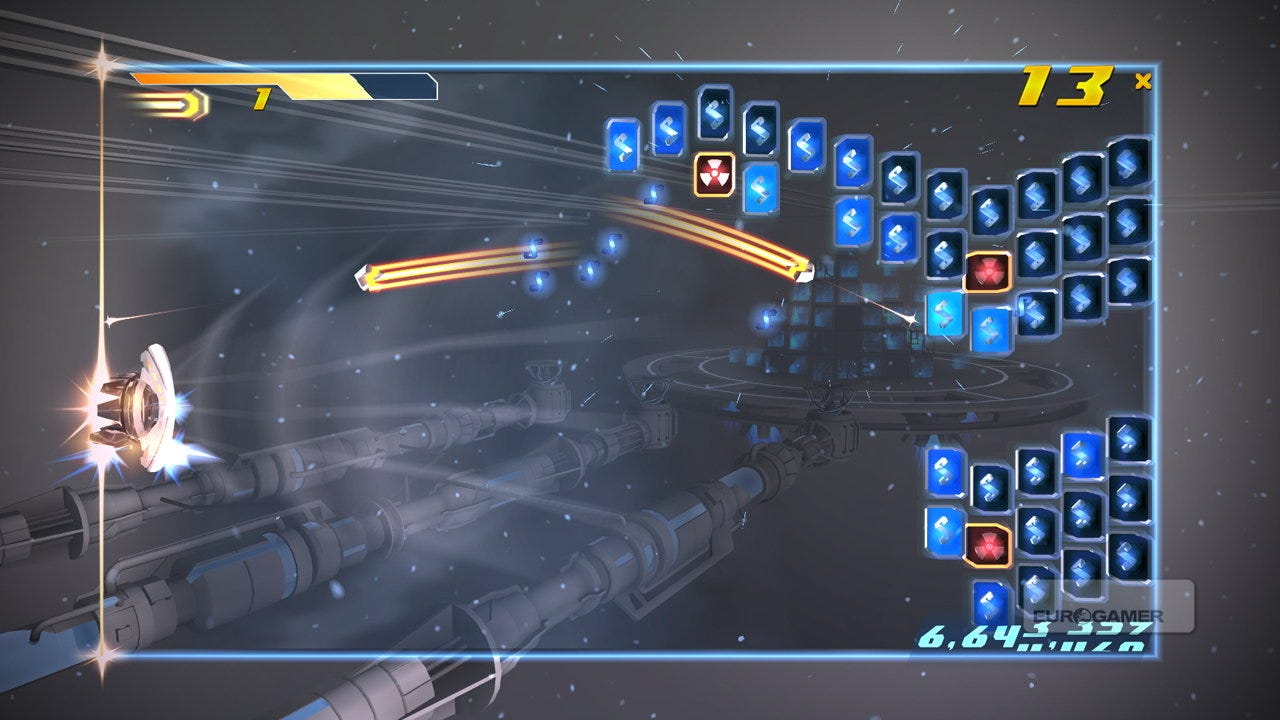
Sidhe freshens the template up in all the ways you'd expect, varying the size and shape of the playing field, adding power-ups, a layered scoring system, modern physics and a proliferation of new block types with different behaviours. It also adds one major innovation you wouldn't expect and would never have thought of: the ability to suck and blow waves of air from your bat, which doesn't just affect power-ups and other collectables, but also the loose, tumbling blocks themselves and - most importantly - the ball, allowing you to bend its trajectory while it's in mid-flight.

Combined with this game-changing twist are two much more subtle, but still brilliant touches. The surface of your bat is gently curved, meaning the ball produces a different bounce depending on where you strike it. It's a much more intuitive and predictable way to give the player more control than the vague notions of spin favoured by some games of this type. Also, there's a light but very precise indicator showing where the ball will hit if it continues on its current trajectory, which is essential for controlling the flight of the ball to the fullest extent, and which doesn't make Shatter as easy as you might think.

All of this gives the player an unprecedented amount of power and flexibility in a genre that's often frustratingly random, or at least, a test of reactions rather than skill and strategy. Shatter is still a game of chance at heart, but it's one where you have the tools to turn the tables on luck every once in a while, if you think fast and play creatively.

Ignoring the attempt - so perfunctory and stupid it's almost sweet - to give this entirely abstract arcade game some kind of plot, Shatter offers 10 worlds, each a sequence of rooms culminating in a boss. The rooms are sometimes squarish, with the bat sitting traditionally at the bottom; sometimes oblong, logically using the full spread of widescreen, with the bat on the left; and sometimes circular, walled about two-thirds of the way round with the bat at the bottom. The variety keeps you on your toes, although bounces can be mind-bendingly hard to work out in the circular rooms (which is the point, surely), and it's sometimes too easy to keep the ball permanently in play in the deep horizontal rooms just by blowing it away from you.

Blocks leave clouds of shards behind, which can be sucked towards you (when this won't send the ball somewhere you don't want it to go) for a score multiplier and to charge up your power gauge. Power can be unleashed in a "shardstorm", a sort of laser barrage from your bat than can be used to clear swathes of blocks at a time. It can also be used up to shield your bat from falling blocks, important in later stages - getting hit doesn't lose lives, but it takes the bat out of play for a second which is often long enough to miss the ball, and that does lose you a life.

Blocks drop power-ups fairly frequently. 1-ups are generously plentiful: with three continues available too, progress is pretty easy in Shatter until the final two worlds, which shortens the experience a little but keeps frustration low and focuses the mind on improving performance rather than survival. There are score, shard and power multipliers too, and two simple but desirable ball power-ups. Unstoppaball cuts through most blocks rather than bouncing off them, and Manoeuvraball is much easier to steer by sucking and blowing, a real boon in boss stages. Extra balls aren't a power-up, they're a choice, released at the cost of a life, with a big benefit to score if you can keep them in play.

It's all beautifully balanced and clear. Sidhe deserves credit for keeping the power-ups simple and useful, rather than flooding the game with hit-or-miss novelties. The designers have quite rightly poured their invention into the block types and room designs instead.

2

The shards are a crafty lift of Geometry Wars 2's geoms.

There are simple blocks, blocks that explode, blocks that weaken their neighbours when hit, blocks that drop when released by the destruction of anchor blocks, blocks that shoot off like rockets, blocks that suck and blow, blocks that work like hinges and pulleys. Sidhe takes the impish invention of Taito's layouts in Arkanoid and runs with it, constructing animated Heath Robinson cascades of cause and effect, just waiting to be spun into slow-mo, low-gravity chaos by your ball. It's beautiful, and new ideas keep coming all the way through. The bosses are brilliant too, devious and delightful enough not to be spoiled here.

If Shatter slips up anywhere, it's in its scoring. There's just a bit too much going on, the rules aren't transparent or consistent enough, and since the score multiplier is linked to hits off your bat as well as shard collection, it seems to reward playing without using the game's most interesting and skilful feature - the ability to suck and blow. The fact that the multiplier resets to zero at the start of each room constantly robs Shatter of the heart-in-mouth momentum that makes for the best score attack games, and the will to compete with your friends' scores - whether in the world, mode, boss rush or bonus categories - soon ebbs away.

In the end, Shatter is an engrossing, smart, beautifully conceived and executed arcade game, but it doesn't quite have the score-racking purity of purpose that makes a Geometry Wars, Pac-Man CE or Out Run Online Arcade so endlessly compelling. Once you've beaten it, which won't take long, you'll move on - but it's a blissful spell while it lasts, an absolute steal at £4.79, and a definite feather in PSN's cap. And you can always boot it up again just to listen to the music.

8 / 10

Read the Eurogamer.net scoring policy

Comments (61)

Comments for this article are now closed, but please feel free to continue chatting on the forum!

  • Loading...hold tight!