Saviour Machine

AI master Steve Grand talks Creatures, Spore and Simbiosis.

SHODAN may have been scary, but she's got nothing on Lucy. The fun-size pocket robot orangutan may now be consigned to Cyberlife Research vault, but the artificial intelligence comprising her virtual brain - which her creators hoped would see her through real-life kindergarten - is of a level of sophistication that makes Looking Glass' amalgam of clever scripting, voice-acting, and cut-scenes look utterly prehistoric. And while she certainly wasn't blessed with SHODAN's looks, either - in all honesty, she looks like a cross between Estelle Getty and Chucky the Lakeshore Strangler - there's little doubt Lucy's probably the better dinner party guest.

This is the case for most, if not all, of the videogames industry's flaccid attempts at AI. Whilst gaming is constantly reaching new graphical frontiers, AI remains a criminally neglected facet of development - despite its importance and potential ability to revolutionise games design. "The majority of what's called 'AI' by games programmers is just logic," Steve Grand, Lucy's chief architect, says, "or simple rules for behaviour. It bears little relationship to the kinds of AI being developed in research labs. And the rest is what's lovingly called 'Good Old-Fashioned AI' by those of us who despise it. If something is acting according to explicit rules then it isn't intelligent. Intelligence is when you make up your own rules, infer them from experience, or choose to break them."

Grand, as you will probably know if you've at least two decades under your belt (hey, remember Milli Vanilli?) is the computer scientist responsible for Creatures, the AI-driven life simulator (and surprise hit) released in its first iteration in 1996. Creatures tasks the player with teaching and guiding little creatures (known as Norns) to maturity and independence. Norns weren't mere Lemmings - they were coded from the genetic level upwards and featured the first example of proper neural network brains in what you could loosely call a videogame. (Grand avoids the term entirely, preferring "simulation".)

Creatures was, in many ways, a revolution. Which is perhaps why you might be able to understand why Grand is so chagrined when it's compared to other simulation-style videogames. "They are trying to mimic the sorts of simulations I do," he explains. "I'm not really interested in computer games - I'm a scientist and I'm interested in what intelligence, life and minds really are. If you just write a simulation that looks on the outside like it's alive, that doesn't actually make it alive or tell you very much about the nature of life. And from a practical perspective it doesn't deliver the goods either - it only ever works up to a point.

"There are two kinds or orders of simulation. If you write equations that behave like an economy, then it's a first-order simulation of an economy and it merely mimics a real economy. If you write equations that behave like little people who can trade with each other, you have only mimicked those people. But if the pretend people then start to trade and the end result behaves like an economy, then this is a second-order simulation and there is an important sense in which the result really is an economy. It's also more likely to reflect reality than the simpler model, because you often get a lot of features for free."
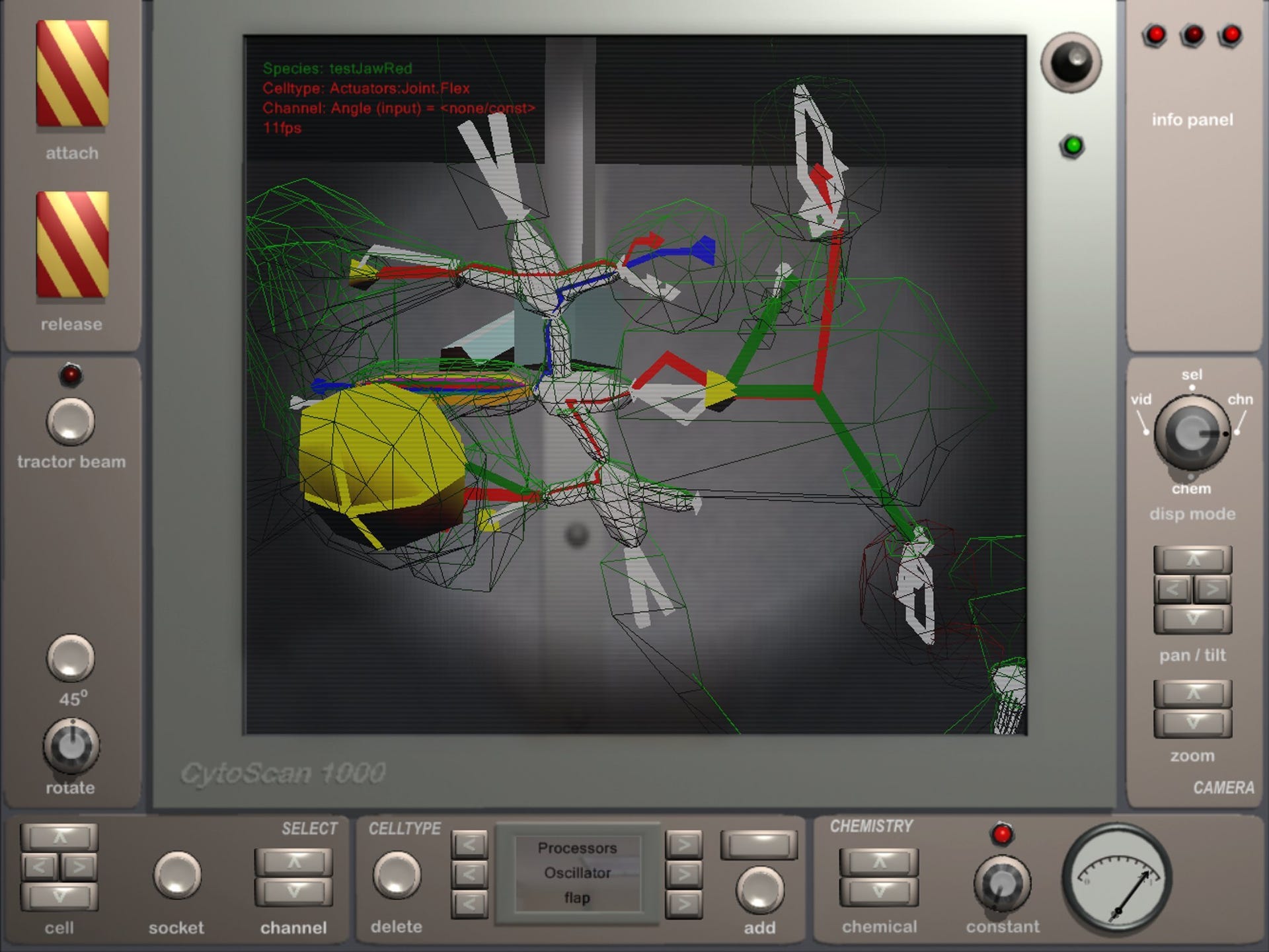
'Saviour Machine' Screenshot 1

To date, though, most developers opt for the easier option; beyond cost considerations, the general consensus seems to be that players only really want to be entertained, and won't bother prodding the simulation to breaking point if it requires too much thought. "And as a result," Grand continues, "games have reinforced the idea that intelligence is directly related to logic and that human behaviour is comparatively easily reduced to simple IF/THEN constructs. And people are easily fooled, up to a point. If you make something that looks spectacularly like a duck, using the best pixel shaders for feathers and translucency, and then you program it to quack every now and then, it's surprisingly easy for people to assume you've made a duck. I would prefer people to understand just how complex, astounding and sublime natural intelligence really is, and game AI tends to give the wrong impression."

In many cases, that's not such a big deal - after all, the complexity and beauty of a duck's natural intelligence is a suborder consideration when you're gunning over its spine in Gran Turismo. But Spore brought the issues of AI and life simulation back to the fore. Spore, after all, was fun, but it was a somewhat Fisher Price version of life simulation, and disappointed critics and gamers who felt the pre-release hype was hinting at a more complex game.

Interestingly, Grand was developing Simbiosis at roughly the same time. It was broadly similar to Spore in thrust, but his project looked a lot more like what the disenfranchised aforementioned had envisioned than Maxis' game. "I met Will Wright just before I started Creatures," Grand recalls, "and so I knew he thought in a very similar way to me, and liked creating emergent simulations. So, all the time, while I was developing Simbiosis by myself, I was terrified of what Will was going to achieve with dozens of programmers and artists. But in the end it seems like Spore is more of a mimic of life than an implementation of it."

Simbiosis, unlike Spore, went much deeper than cosmetic customisation. It was about creating organisms at an (almost) cellular level, and observing their behaviours as they interacted with each other. "The idea goes right back to about 1979," Grand explains, "when I first started to experiment with what was to become Artificial Life. I had an idea for a simple grid of cells that could interact with each other to produce a creature. The entire properties of the creature would be determined by the nature and arrangement of the cells - stinging cells, digestive cells, nerve cells, etc. I thought that I might be able to design creatures that could navigate by themselves, seek out food, protect themselves against predators and so on, by designing 'circuits' in much the same way that an electronics engineer designs an amplifier or radio circuit.

"But in those days computers and computer graphics simply weren't up to the task. I made some plants that could evolve but that was all. So when I found myself needing a new project to make some money, the fact that computers were now thousands of times faster and capable of 3D graphics made me revisit the idea."

Simbiosis' "building blocks" were, as Grand puts it, "sort of a cross between a cell and an organ. [Each] had a specific internal function - sensitivity to light, the ability to bend, the ability to convert one chemical into another, or whatever. And it had a set of channels, through which virtual chemicals could flow. These channels corresponded to the inputs, outputs and other variables controlling the cell. The output of a light sensor, for instance, would be a chemical whose concentration rose as the scene got brighter. If you fed that chemical into a muscle cell, the cell would bend in proportion to the amount of light.

"By combining these cells into simple circuits you could make creatures that swam towards light, or grabbed food as it passed overhead. But once you'd made simple creatures like these, you could become more adventurous and try to make other, more complex creatures, which could catch and eat the simpler ones. The game was based underwater, since that gives you lots of opportunities for different kinds of locomotion, etc., and you built the creatures inside a laboratory ship. Once you'd released them into the wild you could climb into a submersible and tour around studying them and debugging your design unless you wanted evolution to do it for you."

Unfortunately, due to shifting personal circumstances and waning interest, Simbiosis has been shelved. But Grand is apparently working on a new, unannounced project - potentially, from the sounds of it, a spiritual successor to Creatures. He isn't, admittedly, quite sure where he's going to take the project, but he will say this: "All I know is that it's 13 years since I finished Creatures and, in the meantime, computer technology, as well as my ideas about A-life and AI, have moved on quite a long way.

'Saviour Machine' Screenshot 2

"So I want to create some new creatures - hopefully the most advanced artificial life-forms on the planet - although that's not asking much; not much has happened since Creatures. I want to incorporate some of my ideas about how the brain might give rise to imagination and mental imagery, and how that drives intelligence. But I don't really know what it's all going to look like yet. I might open a pet shop and sell aliens, or I might do something else. Whatever it is, it will emerge. Life always finds a way."

Whatever shape his project takes, there is one mistake Grand is in no hurry to repeat - this time, he'll work alone and self-publish. Creatures may have reached a wider audience thanks to its Mindscape publishing deal - it was, actually, considered by Maxis at one point - but the rewards for Grand were minimal. "I'd rather have 100 per cent control and 100 per cent royalty on a small number of sales than be messed around by publishers and only get a fraction of the money from a larger sale," he says.

"I didn't earn a cent from Creatures beyond my salary and I've put years of work into developing my thoughts and ideas, so this time I really need some cash! But I think I have enough of a reputation and following to sell a modest number of copies to a small but passionate community, and I'd much rather do that than be part of a huge marketing machine."

Hopefully, we'll see a glimpse of this nebulous project in the not-too-distant. If Spore, after all, was the game to re-ignite interest in emergence and AI, then this may well be the title to fulfil it. Just don't tell SHODAN - you know how she gets when pathetic creatures of meat and bone get the better of her.

Comments (19) Latest comment 3 years ago

Comments threads automatically close after 30 days, but please feel free to continue chatting on the forum!

  • Bearintraining #1 3 years ago

    Creatures was cool, but quite boring as a game... it was more a screensaver or so. If I can remember correctly, there was a 2 which expanded things a bit, no?
  • SHNUFF #2 3 years ago

    very interesting article. from time to time someone has to speak up and tell the world they havent advanced a single line of code in the last 15 years. go grand! i loved everything you did and will support you ever more.
    until hes ready with his new project have a look at weka
  • Xerx3s #3 3 years ago

    "Just don't tell SHODAN - you know how she gets when pathetic creatures of meat and bone get the better of her."

    We still aren't on speaking terms. ¬_¬
  • secombe #4 3 years ago

    Interesting, for all the graphical advances, it does amaze me how little has been done with regards to AI in the average video game, especially given the power now available. Gran Turismo is a good example, for all the hype this game generates, they basically just rebuild a prettier version of the game each time, the AI is still as appallingly bad as it was on day one.

    I guess gamers at large are responsible for this, "we" demand graphical updates, they are an obvious advancement, even at an early stage when screenshots and video is released. AI? Not so obvious until you've actually played it.

    Although it's not AI based, it brings to mind the EA demo of Grand Slam Tennis, where many, many people here cried foul that it was faked...funny that they aren't claiming that now, and a competent gamer is able to do exactly what was shown in the preview. Like AI, responsive motion controls aren't immediately obvious to the average gaming fan looking at previews etc.

  • Kiigan #5 3 years ago

    I don't understand why this article seems to suggest that game developers should be researching AI. Fundamentally, "AI" is a very different field to what is sometimes termed "videogame AI" , with very different goals. For any company who wants to create entertainment, there isn't always a lot of overlap between the two areas.

    Of course there HAVE been plenty of advances in "videogame AI" over the years, but when it is done well you won't really notice, because that's the point of it. You'll just enjoy the game.

    In my opinion, to date there have been very few examples of "proper AI" actually yielding fun results in a game. If someone wants to piss about with learning systems and neural networks that's great, but such effort isn't always aligned (or even vaguely compatible) with creating a game that is entertaining and fun to play. In truth, often the crudest smoke-n-mirrors / finite state machine approach to "videogame AI" can produce the most fun results. There are always exceptions of course, but until such AI research is proven to yield entertaining game experiences, there's little to compel game devs to piss away money on it.
  • kangarootoo #6 3 years ago

    "I don't understand why this article seems to suggest that game developers should be researching AI. Fundamentally, "AI" is a very different field to what is sometimes termed "videogame AI" , with very different goals. For any company who wants to create entertainment, there isn't always a lot of overlap between the two areas."

    Very well put.

    "Realistic AI" is one of my two highest rated "stuff gamers say they want, when they don't really" (the other being open ended experiences). Entertaining AI is really what people want, and like you say, that orften has little to do with realism and if they are getting it they probably won't notice.
  • Doctor_What #7 3 years ago

    I remember Creatures. It made my girlfriend of the time cry when the damn things kept on playing with the monsters that made them sick, then her favourite norns died. I can't say they're particularly happy memories, but it certainly put emotion into games.

    Games usually rely on a performance of AI, not actual AI. If I were to play against a genuinely intelligent computer then all of my enemies would group together and rush at me, or never stand next to those conveniently explosive red barrels. Yes, it would be intelligent, but it wouldn't be any fun.
  • wittynic #8 3 years ago

    i admire his work but Grand comes across as a bit of a dick.
  • kangarootoo #9 3 years ago

    Just read this through in more detail, and there does seem to be sense that Grand is dismissing a lot of current game AI, not because its bad for the game but because it is "not real AI". So what, would be my big fat reply.

    I wouldn't call him a dick, but I do think he has lost sight of the woods.
  • sneetch #10 3 years ago

    @kangarootoo
    Just read this through in more detail, and there does seem to be sense that Grand is dismissing a lot of current game AI, not because its bad for the game but because it is "not real AI". So what, would be my big fat reply.

    I wouldn't call him a dick, but I do think he has lost sight of the woods.


    Indeed, real AI would not be fun in games. It'll be like going up against special forces in paintball.

    Imagine a game like Rainbow Six Vegas where both the player and the enemy AI have the same armour, health systems (including regen) and weaponry and the computer has "real AI" which we shall assume is limited to human levels (as in the computer doesn't "cheat" and only has the same level of skill and senses that a regular human has).

    This will not be fun for several reasons:

    1) The player is outnumbered several dozen to one by "real" opponents.
    2) The AI will coordinate the efforts of the soldiers under its command. They wont simply stand there waiting to be blasted apart like idiots.
    3) The AI will lay traps, even simple behaviour like not shouting "there they are" and opening up the moment they spot a player instead staying out of sight until the player is exposed, in the centre of the room or has his back to them or simply by taking careful aim rather than spraying lead in a random fashion.
    4) The AI will use proper tactics, again, even simple ones like where a bunch of enemy AI soldiers take careful cover and pin the player down in a doorway/behind a pillar using the same tools the player has (holding fire and aiming at where the human will pop out, then shooting him the moment he does for example) then simply flanking the player or else spamming grenades to flush them out.
    5) The AIs actions will be better coordinated than a team of humans.

    Either way a lone human will not have a chance against "real AI", try playing 1 against 15 in CS or COD. See how long you last.
    Edited by 1 at 13/07/09 @ 15:50
  • kangarootoo #11 3 years ago

    Absolutely.

    Even one on one, I would expect a "realistic" special forces AI to own my sorry ass every single time. I probably wouldn't even see where the bullet came from. :)
  • MyPointIs #12 3 years ago

    Not even movies show 'real AI', look at any action flick :-)
    Games discovered years ago that it was all about finely tuned Artificial Stupidity.
  • Sharzam #13 3 years ago

    We all want some sort of AI, in the most literal sense for example imagine halo or gears of war where the emenies walked into walls instead shooting you.

    But we dont need AI in the more scientific way that Mr Grand is talking as this may be more realistic but not nessarily entertaining.
  • SHNUFF #14 3 years ago

    "Of course there HAVE been plenty of advances in "videogame AI" over the years, but when it is done well you won't really notice, because that's the point of it."
    "But we dont need AI in the more scientific way that Mr Grand is talking as this may be more realistic but not nessarily entertaining."

    Has anyone here the slightest idea what Mr. Grand was talking about? Seems not. He never mentioned "entertaining" as any relevant goal of ai programming. This isnt about entertaining some fuckheads but doing some substantial research in this field. Gaming has relied on patterns (all the time for the better) to entertain, challenge and make the game what it is.
    The thoughts mentioned here in the comments is just the same shit dumb developers have done since the invention of the computer. Its fucking *possible* to think about it, maybe do it, so lets try.
    Either the results will be stellar, or, as now, irrelevant.
    Edited by 1 at 13/07/09 @ 19:01
  • smelly #15 3 years ago

    >i admire his work but Grand comes across as a bit of a dick.

    says the guy who comes across as a dick...
  • kangarootoo #16 3 years ago

    @SHNUFF

    You need to calm down a bit.

    Nobody is saying Grand's efforts aren't laudable (well, except the guy that called him a dick, but we'll ignore that). Its just that they don't apply to games, which is kind of the focus of the article.

    Grand may not give a rats ass about games, and yet he has and in the future will again, release them.

    Its all relevant to a wide ranging discussion. So have a glass of milk and count to ten. Then maybe you can join the discussion like an adult instead of an angry fuckhead (to coin your own).
    Edited by 1 at 14/07/09 @ 10:39
  • ChrisOTR #17 3 years ago

    SHODAN. Oh man, that was the pinnacle of my gaming career. Must've bought the first System Shock 3 or 4 times by now...
  • LordDante #18 3 years ago

    When will we see the next system shock?
  • Sharzam #19 3 years ago

    @kangarootoo

    I totally agree.

    @SHNUFF

    Neither myself or the majortiy of the other posters here have said that the research of AI is pointless we just simpley saying that what AI in the terms of 'real' intelligence is not nessarily part of gaming.