Sakura Wars: So Long, My Love
Mecha critic.


The thought process behind the conception of the Sakura Taisen series is obvious. Combining two Japanese loves (dating sims and big robots), it's little wonder the franchise has spawned multiple spin-offs, a film, a TV show, manga and other merchandise in its homeland. It's equally unsurprising that such a quintessentially Eastern idea has never made it to the west.
Until now, of course. There seems little rhyme or reason behind the localisation of the fifth game in the series bar its setting: a steam-powered alternate-universe New York. But it's about as idiosyncratically Japanese as a game can get, combining turn-based mech combat with doe-eyed anime flirting and more elliptical pauses than your average Cing title... Well, perhaps not that many.
Structurally, it's laid out like a seven-episode season of the anime series, each chapter focusing on an individual character, with an over-arching story about evil forces threatening New York. The city's capitalist opulence is deemed to be the perfect breeding ground for dark auras, or Pneuma, which a demonic enemy is determined to use against it. DS visual novel Lux-Pain explored a similar concept recently, but perhaps the most appropriate comparison is the Persona series, which also offers two discrete play mechanics that influence one another.
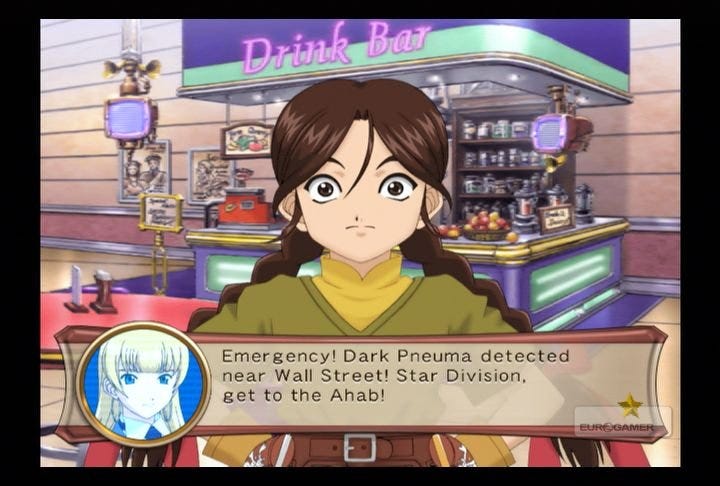
The dating sim segments make up the bulk of the game, as young, idealistic Japanese soldier Shinjiro Taiga is inducted into the New York Combat Revue: a team fighting the forces of darkness under the cover of a theatre group, obviously. By day you'll engage in lengthy chats with an almost exclusively female cast, building relationships which affect the potency of your cabal in battle. Dialogue sequences are presented in a style familiar to fans of the Ace Attorney series, with anime characters shouting, winking and blushing against static backdrops.
It's all very wordy, but it's not simply a case of tapping through reams of text. Every so often you'll be prompted into choosing a reply from two or more different answers. Pick well, and you'll hear a short jazzy musical sting as you go up in the estimation of your colleagues, with a slightly extended jingle for a particularly well-judged response. There's an interesting twist on this concept in certain key questions where the force of your response can be selected with the left stick. It's called Analog LIPS, which sounds like an eighties electro-pop group.
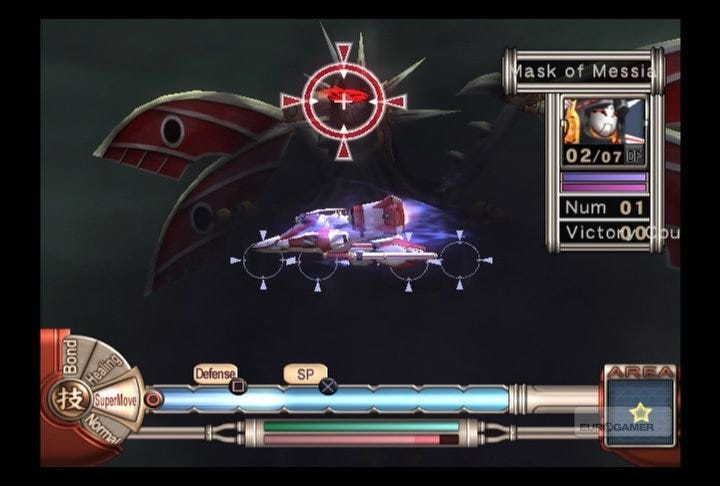
Meanwhile, sections which require actions rather than words play out like Quick Time Events, with a meter gradually filling up as you input commands with the left analogue stick and the remote's d-pad. There's a classic controller option which makes the right-stick commands a little easier, but curiously the game doesn't adjust any of the control descriptions elsewhere, which can get confusing as the button commands are naturally mapped differently in both set-ups. The only real concession to the Wii remote's unique capabilities arrives in sections where you can use the pointer to examine scenery (or cast your eyes over various parts of your current partner's anatomy).
While some conversations can drag on, the pacing is usually fairly brisk. Periodically, you'll be asked to explore the city, often to look for a character or an important item. With horribly basic low-poly characters and backgrounds, these sequences are among the game's weakest moments, and they don't just disappoint from a visual standpoint. Because most of them are time-limited, with few clues as to where best to look, it's easy to end up wandering aimlessly and missing key conversations, bringing about negative responses from companions and theoretically reducing your chances in battle.
Note: theoretically. In practice, your team's performance is rarely entirely dependent on what's gone before. An attack may gain power if you've forged a good relationship with another crew member, but the difference seems minimal. With most chapters focused on you sorting out one girl's problems by hook or by crook, only the most inept players will fail to get some kind of relationship boost by the time the episode's climactic fight begins.
Only someone wilfully playing as a lecherous perv or an aggressive, unfeeling prick will prevent the team from functioning effectively as a unit, which makes your choices feel somehow less important - at least until the final chapter, when you finally get the chance to ask your favourite girl out on a date. (For the record, I plumped for schizo redhead Gemini, though if you've more of a thing for blonde women in uniform or even androgynous types who refer to themselves in the third person, your tastes are well catered for.)