Rooms: The Main Building Review

Sliding doors.

Version tested: DS

The slide puzzle: crutch of every tired, lazy or creatively bankrupt game designer. Used to bulk out countless adventure games, these pictorial conundrums - in which you slide tiles one by one around a bordered play area while attempting to arrange them to create a picture - predate videogames by some margin. And yet there's gold in these simple clichés for the talented contemporary designer to uncover, as their occasional appearances in the Professor Layton series have demonstrated, with some cute twists on the antiquated formula.

Rooms: The Main Building goes one step further by attempting to build an entire game around the slide puzzle template, one complete with its own narrative, characters and film noir ambiance. Not only that, but its Korean designers layer new mechanics on top of the core slide puzzle system, multiplying its complexity in an effort to, presumably, match its aspiration to a full-scale DS release. Ambitious? Yes. Successful? No.

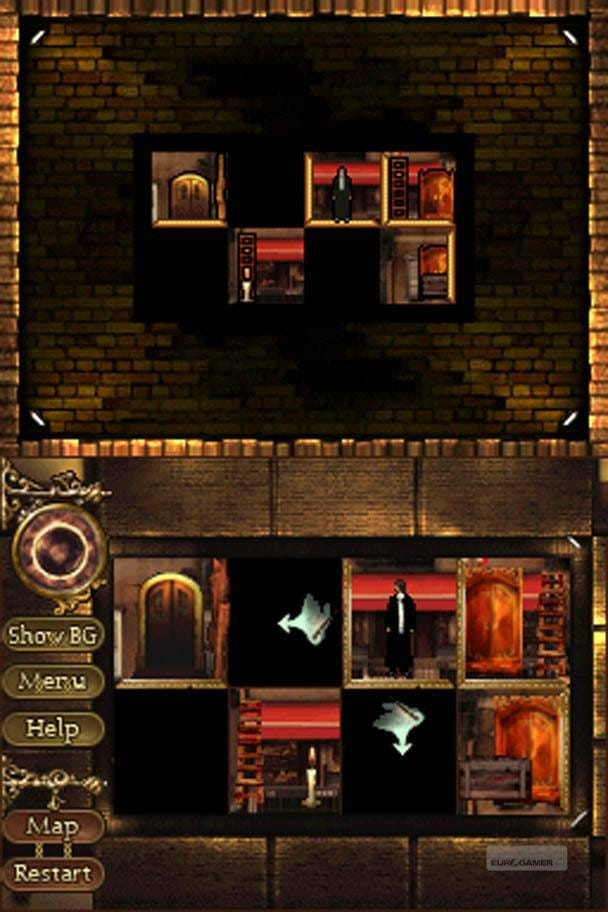
Those who abhor this micro-genre will relate to protagonist Mr X, who finds himself literally trapped within the puzzles, desperate to escape their transient confines. The primary aim in each puzzle is to guide Mr X to the exit door, contained within one of the slide tiles. To do this you'll need to slide the tiles around the board in order to create walkways for Mr X to traverse.
1

Fail to evacuate a tile before a stick of dynamite explodes and you'll be greeted with a mocking Game Over screen that does little to endear the scriptwriters to you.

Some tiles have walls on one side or a solid ceiling or floor, preventing access to the adjacent tile. Others contain ladders allowing you to climb up into the tile above. Each puzzle is solved by manoeuvring tiles in such a way as to allow Mr X to make his way to the exit point, the solution arrived at either by a process of trial and error or careful planning, depending on your approach and mentality.

Initially, levels contain just a handful of tiles, complexity scaling as the game progresses through the introduction of more tiles per level, and more interactive features within those tiles. Telephones allow you to teleport from one tile to another, while stepping into a wardrobe will swap that tile with a second, rearranging the play area without the need to move any other pieces.

Tinderboxes positioned next to weak walls can be destroyed with a stick of dynamite picked up elsewhere in the puzzle, thereby creating new walkways. Then, of course, these gently imaginative metaphors are bolstered by endless key-and-locked-door aspects to each puzzle. By layering these features on top of the slide puzzle, the density of each puzzle is increased, until you're juggling a dizzying number of considerations while groping around for a solution.

Almost every stage in the game has multiple solutions. As a result, a secondary aim is introduced to each, one based upon the more traditional slide puzzle endgame of completing a picture with the arrangement of tiles on the board. Each tile is painted with part of a street scene. Correctly arrange the tiles in each puzzle and you'll complete the scene. Manage to guide Mr X to the exit door while leaving every piece in its correct position then you'll be awarded with a 'gold' map piece, indicating that you completed that particular puzzle in the way the designers intended.

Herein lies the first of Rooms' debilitating flaws. The presentation is so poor, with the board and tiles constricted to an area around half the size of one of the DS' screens, that it's almost impossible to see the detail on each tile. The sprites have a kind of waxy, sub-SNES Donkey Kong look to them, making it very difficult to ascertain whether a piece is depicting, say, a section of pavement or a bridge.

This creates an unnecessary barrier to completing each puzzle, as not only are you working out where each tile is supposed to fit, and indeed how Mr X can move through them to reach the exit, but also what each tile depicts, which is both unnecessary and frustrating. There is also a clear tipping point where puzzles that have been manageable and somewhat rewarding to solve tip over into frustrating shuffles of trial and error, the sheer number of variants and steps towards a solution too numerous for any player to foresee.

While the structure of the game is fundamentally sound, presenting 60 core puzzles spread across four worlds or 'mansions' as they're known here, the theme and story itself is awkward and adds little to the experience. Mr X is guided by a floating, laconic leather-bound book, and tasked with throwing wood chips he finds for solving some puzzles into a sleeping treasure chest. Throw enough wood chips into the chest and it will spit out a jigsaw puzzle piece, unlocking new puzzles to solve.

2

The introduction of a subway train running through one level is inventive, requiring you to step onto and off the train as you pass through different tiles.

The Lynchian ambiance of the game and fractured, weird narrative sets a peculiar, claustrophobic tone that sits well with the puzzles in which you're trapped. But that lack of satisfying pay-off bespeaks a young development team - indeed, the core staff are fresh out of Korea's Sungkyunkwan University - too inexperienced to tie up the loose ends of their chosen premise.

So, the slide puzzle: crutch of every tired, lazy or creatively bankrupt game designer? Not on this evidence. The developers have clearly dug deep into the ancient formula in an effort to tap new, undiscovered streams of potential. And they are on to something. The core concept is robust and the ways in which the team extrapolates from it are often interesting and unique.

But there's just not enough here to sustain a whole game, a problem exacerbated by the ruinous presentation, lacklustre graphical assets and fractured storyline layered on top. With the promise of an expanded version for Xbox Live Arcade, one hopes that the team can find a way to repackage its ideas in a more palatable manner. But whether that is a puzzle worth solving is another matter entirely.

4 / 10

Read the Eurogamer.net scoring policy

Comments (44)

Comments for this article are now closed, but please feel free to continue chatting on the forum!

  • Loading...hold tight!