Retro Game Challenge Review

Something old, something new.

Version tested: DS

Shinya Arino is the man Dr Kawashima might have become if he'd blown his student loan on shoot-'em-ups and Mario plushies, and spent all of his time playing videogames at medical school instead of studying. Like Kawashima in Brain Training, Arino presents his game in the form of a disembodied head, issuing challenges designed to test your reflexes, nerve and cunning. But while Nintendo's health-'em-up is concerned with testing your mental dexterity, Arino's purpose is simply to test your skill at videogames, specifically the kind of 8-bit Japanese classics of the mid-1980s.

It's difficult to pinpoint exactly when nostalgia became an aesthetical choice for contemporary game developers. But titles such as Capcom's Megaman 9 prove that a return to the rudimentary sprites and chiptune of the medium's beginnings through design rather than necessity can yield compelling results. Retro Game Challenge takes the 8-bit pastiche to its extreme, presenting an entire collection of Famicom (NES) titles that never were; new creations dressed as old ones, each one given a fake release date and make-believe magazine coverage. Precision-designed to appeal to 25-35-year-old gamers, Retro Game Challenge seeks to recreate that heady experience of being an 8-year-old hardcore videogame fan in the 1980s, a task to which it applies itself with thrilling relish.

Retro Game Challenge is based on a Japanese retro gaming television show, Game Centre CX, of which Shinya Arino is the presenter. At the start of the game Arino winds the clock back to the early 1980s, just as Nintendo's Famicom is gaining widespread popularity around the world. Here the young Arino and your character sit cross-legged on tatami mats in his family home, staring into a 14-inch CRT television set playing the latest titles together in that innocent and unquestioning way that only two 8-year-old gamers can.
1

GameFan includes so much useful information that the game gives you a memo pad on which to organize your preferred cheat codes, level-select passwords and other nuggets of useful data.

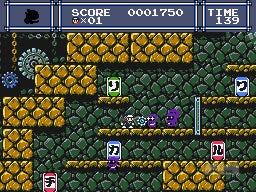
To begin with the young Arino owns just one cartridge, a Galaga-style shoot-'em-up called Cosmic Gate, but, as you clear challenges you're given access to new fictional Famicom games across a variety of genres. Each title parodies an actual classic, the top-down racer Rally King taking off the Famicom's Grand Prix II, the vertical shoot-'em-up Star Prince loosely based on Star Soldier and the JRPG Guardia Quest heavily influenced by early Dragon Quest. In every case the parody is pitch perfect, from the awkward Japlish text that punctuates the intro and outro of each title, to the expressive sprite work and authentic in-game fonts.

The adult Arino (he of the disembodied head) tasks the player with four challenges for each game. These must be tackled and completed in an order, each successful completion unlocking the next objective. As with contemporary achievements and trophies, Arino's challenges encourage you to play the game in interesting and unusual ways. While some challenges simply require you to pass a certain score threshold or to complete a set number of stages, many are more creative, asking that you complete a level without using a certain move (such as drifting in Rally King XP, or throwing a ninja star in Robot Ninja Haggle Man) or that you find and save your game in a remote town in Guardia Quest. No task takes more than 20 minutes to complete and many take a great deal less time, ensuring that you rarely get bored of your assignments.

Every time a game's challenges are cleared the calendar rolls forward a few months and the young Arino presents you with the latest issue of GameFan magazine. Written in the undemanding style of a mid-eighties game magazine for young boys, it perfectly parodies the tone of the era. Sub-plots are introduced as you read of editors leaving for rival magazines or heading off into development while young staff writers make their way up through the editorial ranks. These stories lend the nostalgia verisimilitude while the content of the magazine - timesaving tips and cheats of the games you're working through for Arino - prove an invaluable asset.

The game perfectly captures the sense of build/release excitement felt by the young consumer. The young Arino's anticipation for newly announced titles is infectious. He palpitates at the mere whisper of a new game, trading techniques and secrets for his current favourites with friends in the school playground (relaying them to you breathlessly each day) and following the exploits of professional gamers through GameFan's pages. His unbridled enthusiasm for the hobby is inspiring, and yet more evidence of the developer's skill in appealing to the older gamer's younger and, perhaps, more gullible self.

2

The developer's picked a timeframe in videogaming's development. Over the course of the game you'll witness the invention of a rapid-fire button, to the release of the first jointly created JRPG from two titans of the business...

The eight games themselves are strong enough to stand alone from the joke of their pastiche. While Rally King SP, released as a giveaway to random GameFan subscribers as a commercial deal with Inokichi Noodles, parodies the popular sponsor-driven variants of the Japanese Famicom era, the racing itself is precise and enjoyable, ensuring that you'll want to play the game even after the challenges are cleared. The satire is a bonus. When your character asks Arino what the difference between Rally King and Rally King SP is, he answers: "Awesome commercials are inserted between races!” It's biting commentary on the state of the videogame industry, albeit, um, the Japanese videogame industry circa 1986.

The games and their challenges are far easier than many bona-fide 8-bit titles and it's not until the last few that the average gamer will have any difficulty clearing tasks. Conversely, the mechanics are often more complex than titles of the era, perhaps bespeaking the fact that our expectations of retrogaming's depths today outstrip its more simple reality. Sadly, there's an over-reliance on sequels (perhaps yet more satire from the game makers?) and at least half of the titles you'll play in the second half of the experience are slightly enhanced updates of earlier releases (apart from Robot Ninja Haggle Man 3, which is a wonderful departure).

Once Arino's core set of challenges are cleared, each game is unlocked in a Freeeplay Mode. Here the game keeps track of a dizzying number of statistics, encouraging high-score attempts, but divorced from the focus of Arino's challenges the games suffer, revealing their inevitable shallowness. But unlike all other retro game compilations, the point of Retro Game Challenge isn't the compilation so much as the context and the commentary and an unapologetic celebration of gaming's formative days. In that sense it's a triumph, offering any gamer who grew up with videogames, whatever the era, a keen sense of that time. For many of us trying to recapture those childhood feelings of awe and wonder, Retro Game Challenge gets to the very heart of why we still play videogames and for that is to be applauded.

8 / 10

Read the Eurogamer.net scoring policy

Comments (31)

Comments for this article are now closed, but please feel free to continue chatting on the forum!

  • Loading...hold tight!