Resident Evil Archives Review

True survivor.

Version tested: Wii

One of the more heartening aspects of the continuing spate of GameCube re-issues on Wii is that it has given developers the chance to tweak games for the better. However mercenary Nintendo's New Play Control range initially appeared, there's no question that it's been an outright success, with the Pikmin games and Donkey Kong Jungle Beat given the thumbs up, while, shortly, the Metroid Prime titles will also benefit from an overhauled control system. Go Nintendo!

Another GameCube classic that we're definitely happy to have back is Resident Evil. Already a remake when it came out in 2002, Capcom was lauded for the way it brought its survival horror masterpiece up to date, with stunning visuals that enhanced the already creepy atmosphere no end. There are few better examples of the original old-school survival horror template in the genre, and hopes were that Capcom would perhaps go back and make an already great game even better with this second update. Enhanced controls? Surround sound? Widescreen? Having tweaked Resident Evil 4 to great effect for its Wii release two years ago, was it too much to ask for similar treatment?

Apparently so. Sadly, this mid-price offering is simply the old GameCube version in almost completely unaltered form. So, widescreen TV owners, that means playing in bordered 4:3, with stereo sound, and Wii remote support as opposed to enhancement.

The choices are as follows: play the game with the nunchuk plugged in to the Wii remote, unplug the nunchuk and turn the Wii remote on its side, or dig out either a Classic Controller or an original GameCube controller and play it that way. Other than that, it's exactly the same in every sense as the GameCube version that you could easily pick up for around half the price that Archives is currently retailing for (SRP is GBP 19.99, but online for under GBP 15).
1

Check out my new handbag.

Once you get over the numbing disappointment of this shovelware approach though, there's much to admire. For recent converts to the series, the first thing to point out is that this bears only superficial resemblance to the more focused, linear shooter that the series has gradually morphed into - for this is survival horror in the truest sense. Back in 2002, Capcom had barely budged an inch from the gameplay template laid out six years before when the series made its debut on PlayStation. That meant players had to deal with idiosyncratic design decisions which were at odds with other action games, but somehow combined to make it one of the most tense, rewarding and genuinely scary experiences around.

Resident Evil's original control system has always been a fertile source of discussion, and no wonder. You press forward to move forward, and back to move back, but pressing left and right rotates you in that direction, meaning that you move around with all the mobility of a tank. It was a problem then, and it still takes a fair bit of getting used to now, but once you master the quick 180-degree turn, you spend far less time running into enemies (and walls).

To add to the sense of haplessness, the game's use of static camera angles was (and still is) enormously disorientating. It afforded Capcom the opportunity to produce lavish pre-rendered backdrops that were otherwise generally beyond the 3D engines of the era, but although every incidental location was atmospheric and pleasing to the eye, it came at the price of rarely giving the player the best view of the action. In certain situations you could find yourself completely unable to even see the enemy you were shooting at, while sudden changes in camera perspective would create bizarre control contradictions where you would find yourself pressing the opposite direction to the one you were running in. All that remains.

Similarly hard to come to terms with is the limited inventory system, where someone thought it would be fun to let you carry just six items at once if you play as Chris, or eight if you play as Jill. In a game where there's an unholy amount of tat scattered to collect, this forces you to continually trot around dumping stuff at the nearest item box, and second-guessing what items you may or may not need. Unlike 2003's Resident Evil Zero, you can't simply drop things anywhere and come back for them later, it's a case of either using the storage box or bashing your head against the nearest joypad.

Another idea seemingly designed to cause intense player distress was and is the typewriter save system, where picking up ink ribbons and using them sparingly becomes a fundamental part of the resource-management system. Likewise, a piddling amount of ammo, and underpowered weapons, leaves players scurrying around like frightened mice, desperately trying to conserve ammo for when it's really needed - such as the traumatic boss encounters.

Resident Evil Archives has all of these quirks and more, but no matter how much you'll damn the eyes of Shinji Mikami and all his relatives, it winds up being one of the most strangely compelling games ever. Just as with many horror titles (including recent PS3 horror RPG classic Demon's Souls), Resident Evil succeeds precisely because it's unforgiving, challenging and bloody scary. It's a game that forces you to learn through exploration and through failure, and you'll discover that failure is usually your own fault - and even when it isn't, you'll know better next time. Success is always sweet.

It's also a game with a heavy emphasis on puzzle-solving - something which has gone lamentably out of fashion in videogames of this generation, including Capcom's. When you first play Resident Evil (or any of the pre-2004 Resident Evil games, for that matter) you'll find yourself boxed into a relatively confined area, forced to explore every nook and cranny for items of interest. It's a game where making notes is pretty much compulsory, as the labyrinthine layout of the mansion and its surrounding area frequently teases you with locked doors and curious contraptions that you know full well will be important at some stage.

But this is a game that takes time to fully appreciate. The near vertical learning curve and confusing layout can take hours to come to terms with. Simple things like not realising you should set fire to zombie corpses can suddenly make the game extremely (and unnecessarily) tough. Progress can suddenly reawaken enemies you thought had croaked, and their transformation into much deadlier opponents forces you to waste ammo and health that you need later on when things get properly tricky. Again, learning the hard way might prove too frustrating for gamers used to modern day checkpointing and recharging health.

2

Tell me about your childhood.

It's amazing how far apart this is from Resident Evil 5. That's not to say that Resident Evil is the better game, but for some gamers it may well be. The superb B-movie atmosphere, intriguing narrative and slower, brooding pace ensures the game takes far longer to unravel, but to get there takes a lot of care, a degree of trial-and-error and the Zen-like ability to deal with dated game mechanics. Once you get over the initial hump of dealing with those those controls again, it's completely absorbing.

Slowly unpicking all of the mansion's secrets becomes an obsession, and the lure of tempting unlockables means it's likely you'll be tempted to give it a second run-through as the other character. Clearly it's not for everyone, and many will remain baffled as to why a game with so many obvious jarring flaws gets so much love, but no one ever said enjoying games was a precise science. Sometimes odd recipes just work despite themselves, and that's definitely the case here.

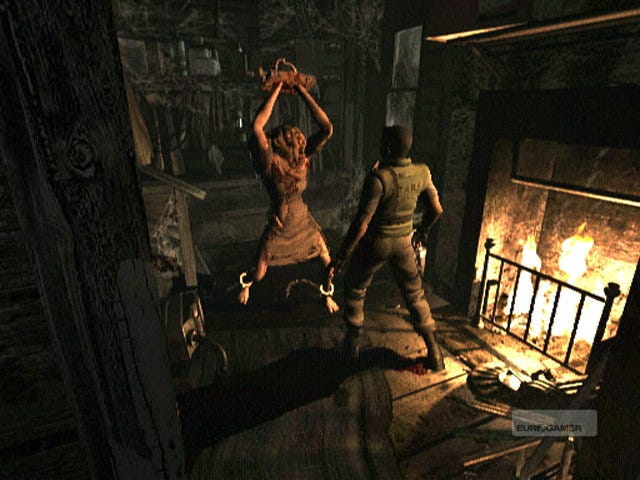
In many other respects, though, the game's appeal is easier to quantify. The crisp, meticulously detailed pre-rendered environments are still a delight, and somehow stand up to the horrible effect that many large HDTVs have on older titles. Similarly, the detailed character models still do the job, while the trademark giant boss monsters are as terrifying as they ever were. Add in the menacing soundtrack and perpetually eerie groans of the infected zombie horde, and it becomes easier to see why Resident Evil still has an immense impact and relevance all these years on.

As much of a shame as it is that Capcom hasn't bothered to enhance Resident Evil in any meaningful sense, there's no denying that this ageing relic remains one of the high points from the old generation of survival horror titles. Boasting an intense atmosphere, satisfying puzzles and nail-biting combat, it's a game that will linger long in the memory for those who succumb to its dark allure. If you missed out on this the first or even second time around, then now's the time to pick up a true classic - at the right price.

8 / 10

Read the Eurogamer.net scoring policy

Comments (67)

Comments for this article are now closed, but please feel free to continue chatting on the forum!

  • Loading...hold tight!