Version tested: DS
36 years on and there's still inspiration to be drawn from Breakout, Atari's formative, blockbusting arcade game that helped define the very vocabulary videogames have been jabbering ever since. A sort of inverse Peggle, with Bjorn the Unicorn swapped out for a missile-riding Tron nanobot, Reflect Missile does little to advance upon its primal inspiration's simplistic visuals. Instead, it snuggles up to the primitive 8-bit aesthetic, placing cool monotone green or red Amstrad blocks atop school exercise-book graph-paper backgrounds and soundtracking them with chiptune lullabies. Only the tiniest flashes of contemporary flair are permitted here: fading missile trails that bisect the screen or pixel-art fireworks that bloom when a stage is completed.
No, at 500 DSi Points, Q-Games isn't interested in turning Breakout into Virtua Tennis. Rather, it's interested in taking Breakout, snapping it apart and putting it back together again with some of the pieces back to front. The developers' ability to take a building-block genre and simmer it down to a zingy concentrate has been proved time and again by way of its PixelJunk suite of titles on PlayStation 3, which have variously reduced and reshaped tower defence, racing and shoot-'em-ups. While Reflect Missile doesn't bear the family name, it certainly shares the family likeness of its PSN cousins, adding a few precise rules and ideas to its inspiration to create something that's at once entirely fresh yet entirely familiar.
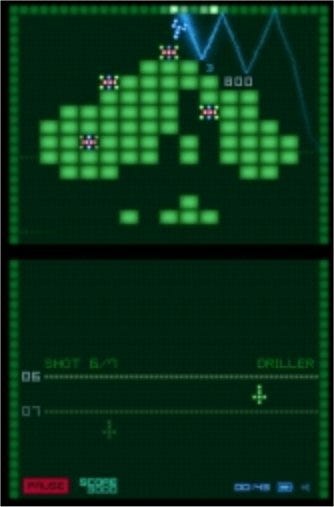
Sometimes you'll need to fire up to three missiles simultaneously, the challenge being to optimise each one's trajectory to reshape the play area.
The similarities to Atari's classic begin and end in the block-breaking objective. Here, rather than having to clear every hover brick in a stage, you have a handful of multicolored targets that must be destroyed. Usually nested in a bed of superfluous bricks, you have to use your limited number of missiles to strike at these targets. Missiles come in a number of different flavours. Reflectors bounce off the play area's walls a limited number of times, chipping away at surrounding blocks as they ricochet around. Drillers tunnel their way towards their targets, creating long gullies down which subsequent projectiles can be sent, while Bombers simply explode on first touch, taking any surrounding blocks with them.
In contrast to Breakout and its legion of clones, Reflect Missile is not a game of twitch reactions. Instead, you painstakingly line up each and every shot, angling the trajectory of each missile till it's perfectly in place, before releasing the stylus to launch it towards its target. Most levels give you just five or six missiles to play with, a tight restriction that moves the experience away from the ball-physics exuberance of Peggle to a far more austere puzzle place, one that requires first experimentation and then perfection of approach.
A score is awarded for each stage, multipliers triggering when you manage to hit more than one target brick within a single shot. However, the real prize is reserved for completing a level with some spare artillery left over, and it's in securing the full set of these medals that the game's true longevity lies. It's one thing to simply solve a level, but quite another to do it on a budget.
Initially it appears as though the core idea isn't substantial enough to populate an entire game with interesting levels, but Q-Games keeps the formula fresh by way of power-up blocks that, for example, can be used to double the number of missiles you have on a particular turn. The game then becomes one of risk/reward, deciding whether the cost of using a missile to secure a power-up can be sufficiently recouped in subsequent turns. As a result the number of possible ways to complete each stage is surprisingly broad, and you'll find yourself starting and restarting particular stages many times over in search of the ideal solution.
Reflect Missile is not without its annoyances. Oftentimes just a single pixel divides the perfect shot from a disastrous one, and settling on the precise angle you want can be frustrating without the ability to nudge the missile arc left and right one pixel at a time with the d-pad. This niggle is exacerbated when playing on public transport, where even the slightest jog can ruin what was otherwise a perfect set of turns. Right from the beginning the game demands rare precision, and a little more effort in affording the player ease of suitable level of control would have been welcome.
Bomb bricks will, when struck, destroy everything in their vicinity, like diminutive 8-bit suicide bombers.
While the package matches its utilitarian name with a sort of stark, prototype-style ambiance, it's anything but ungenerous, with no less than 200 stages available for those who can collect enough medals to unlock higher difficulties. A Quick Play mode removes the pressure of having to work through stark rows of stages, the game instead picking levels at random from each difficulty level's pot. But as with Slitherlink et al, much of the joy is to be found in the metagame of filling in the blanks with marks of completion.
This early into the DSiWare's existence, it's difficult to classify the sort of titles that will come to define the service. Reflect Missile, however, is a welcome possible answer to the question. More developed than a throwaway Flash game, yet less self-conscious and showy than a WiiWare or Xbox Live Arcade effort, it's a product that ignores the spectacle and bluster of gaming in order to more clearly celebrate the raw elegance of good design. As a result its ingenuity may be plainspoken and its perfections modest but neither can be reasonably denied.
8 / 10