Version tested: PlayStation 3
Unreal Tournament III? The other ones were on the PC, Mr PS3 Consumer. Of course you know that (I've always liked you), but some won't. That's the point; it was huge on PC, and Epic and Sony know that PS3's spangly new online network and ferocious hardware is ideal for establishing it properly away from its usual digs. So if you are new, the premise is this: a multiplayer-focused first-person shooter that takes established concepts like deathmatch, team deathmatch, duels and capture the flag, aims to do them very well, and moulds them into tweaked alternatives to establish variety.
When he wrote about the PC release, Jim began with the "feel", and that seems like one of the two or three most important points of discussion between Unreal Tournament III on its home turf and this ambitious US Christmas release on Sony's latest shelf-bending entertainment obelisk. There are a few elements to this. First is the control layer, obviously - and Epic has given us options there, with Sixaxis control the default but support for a USB mouse and keyboard combination for purists.
Except surely purists will be playing it on the PC? Well, they probably should. Mouse and keyboard here feels a bit imprecise. It works, but side-by-side comparisons may concern the aforementioned purists who aren't reading this anyway, and strangely input's only active in-game, with menus having to be navigated by the regular pad (probably one of those TRC things). Fortunately the Sixaxis does a splendid job if you use it for everything. FPS games are tricky to get right on a console, and the fact Halo did so well on its first attempt is one of the main reasons that game is so revered by Xbox owners. UT3 is another good example, with options to tweak sensitivity and turn-acceleration. The Sixaxis' motion-sensing makes an appearance too but in a slightly throwaway implementation that I disabled fairly quickly. Another thing to note is that the server browser can be ordered to exclude keyboard-and-mouse battlers.
The single-player mode has a ludicrous story which maps the absurd rules of competitive internet FPS to a sci-fi narrative. Very amusing.
The other part of the feedback loop Jim described to sum up feel is from the screen back to the player. Solid, chunky and fast, basically. Characters are like those in Epic's other colossus, Gears of War - there are certainly more than a few passing resemblances to Theron Guards, Locust troops and Marcus, Dom and Cole Train in how they appear and dress - and with that you're getting a feeling of gritty burliness when you're amongst other players, rather than the spindliness of some of the players you'd encounter in Resistance: Fall of Man or TimeSplitters. There's a fair amount to aim at, the sight of projectile impact (particularly the pacey rockets) is terrific, and everything you intend seems to happen with the ever so slightly absurd brutality Epic's last couple of releases have focused on. It's a bit like watching bodybuilders go paintballing, except the paintballs blow them into abstract husks of ribcage and improbable ketchup spills of lumpy organic refuse which disappear before any of it has a chance to corrupt your senses. There's certainly no Manhunt objection here - visually this is to real life warfare as Twiglets are to wood.
So we can say it feels good. It handles well, if you like. I had expected to go into bouts of the more complicated game modes like Vehicle CTF and Warfare - both of which we'll come to presently - with a certain amount of trepidation based on the typically different curve of difficulty on a pad-based FPS control scheme, but with the tweaks and success elsewhere in the loop it wasn't the case. A lot of that is to do with Epic's considerable talent for building arenas and a few sign-posting elements. Starting offline with the single-player campaign, you're given narrated overviews of each game mode as you begin, and there are trails of arrows to direct you between the significant objectives where it might otherwise be daunting. By the time you've conquered the first half-dozen tasks, any hint of trepidation has gone. It's certainly not that the computer-controlled bots give you an easy ride either - Epic's capture of talented AI designers early on in its life continues to pay off, with adversaries and team-mates who behave just as agreeably as most of the real-life players stumbling around online.
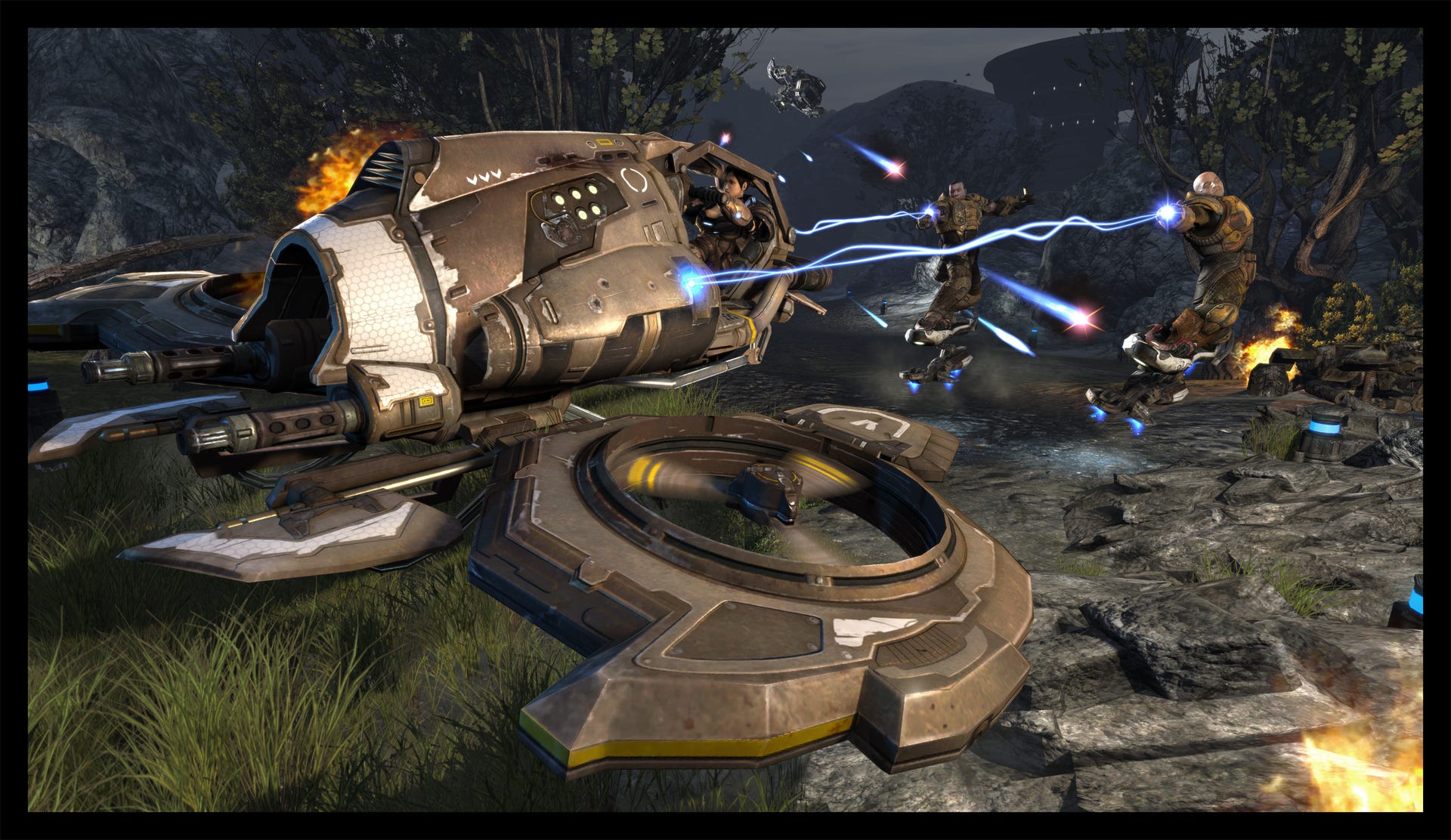
The Necris vehicles are completely brilliant.
Vehicles, weapons, arenas, controls - it's all very intuitive, could probably survive without the added layers of instruction, and significantly still feels natural when the diversifications from standard multiplayer FPS modes and equipment are asked to work together. Warfare is a splendid mode - I always found the old Domination mode, where you simply fight to control capture-points as a team, rather dull, probably because I've a tendency to want to take full control of the scenario myself, but Warfare doesn't present this problem because everyone 'gets' it quickly, and the dynamics of each element are engaging.
The idea is to capture, reinforce and defend central nodes to allow others to break through to the enemy stronghold and destroy their core. Extra nodes allow control of vehicles and turret guns on rails. Capturing, reinforcing and defending the pivotal nodes between opposing cores is a deceptively basic act rife with important considerations; the other side might try to push to the node with an orb that allows for its immediate capture, or they might try and take it down with the maximum possible strength of numbers, while your protection needs to include pumping the node with replenishing Link Gun rounds to stop it falling into neutrality, where a brush from an opposing team player would rotate ownership to them. Even the little design decisions, like forcing you to suicide to destroy an enemy's node-capturing orb if it's dropped, or waiting for it to slowly expire, speak to a lot of well-judged absorption of feedback from testing.
Vehicle CTF, too, is untroubled by the potential complexities of where the vehicles live, how they behave, how you can use them as a group, and so on. Even the bigger levels can be covered quite quickly on your hoverboard, which everyone gets, and the game seems to have been purposely built to minimise dead-ends and loops of repetitious architecture that might trouble your passage - a particular concern when it's the frantic passage of a man with the flag.
Even the power-ups, which I'm not usually a fan of in team-based FPS, are more frag than suicide. The one I liked most in previews - what I termed the "slow bubble", now the "Stasis Field" - is a novelty delight, slowing everything in its gelatinous grip, but also very useful for ruining chokepoints for your enemies, and others like the Shield Generator (similar to Halo 3's shield bubble) and Jump Boots are a positive influence. That's really the story of UT3: a lot of cool things that work well together, but don't have to be put together, and don't diminish your enjoyment if you do want or need to exclude them. Simply playing deathmatch or normal CTF is as much fun as I've had doing that probably since I was obsessed with Quake 3 Arena and, well, the first Unreal Tournament.
Perhaps the most important of the main things left to talk about is performance - both in terms of how the game runs on PS3 and how it plays over PSN. The latter's easiest to deal with - the server browser shows you pings, you pick a server, get on and it just works. Mileage always does vary with such things, but even playing from the UK (on my UK PSN account, incidentally) against folks in the States hasn't been the torture you might fear. It's been great fun, actually. There's a LAN option too, unlike Orange Box, including a LAN co-op option for the single-player campaign. Sadly there's no split-screen, but Epic says it's going to evaluate adding that.
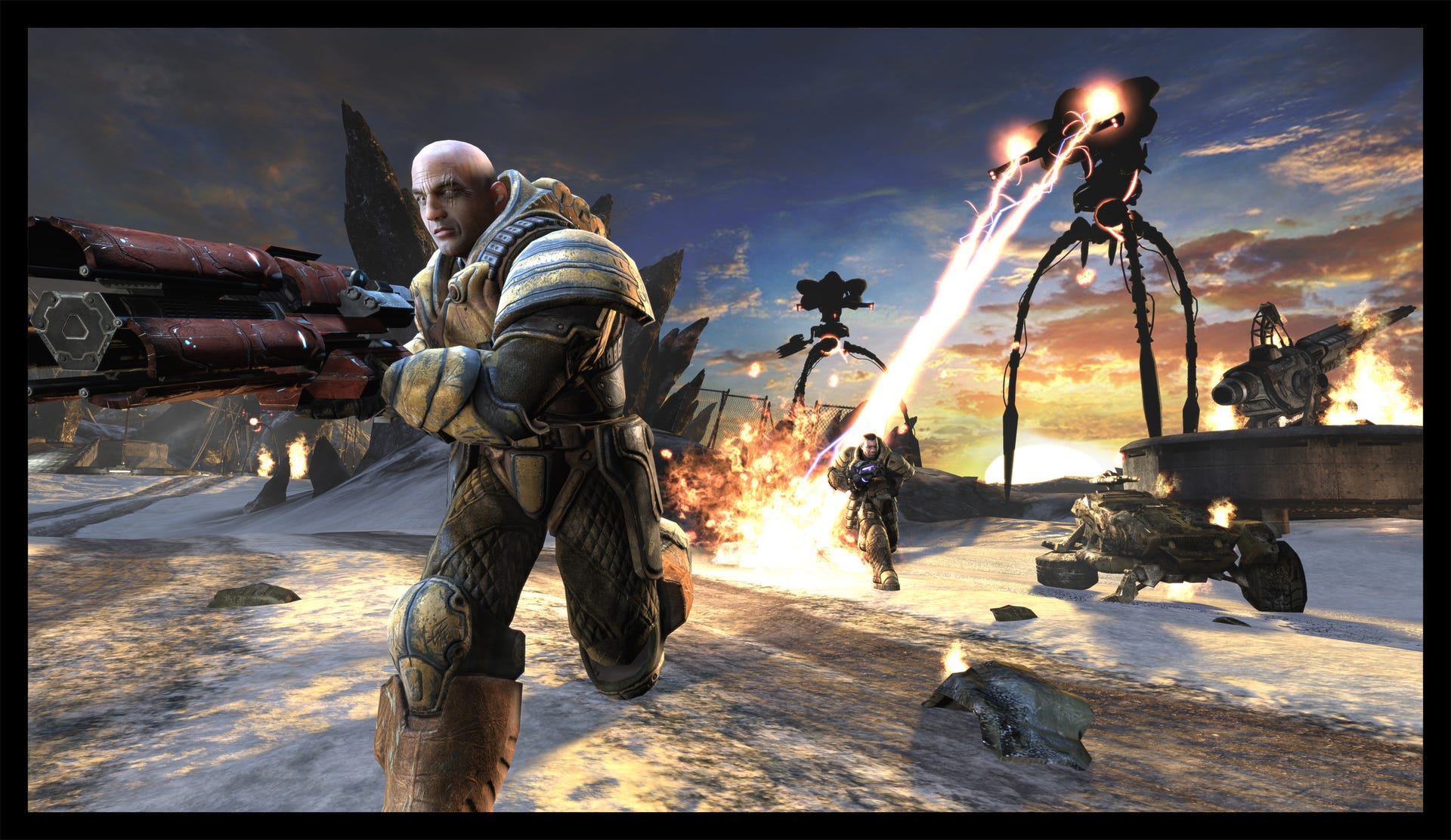
You wouldn't want to mess with the Leviathan. Unless you've got the Redeemer or something. God that was a rubbish caption.
The PS3 handles Unreal Engine 3 well too. Back at Games Convention, Epic's Mark Rein spoke of how Epic's development process on the engine for PS3 would probably hit performance crescendo with the release of UT3, because it would be the point that they were able to have dealt with all the significant issues themselves, enabling them to better help licensees going forward. How it worked with Gears of War and UE3 on 360, essentially. I haven't spoken to Mark recently, but he'd probably stick with that, and he'd be hard to argue with - the PS3 sometimes strains itself to load in textures, leading to noticeable pop-in, but you can install the game to the hard disk which reduces this considerably (albeit not entirely), and the flow of even intense combat is almost never disrupted by the frame-rate going for a bath, although sometimes when you're racing around with masses of bots on a huge map it notices the dirt on its neck and slips out for a scrub.
Really the only slight PC-to-PS3 negative is the absence of the mooted mod support at the time of writing - something Epic had to delay to get the game out on schedule. But then again, mods rarely emerge this quickly after release, it almost certainly won't be a problem when the game ships in Europe, and it won't actually prevent you from going back and trying out the older ones when it's worked out anyway. (And actually, just prior to publication Epic jumped the Sony legal queue and released a user-made map to give us a taste.)
Can anyone think of a good joke? Or even a bad one?
The other slight negative is more innate: sometimes the detail level is so massive that you struggle to get a grip on what's coming in from where. Epic's even had to highlight players with a weird gloss to help you pick them out. Removed from UT3 specifically, this has become an issue for FPS games as they've become more complex graphically, and in UT3's case the argument really needs to be made on whether the art is worth the imposed crutch. I suppose it is. An interesting minor point here is that sometimes the textures' initial struggle to pop in on PS3s which haven't done the hard-disk install can benefit you slightly by giving certain elements more clarity, but we're really scrambling for negatives if we nitpick that too extensively. Otherwise, the artistic direction is pretty important to how it plays, and while I think there's less acceptance of this kind of brash high-calibre macho composition on this side of the pond generally, I actually really like the stylised approach Epic's opted for with this and Gears. Elsewhere, UT3 could certainly do with Team Fortress 2's who-killed-you-cam post-death, but then so could everyone else making a multiplayer FPS.
The score, then. Jim went for eight on PC. I'm going for nine on PS3. I could fob you off and claim this is because the context is different. In fact, I probably ought to, because it's true: Team Fortress 2 isn't as effective in the PS3's slightly disappointing Orange Box release, although it's still a better multiplayer game outside of the platform question, and the alternatives (Resistance, most notably) don't do as much as well as this does. This feels like the PS3's new online FPS benchmark. But I've digressed - the other part of it is that I guess I like UT3 more than Jim, and he loved it. The fact we both do, and the PS3 version is as it should be, ought to give the console the boost Sony and Epic obviously wanted when their lawyers and money-men stripped off together, and while it's too late to get one in for Christmas, this would make a superb New Year's import. So whether you ultimately think it's an eight or a nine, the important point is that it's one of them for the people here who've played it, and either's a big, big recommendation.
9 / 10
