Version tested: PlayStation 2
To get noticed in a genre as saturated as the dear old first-person shooter, you've got to do things a little differently; mess with people's preconceptions, give them new toys to play around with, and challenge them with canny enemies that surprise us,
It's not enough to expect people to be wowed by incremental advancements, be they technology, AI or even narrative related, and damn the game to hell that dares to stand still. And if you really are going to make just another shooter, for pity's sake at least play the technology card so emphatically that we're prepared to forgive it for being just another shooter.
But in making Urban Chaos (originally known by the less than promising moniker of Roll Call) Rocksteady didn't really worry too much about raising any bars, cutting any edges or various other hideous, life-threatening clichés that may involve envelopes and boxes. Commendably, the Brit studio appears to have ducked the issue altogether by - ulp - doing things a little differently to everyone else. To our eternal gratitude, it's not a poor man's Half-Life 2. It's definitely not trying to be Doom, and Warren Spector wouldn't want to be seen dead anywhere near it.
So what is it, then?
Arcade action
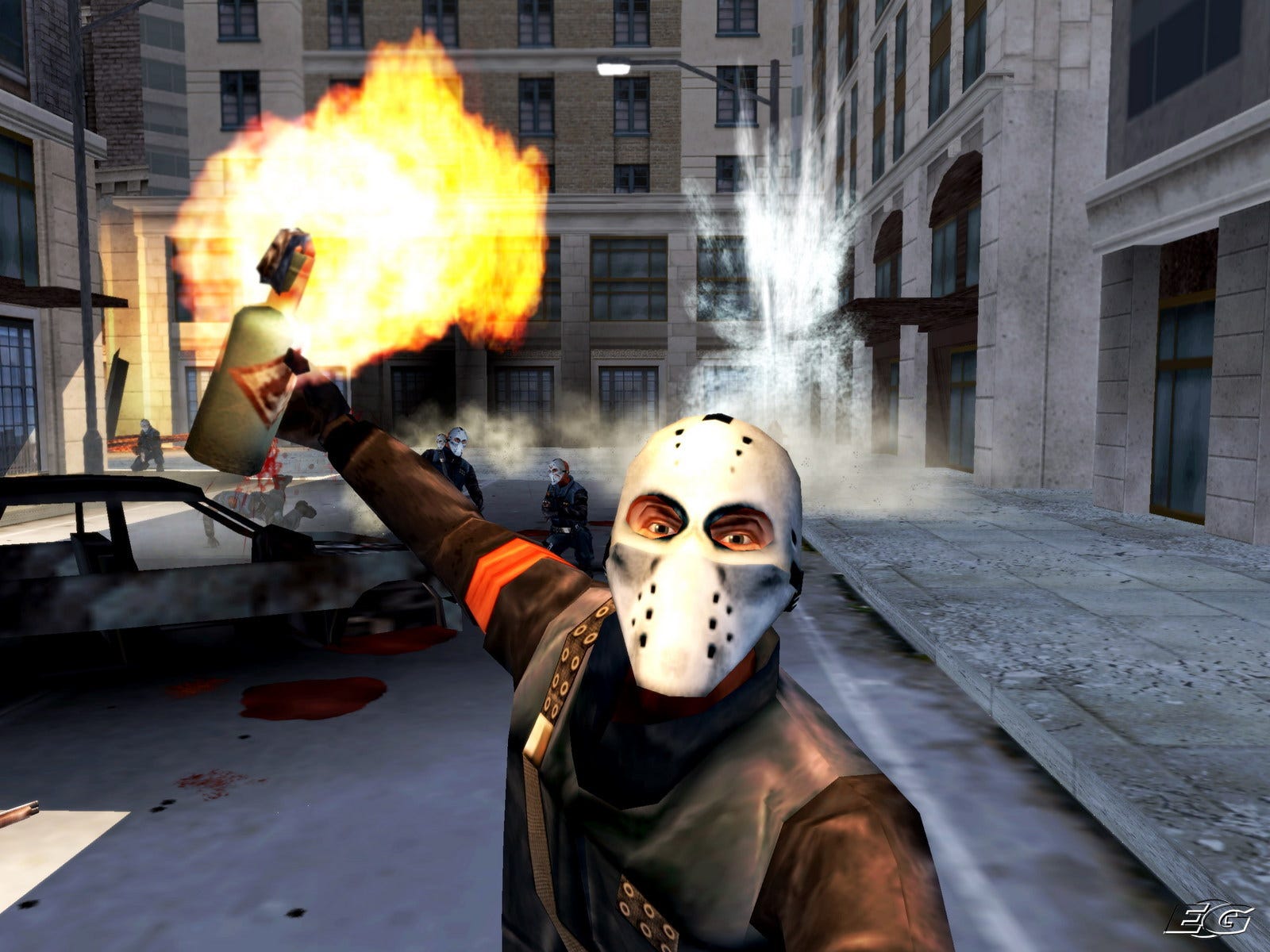
Wanna swig?
By accident or design, Urban Chaos feels charmingly old fashioned; not in a studied Serious Sam/ Painkiller-type way, but more like how you'd imagine first-person shooters could have been if Taito had taken its excellent light gun games like Operation Wolf and Space Gun off the rails. Whether intentional or not, anyone familiar with these crusty old arcade relics will recognise more than a gentle nod to the past. A past where unlocks, upgrades and medals are a means to an end, and short, sharp levels were meant to be replayed until you nailed things perfectly. The last time we played a shooter as unselfconsciously fun was the legendary light gun section of Die Hard Trilogy. That's not to say it's in that league, but the feel and the vibe is hewn from the same rock. It just wants to entertain.
Needless to say, you're one of the good guys sent in to see off the bad guys (the terrorist Burner gang). Intent on laying waste to half of the city seemingly just because they can, these hockey-mask-wearing goons lob moltovs, chuck cleavers at your skull, squirt flamethrowers, wield chainsaws and basically provide extreme aggression at all times. We suspect the parents of a troubled gang of death metal warriors simultaneously really pissed them off one evening by asking them how they were getting on with their revision. Before you know it, an entire city is in flames, innocents are being taken hostage and Lori West is reporting on the sorry events live for Channel 7 news.
Evidently, only the untested 'T-Zero' anti-terror squad can combat this bunch of slavering psychos, so it's up to you, Nick Mason, to assist the emergency services, rescue hostages and generally fire a lot of hot lead at hundreds of extremely aggressive and hilariously foolish perps willing to die for some entirely misguided cause. But that's videogaming for you. [Among other things. - Ed]
Medals of honour
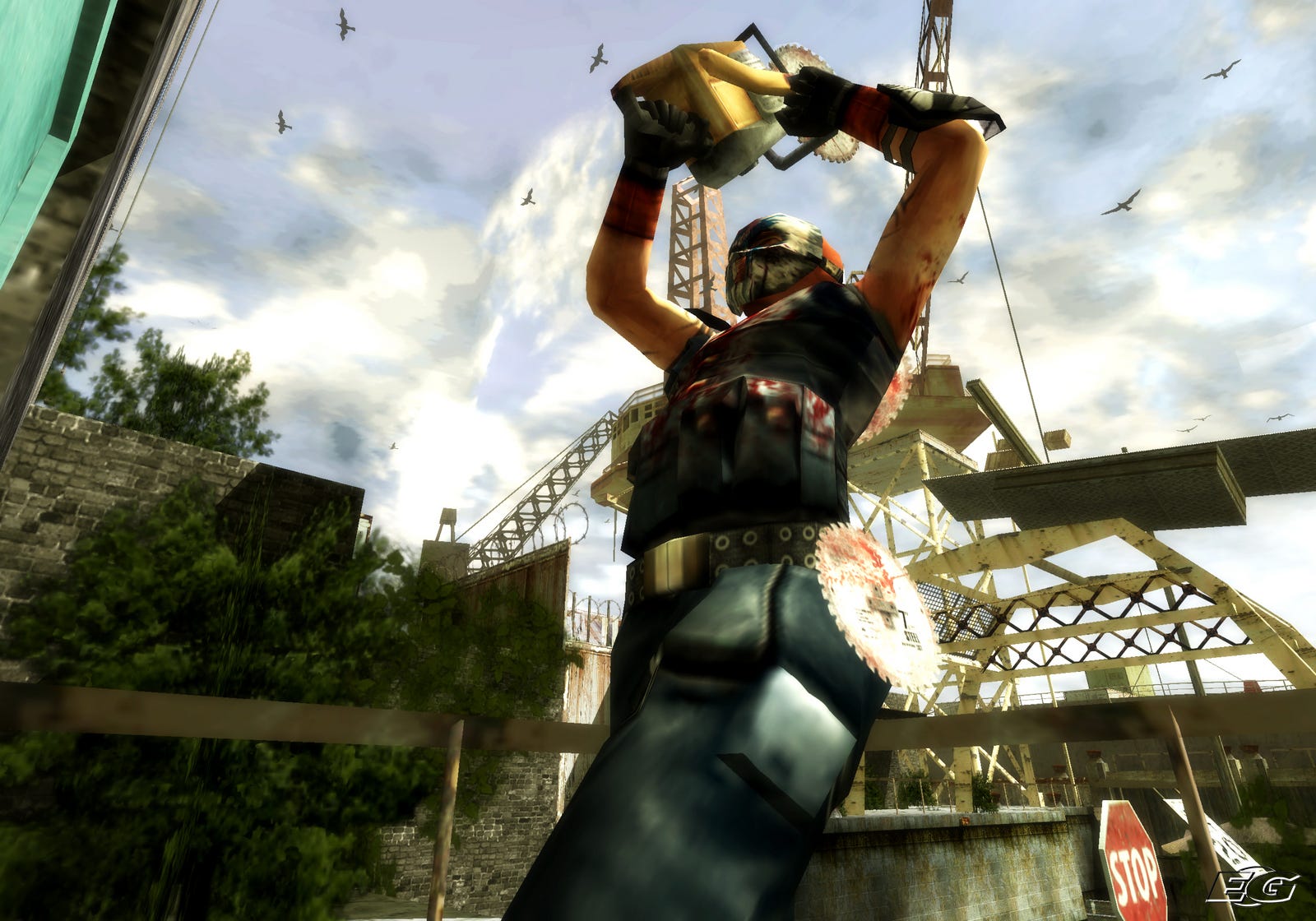
Training for the chainsaw Olympics in full swing.
Although based on well-worn FPS mechanics, medal attainment is as much a central feature of your endeavours as the killing spree that inevitably ensues. Each level gives the player a multitude of sub goals to go for alongside the main tasks, including rewards for a set number of head shots, secret gang mask pick-ups, along with medals for bringing down the level's gang leader alive, not using any continues or taking down the required number of gang members via arrest rather than simply gunning them down.
As you gradually clock up the medals after each level, new weapon upgrades get added to your arsenal, while bringing in gang leaders alive unlocks up to six brief against-the-clock 'Emergency' sub-missions to add to the 11 main story missions. Although it's not exactly the longest game ever made, it's fair to argue that it's one that doesn't outstay its welcome either, and the plethora of unlockables makes it one of the few FPSs you'll be tempted to replay in order to secure all the goodies on offer. Whether it's focusing on rescuing injured civilians from flaming wrecks, protecting emergency personnel, or engaging in the cat and mouse hostage situations, Urban Chaos always delivers punchy, bite-sized tasks where time is of the essence.
Rescuing hostages, for instance, features an interesting dynamic where the player must draw their riot shield and deflect the enemy shots while waiting for a window of opportunity in which to strike back. As soon as the enemy stops to reload, the action slows down for a few seconds to allow you to get a bead on them and chip away at their health. Get too close and you'll spook the aggressor into killing the hostage, meaning you have to work at parrying shots for a few clips before your inevitable moment of slow-mo death glory arrives.
Killing me softly
In fact, Rocksteady indulges rather too heavily in the opportunities to show off its ragdoll death animations in slow-mo, but at quick stab of the X button soon sees normality return once you tire of the effect. In its favour, though, Urban Chaos is one of the few PS2 shooters to employ Havok physics successfully, with crates, bodies and static objects flying asunder at regular intervals. All round, the engine deserves credit for pushing the creaking architecture with a number of impressive effects, such as heat distortion, particle effects and a consistently decent use of fire throughout. In such a tight, claustrophobic game as this, the developer keeps the focus firmly on detail. That said, once you've seen one burned out building you've kinda seen them all; it certainly won't win any awards for variety, put it that way.
The level design is patchy, too, with several drawn-out rescue scenarios forcing you to traipse around the same darkened smoky environments with little guidance of where to go, and thermal goggles that you'll barely use. Occasionally you'll rely on the help of willing firemen, who'll (using a simple d-pad command interface) chop through doors and barricades, put out fires, carry the injured and yank open shutters, but you'll often wonder why the game didn't just give you the choice of doing all of that yourself - you are the ultimate one-man army, after all.
Eventually, the sheer repetition of choking around the same dimly lit areas repeatedly will see you through, but the game is at its weakest when it forces you to do this. At its best, it's literally turning up the heat; pouring enemies at you from the flaming deathtraps and making it feel like a one-man-war in hell. When you're really tested to use your ammo wisely and accurately it feels a skilful, intense affair, but does occasionally run the risk of overstepping the mark with overly harsh checkpoint placement that results in dull and lengthy repetition. At its worst, you'll suss out rare (and rather unforgivable) instances where enemies respawn, where you're best to simply steam through an area rather than linger and try and take everyone down. But gaining such intimate knowledge of the inconsistent inner workings of Rocksteady's level design decisions can be a fairly drawn-out process during the game's more brutal tests. With patience and no small amount of head shot-based marksmanship, though, Urban Chaos can be a satisfying if wholly repetitive blast.
Don't believe the truth
Tazer them to toast. If you're sick.
With decent, but not remarkable shooting fun constituting a solid platform for Urban Chaos, where it starts to win you over is in the finer details. The knowledge that meeting the headshot quota gains you a medal makes you a better, more patient player. Likewise, trying not to kill Burners makes you change tact, too: you'll start to use the shield more to deflect enemy bullets and tazer them once you're up close, rather than wade in all guns blazing. And seeking out the hidden gang masks makes you a more thorough, exploratative kind of player, while going through the level without dying also lends a more old school arcade feel to the game. By layering the routine shooting action with all these extra tasks, Rocksteady subtly shifts the emphasis away from it being yet another run-and-gun slog against another bunch of identikit foe. With this more challenging, rewarding arcade structure encouraging replay, you can't help but like the game a little bit more than you would have otherwise. No-one would argue that it's the last word in action shooters, but plenty of rival developers will be looking at its excellent reward system and want to ape it in future titles. Sure, TimeSplitters has adopted a vaguely similar structure in the past, but Urban Chaos goes far beyond in terms of solidly and seamlessly integrating it into the main fabric of the gameplay - and ends up benefiting significantly.
Inevitably, though, a well thought-out reward system can only do so much for a game that's so determinedly repetitive throughout. Occasional changes of scene like the train level or the chopper fly-by shootout promise to up the ante, but, in truth, the well-worn dynamic of clearing a room full of suicidal, ultra aggressive foes wears a little thin after a few hours. Urban Chaos is one of those games that probably isn't best feasted upon (as we inevitably have to do in review situations), but sampled one chunk at a time. Played over a stretch, the general grind and repetition wears you down, whereas focusing on doing one level at a time - but doing it properly - can feel pretty satisfying.
Reproducing the Spiderman outfit was proving troublesome.
That said, anyone who's gorged on all the shooters out there will admire the positives that Urban Chaos has to offer, but struggle to justify rating it above some of the big names out there. Sure, the arcade structure's a big plus point, and the prospect of countless upgrades encourages you to play it in a completely different way than you'll be used to. Even then, though, you'll wince slightly at the uninspired level design or the one dimensional enemy AI which mainly charges headlong at you, or just stands around and waits for you to take your opportunity. There's no sense that you're facing a highly trained, tactically organised bunch of terrorists, but a dim bunch of thugs that want to jump off buildings and swear profusively at every given opportunity. At the very least, Urban Chaos deserved to have a better repertoire of enemy, and neither is it asking too much for Rocksteady to design slightly more interesting and varied levels. Bolting on basic, eight player online/LAN play doesn't hurt, but it's a) not a patch on what's already available in a dozen other shooters, and b) you won't find many people playing it online even if you do take the plunge.
Flip you, you melon farmer
A few hours of unsophisticated, expletive-strewn ultra violence is pretty good fun in small doses, but don't be surprised if you end up swearing like a sailor after prolonged sessions. Lengthy play of Urban Chaos is a double-edged sword, in fairness. You'll come to admire the arcade structure and the way it taps into gamers' motivations to unlock everything, but the longer you play it, the more you'll spot the cracks in the AI, the level design and some bloody weird bugs. There's definitely potential here for a more ambitious, big budget sequel for the next generation of consoles, but as things stand Urban Chaos firmly occupies that difficult 'rent it if you're in need of a shooter fix' category.
To get noticed in a genre as saturated as the dear old first person shooter, you've got to do things a little differently - sadly Urban Chaos doesn't quite go far enough.
6 / 10
