Stronghold 2
Gripping.

Order yours now from Simply Games.
Whenever someone mentions Stronghold, two facts immediately jump to the fore of my consciousness.
Firstly, the original Stronghold apparently managed to outsell Grand Theft Auto III in Germany. Despite its regressive tech-base and distinctly unglamorous premise, the economic powerhouse of central Europe far preferred to make economic houses of power than join the rest of the world in beating up prostitutes like good little consumers.
Secondly, apparently four monarchs listed cause of death is by consuming a "surfeit of lampreys". One would be enough, but the idea that four bluebloods would chomp down upon piles of slithering eels to the point where their guts just burst is completely bewildering.
Like most of my favourite facts, I'm not actively interested in discovering whether either is actually true. Believing that a chirpy niche RTS/Management game can outsell the Biggest Game In The World in the right marketplace and that lampreys really are that moreish just makes the world a better place. Stronghold 2 features lots of suitably Teutonic construction married to conspicuous consumption of lampreys. As such, despite the many places where it conspicuously misplaces brick, it garners affection.
Most of which originates in the founding stone. Firefly noted that somehow no-one had bothered to do a citadel-construction game since the ancient Interplay demi-classic Castles (or, if you were to be particularly lenient, Atari's Ramparts. And you'd have to be really lenient). Despite its half-sequel Crusaders, Stronghold is very much in a niche of its own, with no competition worthy of the name.
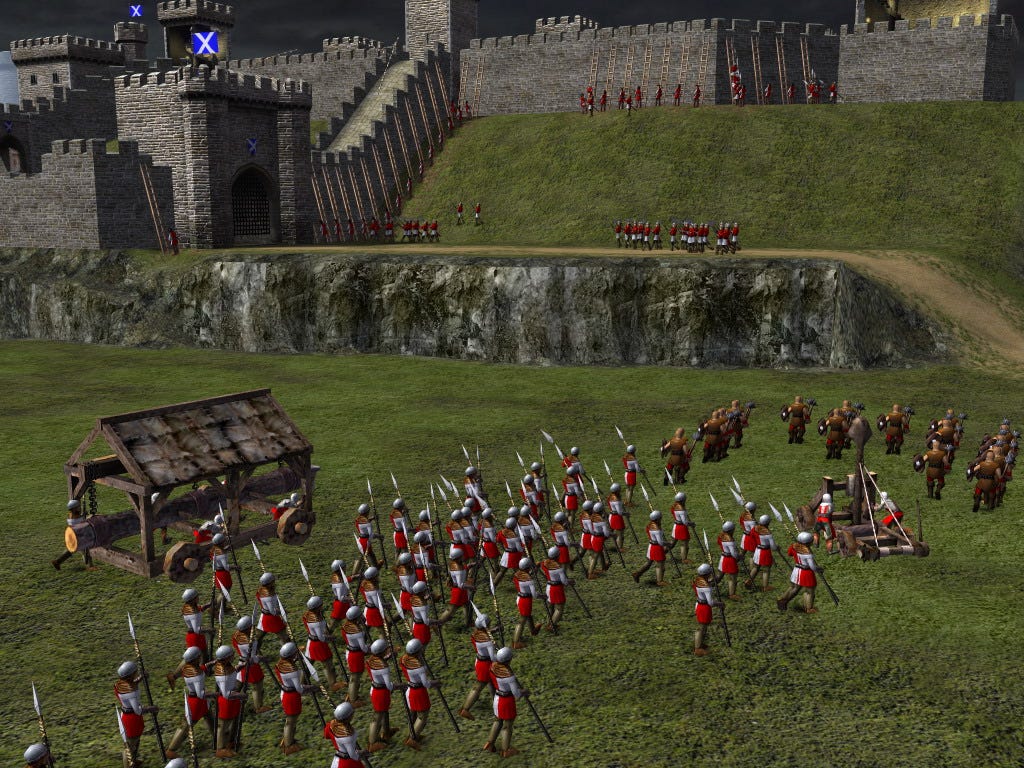
The biggest change is the most obvious. Rather than flat sprites, we're introduced into a world of vibrant polygons with both Gourad and Phong shading (Note to Technical Editor: Check this. Haven't been keeping up to date with meaningless tech buzzwords since 1993 [I would rather expose your lack of research. -Fictitious Technical Editor]). The only problem, apart from the fact that it's all a tad demanding when enormous catapults rocks start reducing stone walls to individual chips, is that it's a little easy to miss a one-square gap in your defences, which an opposing army immediately marches through. Well... unless you've been using the top-down plan view like a good little medieval architect.
Thanks to the graphical advances, the actual castle and its surrounding support structure seem more convincing than ever. Much like the original, and recent management game Children of the Nile, there is a huge amount of detail thrown into the activities of the individuals. For those who can't afford a trip to York and the Jorvik Viking centre [oh so you'll research that -Ed], this is the closest you'll get to seeing hunters hunting, fletchers fletching and gong-collectors... well, collecting gong.
"Gong" is one of the things you'll find yourself worrying about in Stronghold 2. As your community grows, they'll start leaving cheerful piles of muck over the place, which needs collecting. Fail to do so, and everyone's happiness falls. Understandably, as no-one likes the famous medieval complaint of poopy-feet. If it really builds up, you start seeing pestilence, which really ruins everyone's day. This balance between happiness and unhappiness is actually the core of the economics in the game. While there are a serious amount of resources which are manufactured (for those disappointed in the recent pseudo-Settlers, this is a far better candidate for your attentions), the balance between the positive and negative aspects of your rule is what decides whether you keep going or fall over. Essentially, if popularity drops beneath 50, people start leaving your settlement.
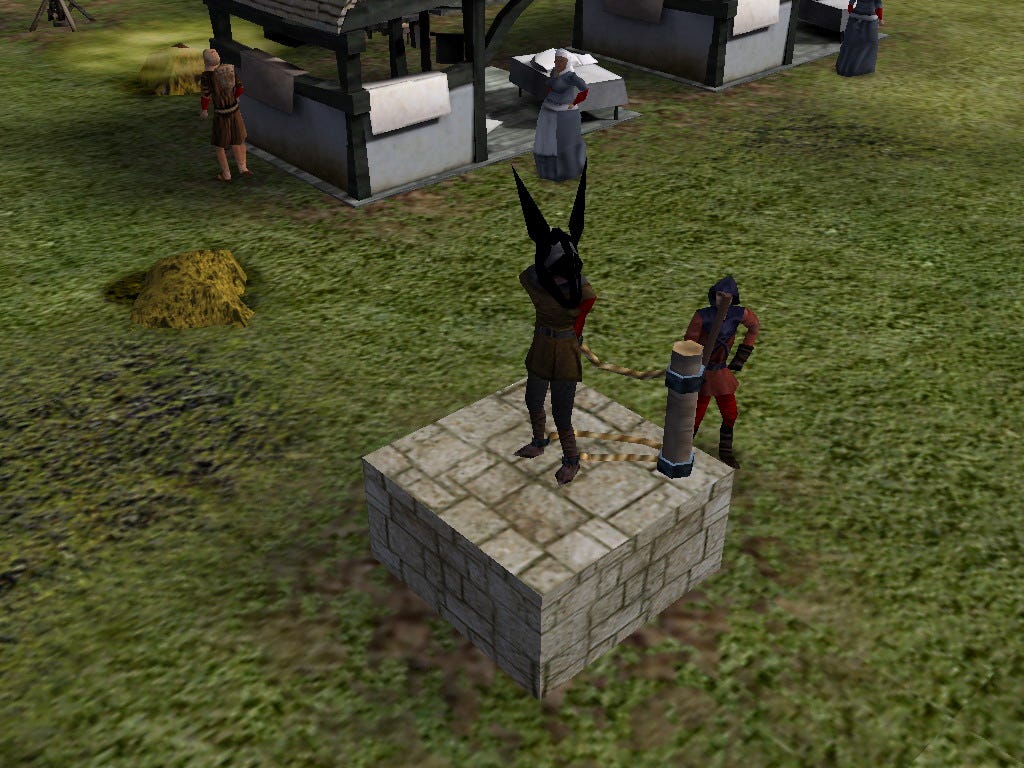
There are many additions to the game in terms of things to build or admire, with a huge array of possible castle designs, and a whole honour system to accumulate this useful resource dependent on the actions of your lieges. (I.e. whether they hunt, demonstrate generosity to serfs, or chase after surfeits of lampreys.) But what mostly proves memorable is the surprising array of ways in which you can play the game. Cleverly divided into two sub-menus to avoid overwhelming the player, the peaceful modes include free-build and a fully developed campaign based around construction, while the war-modes include a skirmish-style Kingmaker mode, real-world sieges to fight, and a full story-lead campaign centred around combat. Add to this multiplayer and the ability to create and play user-maps, then there's an awful lot of game to play; especially so considering that the pace tends towards the glacial.
The real fun is based on the construction of the city and the running of the settlement, with the war as a second interest (compared to a "pure" RTS, it can often seem lumpen). Its most grating problems come not from its systemic decisions, but rather its specific ones. That is, its mission design. It has a tendency to resort to one of the stronger examples of quick-save design applied to an RTS I've seen. Primarily seen in first-person shooters - where they throw in a situation that will kill you immediately (instakill snipers, for example), leading to use of the quick-save becoming a necessary crutch to progress - it's unwelcome here. The campaign games especially take great glee in changing your objectives halfway through, even on the opening levels. The economics, being so slow, means that to complete an objective in a reasonable time, you end up developing your entire economy around that task. When the rules change suddenly, you're left in a situation you simply can't deal with. The solution? Go back in time to a previous save, and try again. But this isn't real strategy. This is just problem-solving.
To take an example from the very first level in the peaceful campaign, you're given the problem of fires. You realise (though you're not properly, actively taught) that you need to hire a collection of well-workers to fight the fires in your southern province while you transport your resources to a more northern settlement, which appears to be free of brushfires. When you get there, however, fires immediately start breaking out there too. You'll have lost a fair chunk of your infrastructure due to the speed of the blaze spreading. Reload, set up water troops in advance, and onwards. To discover you're starting to receive raids from bandits before you've even thought of building up a decent defence force. You load again, and change your approach given this new knowledge.
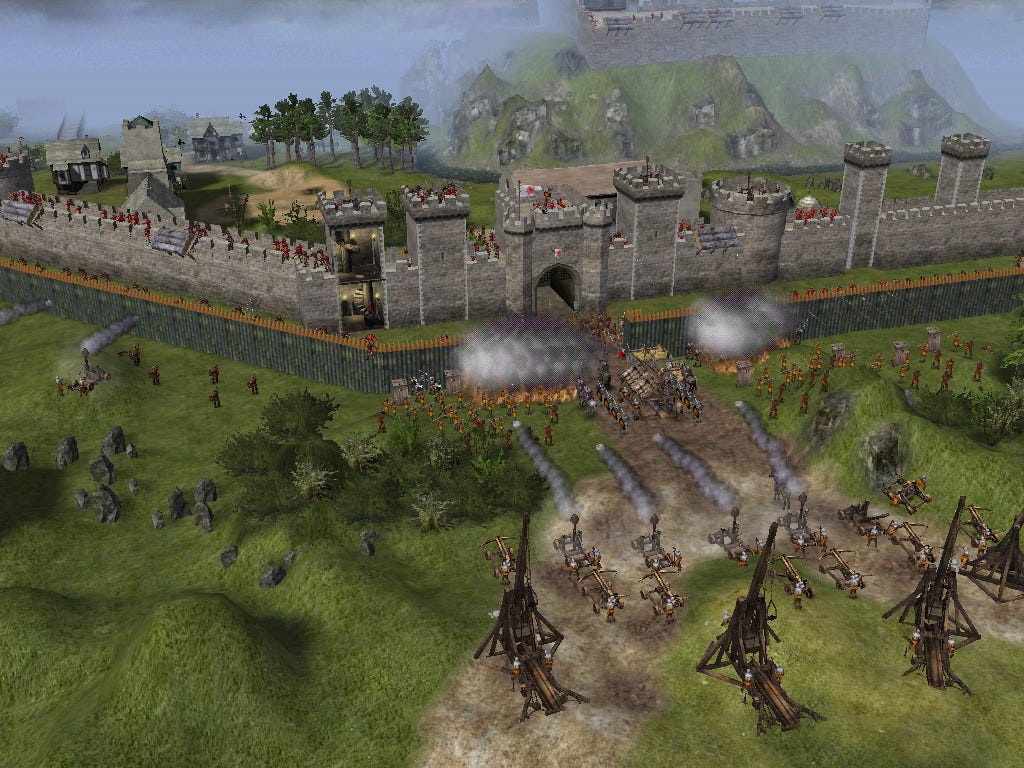
The game, generally speaking, works better in its less structured modes, such as the skirmish-lead Kingmaker. At least there you're on playing fields where you're working towards a known destination and can properly strategise rather than just reacting to the hoops the designers want you to leap through. In other words, the variety of modes which Stronghold 2 offers you is both its boon and curse. Most players won't like everything included, but there's so much stuff - and the array of options offering genuinely different experiences - it means that most breeds of strategy fans will something to charm, while cursing what doesn't.
Its other main noticeable fault would be the lack of variation in computer's battle tactics. While each of the computer-controlled types have obvious personalities, leading them to design castles distinctively, the actual assaults can be a little easy to guess. While stone walls are now suitably invulnerable to foot troops, they'll get stuck into wooden walls and often determinedly decide to reduce the whole wall to matchsticks rather than go and do something more useful.
Which all strikes a more negative stance than I'd like. There's far too much here to even dream of suggesting regicide. It manages to capture much of what makes these stone edifices fascinating, from the actions of a single hunter gathering bunnies for the castle pot, to oil-soaked logs being ignited and sent crashing down the walls to crush an oncoming army. It's a game with style, in the true sense of its word. That is, it has decided what it wants to be and then just does that, without worrying what the world may think of it. Certainly, in its own home turf, it's very much king of the castle.
Order yours now from Simply Games.