Namco Museum 50th Anniversary Arcade Collection Review

A loveless exercise in retro rehashing.

Version tested: Xbox

When Namco started trawling out arcade compilations over ten years ago, the idea was hugely compelling. For starters, MAME was still in its infancy, and most of us hadn't come into contact with the real cabinets since the mid 80s. The mere possibility of playing our childhood favourites was an intoxicating one, and Namco did a fine job of drip-feeding them over six volumes, six games at a time. They were pretty expensive for what they were, but the concept of emulation was still a novel one. The idea of being able to play the real Ms Pac Man and Galaga at home was something we'd dreamed about since before the Spectrum, so you could say there was pent up demand.

Wandering around those 'virtual arcades' and checking out the promotional material felt like opening a time capsule. On top of that, you'd get a few less well-known games to check out into the bargain, so the educational value was even greater.

But then, of course, MAME grew to the extent that you'd end up with access to literally hundreds, nay thousands of arcade games. Suddenly the novelty value of these compilations dwindled to nothing and we needed more motivation to buy them.

Re-issue, re-package
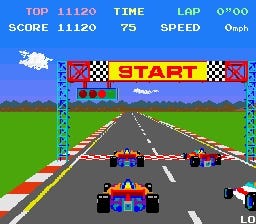
pole

Pole Position? Back of the pack.

If you were in Namco's position, you'd probably want to offer the sorts of things that legally suspect emulators couldn't. Innovative packaging, developer interviews, making-of documentaries, unreleased games, retrospectives. But no. Instead, all Namco has done since 1996 is re-issue compilations again and again and again.

Unlike, say, Taito (which rounded up a huge chunk of its best output on last year's excellent Taito Legends compilation, featuring 29 games), Namco seems bizarrely content to trawl out the same old games time and again. Not only that, it actually offers far less with this rather loveless release than any of its previous compilations, stripping out many of the features that made them a curiosity to hardcore collectors.

The original PlayStation editions, for example, gave users the choice of rotating the screen 90 degrees, so that gamers could (if they had the right set up) fill the entire screen with game and play it the way the designers intended. The games even booted up in the same quirky way the original machines did, complete with the chance to meddle with all the difficulty, lives and bonus settings. It may have looked a bit ugly, but it added to the feeling that these were the 'real' games, right in your own home.

A rush and a push and the cash is ours

dig

I dig Dig Dug, Doug.

This 16-strong compilation may house more games than any previous Namco collection, but it's actually in many senses the worst. Digital Eclipse (veterans of many arcade compilation) has done a spectacular rush job, with a set that does nothing to 'celebrate' Namco's 50th anniversary in any meaningful sense.

Regarding the games, few need any kind of introduction, which is a good sign at least. In the 'classics' camp, you've got some all-time must-haves in the shape of Pac-Man, Ms Pac Man, Galaxian, Galaga and Dig Dug. On the periphery, there's the likes of Mappy, Bosconian, Rally-X, Sky Kid and Xevious, and a couple of reasonable unlockables like Galaga 88 and Pacmania, while the less impressive Pole Position, Pole Position 2, Dragon Spirit and Rolling Thunder help make up the numbers.

The actual standard of emulation (outside of the nitpicking) is solid, and few can have any complaints. Apart from the points we've already mentioned, probably the most startling omissions are the lack of any sort of Xbox Live Leaderboard or high definition support. Unlike, say, the Atari Anthology (which supports 1080i on Xbox) there's not even 480p support, meaning the games all look a bit blurry on standard definition TVs. For games like this that were designed for rubbish TVs it's hardly a big deal, but you'd think Digital Eclipse would at least have offered that one small concession to progress.

Hatful of money

Aside from technical quibbles, it's a solid, unspectacular package. Games like Ms Pac-Man and Galaga, in particular, are so pure in their uncomplicated brilliance that even returning to them 25 years on is something special. It's like hearing a classic 60s pop song that's hugely naïve out of context, but somehow spirits you back to a simpler, less cynical era. Of course, in comparison with any modern game they smile while they slide the knife into your back, but that seems to be part of their inexplicable charm Almost without exception, they're as hard as nails, for sure, but they had to be - these were literally money-making machines specifically designed to extract your loose change, kill you off and leave you wanting more.

Admittedly, if you've played them to death like we have, you probably won't need yet another compilation to add to your groaning collection, but there's still fun to be had - if only to see whether you've still got what it takes to get near your old high score. Now if only they'd release these over the Live Arcade on 360 and we could take our skills onto a worldwide leaderboard.

So, Pac-Man and its more varied, superior sequel Ms Pac-Man share top honours with Galaga - by far the most enduring Space Invaders variant ever released. Just outside that list, Galaxian is a fantastic (but basic) Space Invaders clone, worth revisiting if only for the terrifyingly primal sound effects, and Dig Dug still feels original even now, like an underground Pac-Man where you have to blow up the netherworld beasties before they get you (or escape overground).

Them was rotten days

mrs

Ms Pac-Man, I wanna kiss ya.

Of the less famous in the list, Mappy (the mouse, of the Micro Police) has you bouncing around a museum, seizing stolen goods from a bunch of thieving cats in a game that's fun for a while, but doesn't quite hit the mark. Bosconian is a decent eight-way shooter that has you destroying larger space ships while avoiding oncoming waves, but is one that's set on a frustratingly small portion of the screen and therefore somewhat broken by design. Fun, though.

Rally-X is as basic as retro gaming gets - driving around a top-down maze trying to capture flags while avoiding the attentions of several pursuing vehicles - and again, fun but entirely inessential. Much the same can be said for Xevious, an immensely basic scrolling shooter that was progressive for the time - not only because of the moving vertical playing field, but the ability to shoot ground targets too. Somehow, a combination of the weedy gun and unimaginative visuals, it's one of those basic old titles that laid the groundwork for other titles but feels incredibly primitive now. Even the largely similar Dragon Spirit (from 1987, five years later) aped the central mechanics, but comes across now as just another generic vertical shooter with nothing to make it stand out in the slightest. One thing people seem to forget about the retro era is that good ideas were absolutely done to death - probably just as much as they are now, in fact.

One game that feels completely different from the rest is the side-scrolling shooter SkyKid; it had an interesting central idea (take off, bomb the main target, land safely), but like so many games of the early 80s, it suffers from unwieldy controls, is entirely unforgiving and hugely repetitive. After a just a few games you're reminded exactly why few people remember it. Yet one seminal game that everyone remembers with glowing fondness is actually one of the weakest retro 'classics' you'll ever play: Pole Position. It's probably sacrilegious to dare slag it off, but as much as its importance in the racing genre lingers 24 years on, to try and play it now is as horrible an experience as you can have with a game. The main problem isn't the graphics (they were pretty good for the time, actually), but the absolutely shocking steering that makes it quite comical trying to even attempt a corner, no matter what speed you're doing. You too will feel like your motor skills have been removed and replaced with those of a Tellytubby. The fact that its sequel (complete with, woo, four tracks instead of one) is present on this compilation merely heightens the abject torture.

Back to the old game

mappy

Mappy: don't question my authority.

The side-scrolling shooter/platformer that is 1986's Rolling Thunder is another aberration that fails to stand up to even the most cursory inspection. The prospect of leotard-wearing supervillains leaping out from doorways to shoot you sounds reasonable, if improbable. In practice, it's one of those evil games (like Green Beret, which was great, incidentally) that were in vogue during that year and operated on a split level, allowing enemies to jump down and attack you in a split second. Awful, painful nonsense that ought to be buried along with so much of the retro slurry that's peddled in the name of nostalgia.

Concluding this varied selection of relics are Pacmania and Galaga 88, two largely unnecessary re-treads that saw Namco reviving old hits (before the decade was even over...) in the search of success. The former saw fit to put Pac-Man in isometric 3D Lego-style scrolling mazes, allowing him to jump over them, but most people agreed that it couldn't top the original. Pretty much the same applied to Galaga 88, which was little more than an exercise in showing off the old gameplay with prettier visuals - a concept that we're more than familiar with decades on.

Whether you can be tempted to spend near-full-priced levels of wonga on what ought to be a budget or at best a mid-priced release will depend on several things. Have you been-there-and-done-that with the previous Namco collections? Raided the MAME tomb? Been stung by other retro collections? If so, there's no need to bother with this one, as it's one of the least essential that we've come across. If not, then it's probably worth a look at a knockdown price, or you could just save your cash and wait until Namco finally gets its act together and releases a more expansive retro anthology - something that's long overdue.

4 / 10

Read the Eurogamer.net scoring policy

Comments (34)

Comments for this article are now closed, but please feel free to continue chatting on the forum!

  • Loading...hold tight!