Super Monkey Ball: Banana Blitz
Slipping on its own banana skins.

Just how did those monkeys get trapped inside those balls anyway? How do they eat/sleep/go to the toilet? Aren't they annoyed at their captors for holding them hostage for the past five years? How is it they've suddenly developed the ability to jump? Why do I get to review the duff Monkey Ball? Questions questions.
Banana Blitz - in many ways - neatly distils everything that's good and bad about the Nintendo Wii at the present time. It shoehorns an interesting tilt control system onto a game that, well, already had a perfect control system, and then throws 50 dreadful multiplayer mini-games at you - almost none of which provide a solid case that the experience is in any way improved by the use of the Wii remote.
When Super Monkey Ball first graced the GameCube five years ago, those mini-games were the perfect reward for chipping your way through all those fiendish stages where you rolled your Monkey with precision towards the goal. For many, multiplayer sessions on Monkey Bowling, Monkey Golf and the like were the best thing about it.
Party fears too
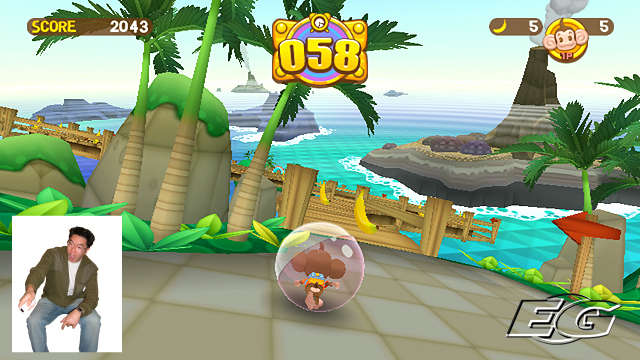
But now, you get all 50 multiplayer party games right from the beginning - some playable in split-screen, others set on one screen - and the order in which you play through them is left entirely up to you. While this sounds like a good idea for those of us that only held onto our copies of SMB for the party games, the process of wading through the vast number included here feels suspiciously like hard work for the most part.
In terms of the 'good' ones we came across, there were precious few that we felt compelled to play repeatedly (and when we say 'good', we generally mean 'the ones we could control'). The most playable games seemed to be the ones that didn't overcomplicate matters with bizarre, counter-intuitive control schemes, but then also suffered from their total lack of depth.
For example, the games where you simply had to aim at the screen and react quickest, like Bug Balance, Keepy Up, Number Ball and the 3D Space Invader clone Space Monkey Attack were all immediately playable, but about as interesting as a throwaway Flash game. Pointing and selecting the pool ball numbers in order in Number Ball feels simple and intuitive enough, but did it warrant inclusion? Similarly, Bug Balance's pile-the-ladybirds-on-the-stick premise sets the tone for a lot of the throwaway crap you have to plough through.
Baby steps
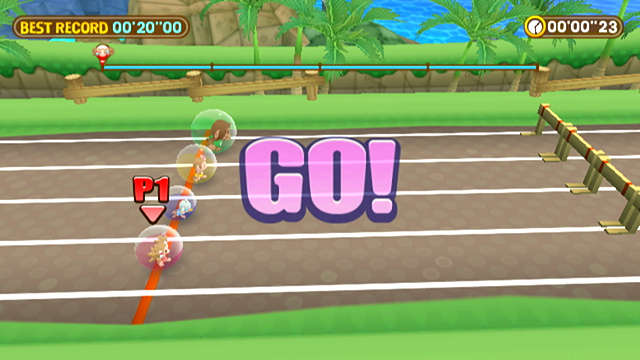
Mostly, the games included are just concept efforts that demonstrate tiny elements of what you can do with the Wii remote - such as Fruit Basket (deflect the fruit into the right basket by tilting forward, left or right), Jump Rope (move the remote up as the skipping rope swings around), and Whack-A-Mole (errr, whack moles by pointing the twitchy cursor at the right hole and strike). Individually not terrifyingly awful, but collectively it's mystifying why SEGA felt the need to throw so many undercooked games into the pot.
Sooner or later you hope for better things, but it's a long wait. The promise of Wii versions of Monkey Bowling, Target and Golf seemed destined to be great, but within seconds you'll just want to go back to playing the originals. Bowling, for example, has none of the finesse or fluid interpretation of your movements like Wii Sports, while Golf and Target instantly rile with their inexplicably terrible control systems that make simple actions complex and unwieldy. You'll repeatedly refer back to the 'how to play' instructions, and still be utterly rubbish at them. So you move on in the hope of better things.
Newcomers like Monkey Darts sound fantastic, but sadly confirm the suspicions at E3 that the execution is so far away from being playable that, frankly, you'd be better off trying something that doesn't make you feel like you're mentally impaired. Monkey Boxer, again, isn't even in the same league as Wii Sports, while Monkey Fencing just has you prodding haplessly at your opponent in the vague hope of being first to parry. Monkey Squash isn't too bad; it's controllable enough and easy to pick up but there's no real speed or feeling of connection with the ball. Likewise, Monkey Race's sideways control system makes it easy to take corners with precision, but the tracks are just too simple to be interesting. Home Run Derby is just a simple timing exercise and requires little actual motion sensing skill. It's all a bit depressing, really.
Arrrrrrrgh

Some though are just irredeemably awful thanks to control systems so far away from being usable that you'll want to stab yourself in the eye with the Wii remote after a couple of goes. It's hard to know even where to start. Trombone seems simple in that it requires you to move over the colour-coordinated note as it appears, but doing so is hilariously hit and miss, Scoop the Goldfish ought to be easy enough but actually breaks your net the second you plunge your net into the water and is just plain fiddly and annoying, while the simple target games like Free Throw, Sling Shot and Ring Toss never seem calibrated to measure the force of your throw like the Wii Play or Wii Sports games do.
Some of the games here even require you to rotate by pulling the nunchuk back while pushing the remote forward (and vice-versa to rotate the opposite way), but it feels like the most unnatural thing in the world to have to do. Games such as Alien Attack, Hovercraft Battle and Hovercraft Race are instantly rendered unplayable as a result, or even with some dogged persistence not-as-playable-as-with-a-joypad. And I haven't even mentioned some of my least favourites yet, like Rock-Paper-Scissors Attack, Racing Birds, Yacht Sailing, or the entirely pointless and fiddly Jigsaw Puzzle.
There are less offensive party games to be found - like Dangerous Routes or Banana Thief - that neither inspire annoyance or pleasure, but the net result is you won't particularly want to play any of them more than a couple of times. The general quality of party games came as a major shock to a long-term Monkey Ball fan such as myself, and also as someone who has been hugely entertained by Wii Sports. Even next to the lightweight Wii Play, the party games on this collection rate very poorly indeed.