Version tested: PlayStation 2
A little ambition is a dangerous thing for a videogame these days. Any game that tries to shake up narrative structures, mess with the player's perception of timelines, and throw a mass of different characters at you had better be worth the ball of confusion that comes with it.
For many, 2003's seminal Forbidden Siren represents the perfect encapsulation of Asian horror gaming; a title that skilfully draws on a myriad of the best movie concepts of the era and reinvents and distorts them for videogaming consumption. Telling a twisting, overlapping story through the eyes of multiple characters, it was a game where the horror came from knowing what your aggressors could see and the helpless terror of trying to avoid them. It was a game where your main weapon was being able to 'Sight-Jack' into their vision and take advantage of their momentary lapses in concentration and slip past them unnoticed. A brilliant idea that works wonderfully in a horror context.
But it was simultaneously the most wilfully inaccessible game we've seen in the genre. It wasn't just plain hard in that it was often ridiculously easy to get killed, but seemingly bloody-minded by design. For starters, there was no means of permanently killing the undead 'Shibito' enemy, meaning that the essential task of scouting out locations (for objects to solve the inevitable puzzles) could be sheer torture if you stumbled the wrong way and had to run the gauntlet all over again - and all without any checkpoints at all.
Loops of fury
Even more aggravating was the way the game was constructed around time 'loops' which meant that unless you'd picked up certain objects during individual scenarios, you ran the risk of having to repeat the loop until you satisfied an inexplicable check list. To the player, though, none of this was explained adequately (or was mistranslated) and you ended up feeling like you were being arbitrarily forced to re-do previously completed scenarios for no reason. Often, progress would be made by pure accident; for example, you'd pick up an obscure object on an otherwise useless rooftop and get a message to alert you to the fact that you'd unlocked another mission somewhere else in the timeline. Unless you had oceanic reserves of patience or didn't mind playing with a guide (in this case pretty essential), you'd probably just give up and do something more fun.
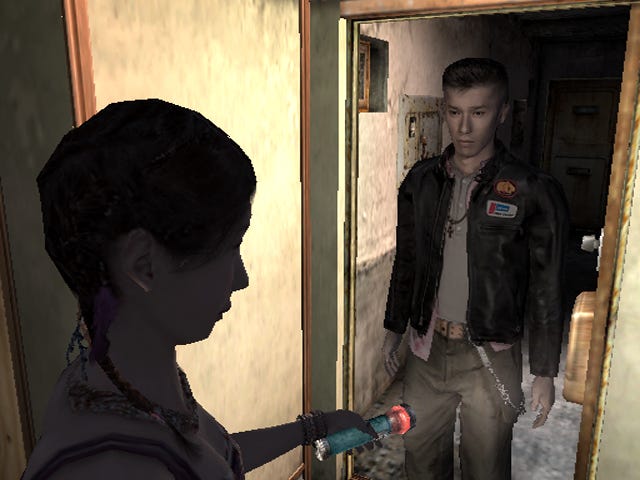
Are you looking at my crotch?
Having said that, there were loads of moments of pure magic in the game that made a lot of the so-called survival-horror games look incredibly unambitious and stuck in their ways by comparison. Through the red mist of frustration, it was still easy to see that all the ingredients were there to make a stunning sequel that used a similar template and chucked out some of the more insane design decisions.
Sadly, Forbidden Siren 2 is not the stunning sequel we were hoping for.
It's hard to put your finger on exactly where it goes wrong, when so many of the flaws of the original have been eradicated. For a start, the game does a much better job of spelling out what you're supposed to do throughout each scenario, and does so alongside a generally excellent in-game hint system that eradicates most of the petty frustrations of the past. Not only that, the game has the decency to checkpoint-save key events, meaning that you can play with a much greater degree of confidence in the knowledge that you haven't got to repeat 30 minutes of painstaking, stealthy play just to explore an otherwise useless building to grab an artefact that opens up a new mission later on.
Pressure creeps
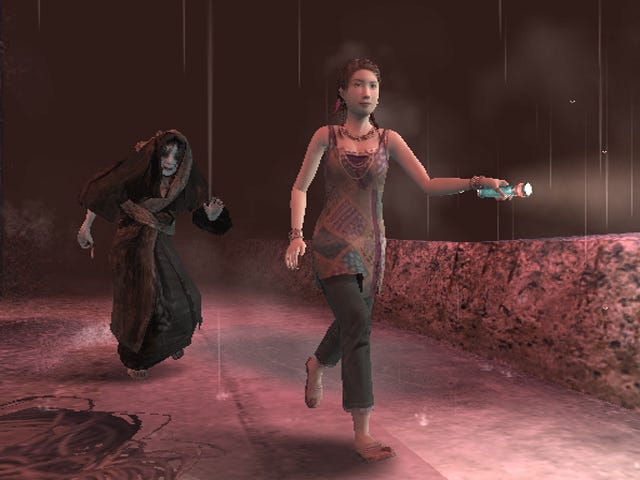
Good to see the Thriller extras getting some work.
It also shifts the balance slightly, empowering the player with new abilities and giving more characters the ability to fight back than was ever the case last time. More missions start with characters armed by default, meaning that you don't always have to worry quite so much about Sight-Jacking at every turn. This makes missions more accessible and hence less frustrating when things don't go to plan, and Shibito aren't so unerring in their aim - a major relief. There's even an Easy mode to allow you to take more damage, so that missions don't go pear shaped the second you're spotted, so if you're just interested in solving the puzzles and becoming immersed in the storyline it's relatively straightforward to play it this way. It does take away a chunk of the tension when you're not sweating quite so much over the enemy threat, but the payback is not losing your rag over endless mishaps. The point is, the choice is yours. In fact, if you've got a completed save of the original, there's even a Hard mode available from the start if you want to play it in the most excruciatingly challenging way possible.
Another plus point is the vast increase in variety in the character's abilities, meaning that missions have a distinctly different flavour. For example, one partially sighted character needs to Sight-Jack his guide dog in order to see, while another has the ability to Sight-Jack into the past, or see things in the present that others cannot see. In addition, the new light-fearing Yamibito enemies (which essentially look like murky brown clouds) mix up the combat variety a touch, as does the great increase in the number of weapons that the Shibito carry around with them. It's no longer just a case of stealth horror where you're monitoring the precise moments of sentries and staying well out of their way. It's much more confrontational than before - though it can still be a hassle to deal with the fact that you can't keep a good Shibito down. Somehow we wish there was a means of killing the little swines, but admittedly it'd make it a very different game.
Where the game ultimately falls down is how routine most of the missions feel, how short most of them are, how disappointingly basic almost all of the puzzles are and how hard it remains to get a proper handle on the fractured storyline.
Cast offs
Taking it point by point, most missions entail little more than picking up an object somewhere (usually already explained to you but not necessarily of direct relevance to the mission at hand) and heading off somewhere else. Almost without exception it's a case of going from point A to B to C and quickly moving onto another mission somewhere else on the island, possibly hours earlier or later. Once you know what you're doing and where to go, most missions can be completed in a matter of minutes - but it's rare to ever get a handle over what the point of your actions is. Timelines scribble over the place, and characters interchange so much that it's tough to keep up with who they are, and isolated cut-scenes deliver out of context fragments of a story which rarely seem to give an insight into what's going on or how the key figures found themselves on this cursed island in the first place. Some were washed up on the shore via a tsunami, but other characters' appearances seem unclear. It's a Gordian knot that seems to delight in its own obscurity.
Having learned our lesson last time around, we made notes before and after each mission in an attempt to make more sense of each character's role in the criss-crossing tale, but even 50-odd missions in, there was still an over-riding sense of general confusion about what was really going on, and why we were going after certain individuals. Fortunately, part of its appeal is unravelling this muddle; tempting and teasing the player on to lift the fog with a series of generally well-acted sequences that feature the same facially stunning character models of the original. Whether you enjoy joining the dots has a lot to do with personal preferences; at times the exploded jigsaw approach seems fascinating, but at others you just wish the excellent sequences made some sense. Without the benefit of context, you often feel like you're playing a series of basic, random survival horror vignettes, when it may have been preferable to be immersed in all this atmosphere in a fully connected environment with a beginning, middle and end. Sure, this may have made the narrative feel more traditional and less daring, but you can't help but feel it would have made it a more focused, entertaining game - which is surely the main goal.
In truth, Forbidden Siren 2 is simultaneously the victim of its own ambition and held back by its self-imposed restraints. Throwing dozens of vaguely connected mini-snapshot 'scenes' at the player is a very bold and eclectic approach, but it also strangles the gameplay in crucial ways. Placing the player in enclosed environments with a focus on undertaking a small number of basic tasks automatically scales everything down. The result is that whatever character you're controlling, and whatever environment you're in, every mission amounts to a perfunctory object hunt in the dark while dealing with lurching enemies you can't kill - that's the gameplay in a nutshell. Sure, the abilities of each character can shift the emphasis slightly from unarmed stealthy escape to more aggressive firefights, but the core goals of most missions remain largely the same. Also, the constant recycling of locations and the strange need to often play through a slight variation of the same mission merely feels like unnecessary padding.
Sight-Jack of all trades
Such a messy eater.
The developer also throws lots of new ideas into the mix and then doesn't build on them. A case in point is the new ability to drive vehicles - used only fleetingly a few times - while other innovations like Sight-Jacking into the past, taking physical control of the Shibito or using the sight of another character are similarly under-used. It seems that once these ideas are introduced early on, they're used very sparsely and for the vast majority of the time the game slips back into default 'find object X, reach location Y' formula.
Technically, the game uses much the same engine as last time, albeit with better lighting techniques. It's still a fine looking game in certain departments; the stylish cut-scenes show off the game at its very best, with superb facial detail lending enormous credibility to the narrative. In the main game, though, the animation's never looks particularly convincing, and there's a distinct clumsiness to the camera and controls. The new first-person mode is initially welcome, but its twitchiness soon has you switching back. Other minor niggles creep in, too, like the over-sensitive sniper mode, the constant lack of ammo (something the Shibito never have to worry about) and the flagging energy levels of characters if you run around too long - things that are just unnecessary and add nothing to the game.
At least the audio has been taken care of this time around. Not only do the English voiceovers suit the characters this time (unlike the hilarity of the clipped Home Counties delivery in the original) but there's also the option to choose the Japanese voiceovers with subtitles. Slapped wrists, though, for Sony's English localisation team, who failed to match the subtitles to the actual words being spoken on so many occasions it's embarrassing. As ever, the brooding atmosphere is made even more oppressive by a catalogue of sinister noises and ambient effects in the background. Never has the lack of a musical soundtrack been more appropriate.
Despite the generally downbeat and exasperated tone of this review, Forbidden Siren 2 is still a game that horror fans should check out. With so few games of note arriving in the genre, it's very much a case of getting your fix where you can. With Project Zero 3 the only other horror title of note to arrive so far this year, and no new 'proper' Silent Hill or Resident Evil games likely to emerge for at least another year, it's definitely a barren time for the adventurer. It's easy to acknowledge that Sony has crafted a much more accessible episode this time, but in doing so has unwittingly managed to expose some flaws and limitations in this stop-start formula. If you've got the will to stick with the interweaving plot and don't mind a bit of repetition then you'll doubtlessly get through by enjoying the game's incredibly rich atmosphere - as we did. It's important to stress that Forbidden Siren 2 is always highly enjoyable, but we expected so much more; its elusive lack of focus makes it feel like you're playing a random collection of mini-episodes, while the basic tasks given to you rarely extend beyond the perfunctory, and it's the latter point that's most disconcerting. If you like your videogames to have straightforward gameplay with a story like a fragmented jigsaw puzzle, then go right ahead. If you stick with it, the rewards are there. The rest of you might end up questioning why you're bothering.
7 / 10
