Electroplankton
Some love it. Some hate it. We've got one of each.
How do you review a game which isn't a game and isn't even trying to get away with pretending to be a game? Electoplankton is an oddity; a collection of little applets - for want of a better word - that allow you to create little pieces of music. And it divides opinion - polarizes it, in some cases. With the game due out over here next month on April 21st, we secured the services of regular contributor Mathew Kumar, an avid gamer, and talented young musician Jake Yapp to take a look, and hopefully give you an idea of how you'll feel about it.
That sinking feeling
Electroplankton is published by Nintendo and is played on a Nintendo DS. From this you might infer it's a game. Electroplankton is the creation of Japanese media artist Toshio Iwai, winner of the 1997 Prix Arts Electronica (Interactive Art Category) with Ryuchi Sakamoto, and has worked with the likes of Studio Ghibli creator Hayao Miyazaki. From this you might infer it's a piece of art.
Electroplankton has a variety of musical 'plankton' that you play with using the stylus, buttons, and microphone. There is no 'aim' other than to create the most pleasing images or sound, and no conclusion other than when you get bored and switch it off. From this, you might decide it's simply a toy.
If you're anything like me, once you're over the shock of three things (that the lovely Japanese packaging has been done away with; that the localisation time appears to have been spent entirely on the manual; that you don't have to hit A six or fifteen times to reach the start screen), you'll slap the stylus upon Performance mode (one of only two options in the game; the other, Audience mode, leaves the player entirely passive), and rush your way to plankton number 9, Beatnes.
This is the only plankton anyone really cares about. The four long-tailed Beatnes plankton sway soothingly, or not so soothingly, depending on the tempo you choose with the directional pad, and the instant nostalgia of the Super Mario Bros. invincibility theme plays. There's a choice of four themes, including, most oddly, cult favourite Kid Icarus. As the player, your choices are to hit the segments of the plankton, roughly arranged into pitch and tone, with highly recognisable samples like the Mario death throes pokable at the heads and tails, to make tunes. Each plankton will repeat the sequence you tap upon them for a total of four bars before forgetting it.
Beatnes is easily the most accessible and accomplished part of Electroplankton. Due to the swaying plankton and their short, sadly unconfigurable memories, you'll need to have some skill to replay the amazing 180 BPM gabber anthem you just composed if anyone happens into the room, or to even keep the tune going for more than, oh, four bars. And if you hadn't figured it out when I suggested Nintendo spent the last year or so just working on the manual ("A ruler is a great way to draw straight lines!" it helpfully states, at one point), then here it is: they clearly ignored the fact that all anyone with the Japanese version did was complain about the lack of a save. There isn't one.
Though it's not the creator's aim for the software, a few other plankton offer slight potential as music tools. In Luminara, four plankton dance around the screen on a grid of arrows, creating music with each beat that can be carefully arranged by the direction of the arrows. Lumiloop, otherwise known personally as the David-Lynch-Soundtrack-Plankton [Angelo Badalamenti?- Ed], create ethereal tones in the pentatonic scale and, due to the abusively fast plate-spinning techniques you'll require, scratch your screen to hell if you're using anything harder than a cotton bud.
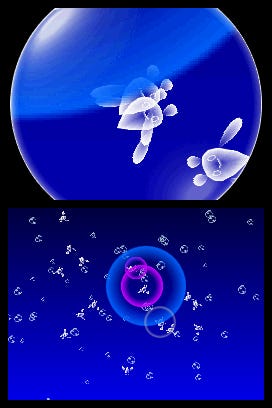
Hanebow, in which you angle leaves on screen for Hanebow plankton to launch to and from, produces quite beautiful plinks and plonks, and serves a dual purpose by being the most game-like of the plankton. As the traffic increases, the leaves change colour and resultant tone until a flower blooms. Creating a flower is actually a significant challenge, and with that aim in mind you'll waste a great deal of time playing with Hanebow. It's perhaps for this reason that it's one of the ones I return to the most.
Few of the other plankton are particularly useful if you wish to create anything structured, with the output often cacophonous. Tracy plankton, in which the lines you draw on screen usually create the sound of someone throwing a bag full of pianos and xylophones down the stairs is a good example of this. Others appear utterly useless. The Volvoice plankton lets you record your voice and then play it back in a variety of funny ways, and is amusing for a negative amount of time. Even more disappointingly, Rec-Rec manages to be both cacophonous and utterly useless - it lets you record up to four sounds and play them back to a beat, but needlessly demands that you time the recordings as you can't move or change the timing of each separately.
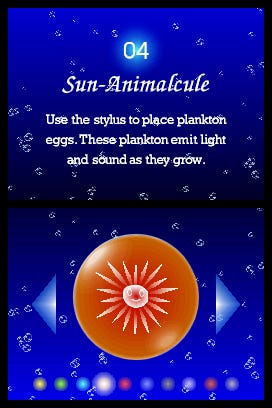
The other plankton, Sun-Amanicule, Nanocarp, and Marine-Snow, are each conceptually interesting in their own way, but not one offers anything in the way of lasting interest. I found myself, after just fifteen minutes with Electroplankton, only returning to Beatnes, and Hanebow for its beautiful sounds and tangible reward. Everything else I went back to was just out of sheer stubbornness to 'see the game through'. And when it comes down to it, without a save mode, without any aims, Electroplankton is not a game. As an undefined collection of interactive features, lacking a unified vision or meaning, Electroplankton is not a piece of art either.
In fact, Electroplankton feels like it could have been accurately enjoyed in flash with no loss of intricacy. Nintendo's fine website for the game makes that abundantly clear, and by offering the lovely manual in full PDF format, also sadly gives away for free one of the few selling points.
Now, I think there are probably a lot of readers who believe I am missing the point of Electroplankton; in particular by bemoaning the lack of game elements, or complaining that it's not a useful enough music tool. But I'm not. I see Electroplankton for what it is: a mere toy.
Mathew Kumar