Age of Empires: The Age of Kings Review
The art of shrinking thinking.
Version tested: DS
Let's hear it for turn-based strategy. Too often decried for being a plodding throwback to the 16-bit era, it's a tried and tested gameplay format that is long overdue a comeback. Real-time strategy is all very well but, a few notable exceptions aside, most RTS games are more about the real-time and less about the strategy. Frantically harvesting resources and churning out combat units before click-dragging the whole bloody lot and flinging them at the enemy - there's not really much room for nuanced thought in that equation. By using the lowly chess approach, turn-based games force you to ponder, to think and to - hey! - strategise.
In transforming Ensemble Studios' flagship franchise to the diminutive DS, Backbone Entertainment has shaken things up in a mostly refreshing way - the most obvious change being the shift from RTS to turn-based play. The game has a few pressing flaws, of which more later, but none of them stem from the slowed-down pace. They've ignored last year's Age of Empires III and looked back instead to 1999, and Age of Empires II, for the foundations of this edition. It's a wise move. Wise because the third game was something of a disappointment, but also because its relatively lo-tech predecessor is a far more suitable candidate for the shrinking process required.
To Be This Good Takes Ages
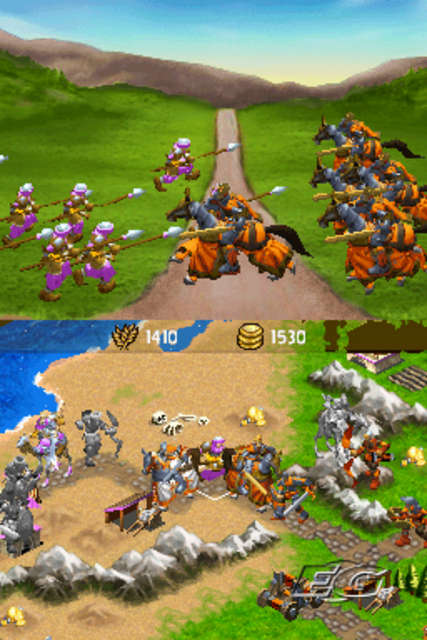
Horses in skirts. No wonder they called it the Dark Ages.
Of course, shrinking is a relative term. By PC standards, this version is a cute diversion. By handheld standards, it's an absolute beast. There are five civilizations to command, each boasting unique strengths and weaknesses, as well as five or six historical scenario missions apiece. There are over 65 unit types, many exclusive to certain civilizations, and all finely balanced. There are 15 building types, each bringing distinct benefits to your battlefield ambitions. And there are also dozens of researchable technologies which boost your efficiency in key areas.
Coming in a week when Sid Meier hinted at bringing Civ to the DS, it's a tantalising display of how much can be crammed onto one of those dinky cards. Especially impressive is how Backbone has stripped the Age of Empires series down to its component parts and then reassembled them into something that looks and plays nothing like the previous titles, yet is still recognisable as Age of Empires. The conversion process hasn't been entirely successful, but we'll get to the nitpicky bits later.
Single-player games can take two forms. First is the empire specific Campaign Mode which leads you through some surprisingly detailed potted history lessons, requiring you to fulfil certain objectives along the way. The empires are ranked from Easy (Joan of Arc, whose missions also act as a tutorial) to Hard (Richard the Lionheart). Sprinkled in between are Yoshitsume, Genghis Khan and Saladin. It's accurate in that broad Braveheart manner, with characters like Robin Hood entering the fray, but it's still a slyly educational experience.
In It For The Long Haul
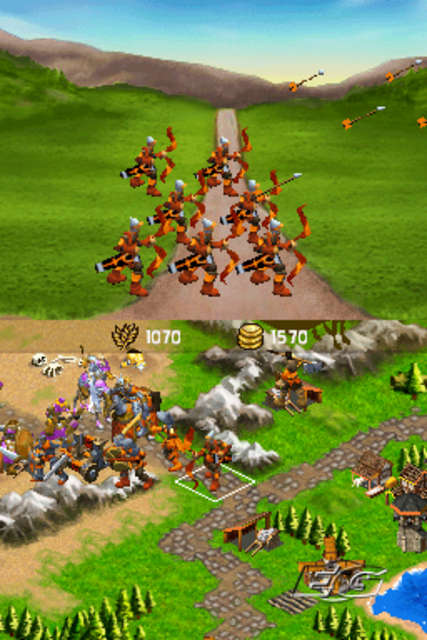
Archers are great at whittling down the enemy, but get creamed up close.
Rather than simply throwing you against an opposing force and asking you to emerge triumphant, the narrative flow of these campaign missions means that you'll find yourself tracking down holy relics, defending besieged cities or recreating legendary battles. Successful completion of mission objectives accrues points which can be traded in at the main menu for an additional eight specialist unit types and other goodies. Sometimes the task will require you to build towns and harvest resources. At other times, the mission will just be a test of your military mind. Rest assured, these campaign missions alone would be ample content for most games. Even Joan of Arc's introductory chapters boast hours of gameplay, and are hardly the pushover the "tutorial" tag suggests. If you want to work your way through all of them, you'd best set aside a few free months - or at least book some very long train journeys.
Additional to the campaigns is the more freeform Empire Map mode, which starts you off with your ruler, a military unit and a villager and lets you find your own way from there. There are twenty maps to choose from, with an extra 15 to be unlocked with your campaign points, so once again you're faced with an impressive array of choices.
Empire Map play is against one of three AI opponents, each of which can be set to one of three difficulty settings. Sadly, it's here that the first of several complaints begin to arise. Despite apparently having different temperaments, no matter which opponent I chose, or which difficulty level, the enemy always made a beeline for my fledgling empire with a suspiciously large military force and smacked the bejesus out of me. You can play against another person - either through the wireless hook-up, or simply by passing the console between you - and strategy fans with similarly inclined friends will get more satisfaction by playing this way.
Part of the problem is that these freeform maps are just too small - most measuring no more than 25x25 unit squares - so its inevitable that you'll clash with your neighbour sooner rather than later. This leaves you with precious little time to establish your presence, which in turn means you end up playing in the RTS style I grumbled about at the start, slipping into a cycle of "harvest, build, train, attack" that doesn't really inspire much long-term strategy beyond keeping your empire armed and aggressive.
Money Money Money (And Wheat)
The non-military aspects of the game are rather perfunctory anyway, with the available resources reduced to just two - food and gold - both of which are required to build or train. Once you've established a few farms and goldmines, this side of the game pretty much takes care of itself, leaving your villagers to scramble around the map, avoiding death and finding places to construct the latest buildings. The same is true of research. Although they're presented in the Civ style, there's little subtlety to their implementation. They're really just fancy ways of boosting your stats - advanced mining techniques bring 10 per cent increases in gold output, inventing better shoes gives villagers an extra movement square per turn. As long as you prioritise the areas needed to advance your empire to the next age, progress isn't that hard. As you advance from the Dark Ages to the Imperial Age, new buildings open up to enable new unit types - stables train cavalry, barracks train soldiers and so on - with more sophisticated versions becoming available with each stage.
In keeping with the truncated maps, the timescale of the game has been accelerated as well. Regardless of size or complexity, training units, researching technologies or constructing buildings always takes just one day of game time. This simplifies things, but it does mean another avenue of strategy is lost. There's no need to keep the bottom rungs of your army supplied with grunts while working on the more lethal weaponry - you can just churn them all out overnight. This rapid turnover also makes it incredibly tough to topple an enemy town, as each turn spawns fresh troops to replace those you manage to vanquish. To balance this out, the game imposes a unit cap, so when you reach a certain number of units (including villagers) you have to wait for one to be defeated before you can train another. Injured units can be merged to reduce numbers, but while the technical reasons for this restriction are obvious it's still a frustrating barrier to place in your path.
The units are thoughtfully balanced against each other, though there is still an element of "rock, paper, scissors" evident in the way victory is dictated by using the right unit to attack with. Pikemen make mincemeat of those on horseback, but foot soldiers fall before cavalry. Terrain plays a part, and your ruler unit can also call upon special powers to boost the stats of nearby allies. Once you get into the rhythm of the game, there's a compelling ebb and flow to the battles that feels tangibly real, two forces pushing against each other on different fronts, rather than just a series of unrelated scraps. This is all fairly standard stuff in the PC series but to see all these elements interacting so convincingly on a handheld, even in an occasionally rudimentary form, is still quite an achievement.
Crowd Control

Keeping your town updated with the latest tech is vital to progress and victory in battle.
Graphically, the game opts for an isometric view on the bottom screen, with unit information and battle scenes played out on the top. These little skirmish animations are quite cute - and there's a genuine thrill to seeing your archers let fly with a satisfying "thwup, thwup, thwup" volley of arrows - but they can be skipped when you tire of them. It's on the bottom screen where the game's main visual flaw emerges. While the isometric view certainly makes for nicer screenshots, once the map fills up with units it becomes increasingly difficult to discern who is where and which is what.
It doesn't help that some units look very similar. Briton villagers and men-at-arms, for example, are nigh indistinguishable in the middle of a ruck. You end up relying on the right shoulder button to skip to each available unit, rather than trying to prod the right square with the stylus, and then checking the top screen to see who you've selected and what condition they're in. It's not an unworkable way of playing, but it is rather clumsy and could easily have been smoothed out with the simple inclusion of an optional top-down battlefield view.

The purple arrows could only mean one thing - Prince and the Revolution had entered the fray.
None of these flaws are enough to diminish the achievement that Age of Empires represents on the DS, but they do serve to tarnish the overall experience a tad. Just when you're dazzled by how much has been crammed in, you bump into an invisible gameplay barrier that reminds you that for all its numerical might, it's not quite as big as you think, enough to make it sometimes feel more like a tantalising hint of things to come, rather than a leap forward in its own right. While there's still plenty to improve in a sequel, it sets an imposing benchmark for the next DS strategy title to measure up to.
You've probably noticed that I've studiously avoided mentioning Advance Wars so far. As the only other strategy game of note on the DS, it's obviously tempting to pit the two against each other, point for point, but there's no reason why strategy fans shouldn't enjoy both. Indeed, they almost certainly should. For all its ambition and scale, Age of Empires on the DS has a few too many shortcomings to make it the superior game in my eyes, but it definitely has the upper hand in some noteworthy areas. If nothing else, Age of Empires DS provides a title that will appeal to those Discovery Channel Dads who picked up the stylus for Brain Training, and proves that Nintendo's flip-top toy can supply grown-up depth as well as giddy frivolity. Now, if we can just get a DS version of Laser Squad Nemesis...
7 / 10
You may also like...
-
Retrospective: Star Wars Episode I Racer
-
Mass Effect 3 Demo: The First 20 Minutes
-
Why Devs Owe You Nothing
-
Face-Off: Final Fantasy 13-2
-
Digital Foundry: PS3 Skyrim Lag Fixed?
-
Game of the Week: Catherine
-
Who Killed Rare?
-
App of the Day: Ascension: Chronicle of the Godslayer
-
Gotham City Impostors Review
-
Face-Off: The Darkness 2
-
Kingdoms of Amalur: Reckoning Review
-
Epic's Sweeney on graphics tech: "the limit really is in sight"
-
The Darkness 2 Review
-
EA evaluating FIFA Street features for FIFA 13
-
Grand Slam Tennis 2 Review
-
Ultimate Marvel vs. Capcom 3 Vita Review
-
Catherine Review
-
App of the Day: Sir Benfro's Brilliant Balloon
-
One Piece: Unlimited Cruise SP Review
-
Sony admits "dropping the ball" with Demon's Souls
-
King Arthur 2 Review
-
Catherine launch trailer is looking saucy
-
Metal Gear Solid: The "Lost" HD Remasters
-
Skyrim patch 1.4 now live for Xbox 360
-
Skyrim patch 1.4 performance tip: make a new manual save


Comments (30) Latest comment 4 years ago
Comments threads automatically close after 30 days, but please feel free to continue chatting on the forum!
Comment below viewing threshold Show
"there's no reason why strategy fans shouldn't enjoy both. Indeed, they almost certainly should." Could not agree more!
Comment below viewing threshold Show
<a href=http://www.eurogamer.net/article.php?article_id=70637&g t;Look no further</a>
Interesting concept might look at these type of titles from afar.
Comment below viewing threshold Show
Specifically getting rushed by an overwhelming force, respawning enemy forces in towns, and unit caps.
Comment below viewing threshold Show
Civ: Deliciously Sexy!
Comment below viewing threshold Show
If nothing else, Age of Empires DS provides a title that will appeal to those Discovery Channel Dads who picked up the stylus for Brain Training
lol. I think I'm turning into one of them.
Comment below viewing threshold Show
Also, UFO: Enemy Unknown/Terror From the Deep DS while we're at it, please?
Comment below viewing threshold Show
LOL
Comment below viewing threshold Show
And that's a good summary (along with what Carlo quoted):
For all its ambition and scale, Age of Empires on the DS has a few too many shortcomings to make it the superior game in my eyes, but it definitely has the upper hand in some noteworthy areas
Comment below viewing threshold Show
Zelda.
Get on with it!
Comment below viewing threshold Show
Tomorrow allegedly.
Comment below viewing threshold Show
I have, and do....enjoy both
Laser Squad Nemesis or UFO Enemy Unknown for the DS Please!
Comment below viewing threshold Show
Otherwise: good game, good review
Comment below viewing threshold Show
Zelda.</em>
To write a review of Zelda, one has to tear oneself away from playing it. Judging by other reviews, that's hard to do...
Comment below viewing threshold Show
The unit cap can be increased by making more farms; you need the food to feed your new troops. It makes a crazy amount of sense!
Currently playing through the Salahdin missions and enjoying the game a lot
Comment below viewing threshold Show
I enjoyed the full game on the PC, but the DS version had a few too many shortcomings. As mentioned in the review, the isometric confusion being a prominent one. Another being that when facing two civilisations on the map they would simply both attack at the same time. (Edit) And having read another person's note, my main gripe is that you need at least 2 units adjacent to a building in order to EVENTUALLY bring it down because of constant respawning of enemy units within the building (until you advance to the 3rd or 4th age and gain long-range seige weapons after some considerably annoying hours).
It's a real shame. I wanted to really like this game but it left me fuming at wasted hours trying to gain advantage at a choke-point on the map only to lose three or four key units and after 3 hours lose the fight. Inicidentally I checked on my Advance Wars DS stats and found that I've played over 171 hours on that game. I put in a concerted 12-15 on Age of Empires before giving up.
So, anyone want to buy it second hand ?!
Comment below viewing threshold Show
The missions can take quite a while though as the review states; much longer than missions in Advance Wars. The missions are based on real historical events and are actually quite varied with the types of objectives given; missions often don't simply boil down to destroying all enemy towns.
AoE promotes players comprising their armies of different units really well - for example build an army of the best uber cavalry units and they'll still take heavy casualties against cheapo pikemen (especially if the pikemen are positioned on hills/mountains/forests/etc). Or build entirely Longbowmen (the best archer unit) and they'll get outrun & demolished by a bunch of even the most basic cavalry. And so on. Basically it promotes you to build a varied selection of units to complement each other. I found myself utilising the strengths of pretty much every type of unit available in every mission.
The only real issue negative issues I had was scrolling around the map is a chore (repeatedly pressing the stylus on a side of the screen to scroll in that direction), the isometric view means the screen can get VERY cluttered with units, and in some missions once you've broken the back of the enemy the mission really drags on.
A map editor would have been a great addition too. Hopefully they'll get to do a sequel and include one.
"...respawning enemy forces in towns..."
There's no enemy "respawning" - the enemy can of course build more units at their town(s), just like you can.
"...unit caps"
I found the unit cap works well; it encourages thinking about which units to build to have a well balanced army. Without a unit cap I imagine players would just be spamming hordes of the same type of uber unit. Your own unit cap is increased by building more mills and farms - by the end of a long game typically your unit cap is at around 30, which is plenty enough seeing as though it'll still take a good 5 minutes+ per turn.
"my main gripe is that you need at least 2 units adjacent to a building in order to EVENTUALLY bring it down"
For those who haven't played it you can only damage a building if there is no enemy unit occupying that building, so you can find yourself killing an enemy on a barracks only for another unit to have been built there by the time of your next turn, and repeat this over and over.
Yes this is a bit of an issue but not a biggie imo. Newly built units only have 50% health until their next turn so are pretty easily killed when first built. If you're the attacker then for the defender it's money down the drain to repeatedly build units only to have them immediately killed on the enemy's next turn, and if you're the defender then it allows you to build some rudimentary reinforcements to help stem the tide until your main army can get there. Additionally it depends on the type of unit attacking the building; cavalry and archers for instance are completely ineffective at damaging buildings until very late in the game. But mainly, the likelihood of attacking a town with one unit isn't very great; typically towns are attacked with 3-4+ units. Basically I didn't find this much of a problem personally; kill the unit on the building with archers, then during the same turn attack the building itself with soldiers or siege.
Ultimately I enjoyed Advance Wars more, but have definitely got my VFM out of Age of Empires so it's a recommended purchase for AW
Comment below viewing threshold Show