R-Type Dimensions Review

Two by Force.

Version tested: Xbox 360

'On the edge of a dark empire, you embark on a mission no one has survived. Will you?' The answer to the question posed by R-Type's original 1987 promotional flyer is now, as it was then, 'Probably not'. Irem's seminal horizontal shoot-'em-up is infamous for its difficulty, a game in which players' ambition is more often than not aimed at mere survival over any kind of desire for high scores. For those few who did manage to pilot the R9 Arrowhead through the last of R-Type's eight brilliant stages, the psychological release of completion was prize enough. Even today it's an accomplishment worth bragging about. And this last fact has been fully appreciated by the developer of R-Type Dimensions, SouthEnd Interactive, whose emphasis on leaderboards and the meticulous recording of every imaginable in-game statistic is clear and relentless.

R-Type Dimensions bundles together the first two entries to Irem's genre-defining series and unlike many of the late 80s arcade game ports on XBLA, it has clearly been something of a labour of love for the developer. In fact, you can't reasonably call this game either a port or a conversion. Reportedly without access to Irem's original source code and with responsibility for bringing the game into true HD for the first time, the Western developer, best known for its graphic novel FPS XIII, rebuilt both games from scratch. That painstaking investment of time and energy is reflected in its price point which, at 1200 MSP (GBP 10.20 / EUR 14.40) is likely to put many potential consumers off. But, it'd be a mistake to dismiss such a lovingly crafted package so quickly. After all, R-Type's infamous difficulty has always been equally matched by its famous quality.

Released in 1987, two years after Konami's Gradius made its arcade debut, R-Type's maturity of design defied its genre's relative infancy. Slow moving, by comparison to most of the other twitch shooters of the time, R-Type introduced a number of ideas that marked it out from its rivals and secured its longevity with fans. Principle amongst its innovations is the Force, an invincible floating pod dropped by certain enemies, which can be collected and used as both a shield and a weapon.
1

All of R-Type's special weapons are available in the sequel, along with its own novelties: semi-homing missiles, shotgun shells and scatter bombs.

Flying the R9 into the Force attaches it to either the front or rear of your ship, increasing your firepower while also offering some much-needed defence. Pressing the X button sends the Force shooting forward into enemies, after which it floats around the screen, firing of its own accord until you command it return to your nose. The result is that you control two on-screen entities simultaneously, each with their own properties and behaviours, resulting in an ingenious system whose depth and elegance remains remarkable today.

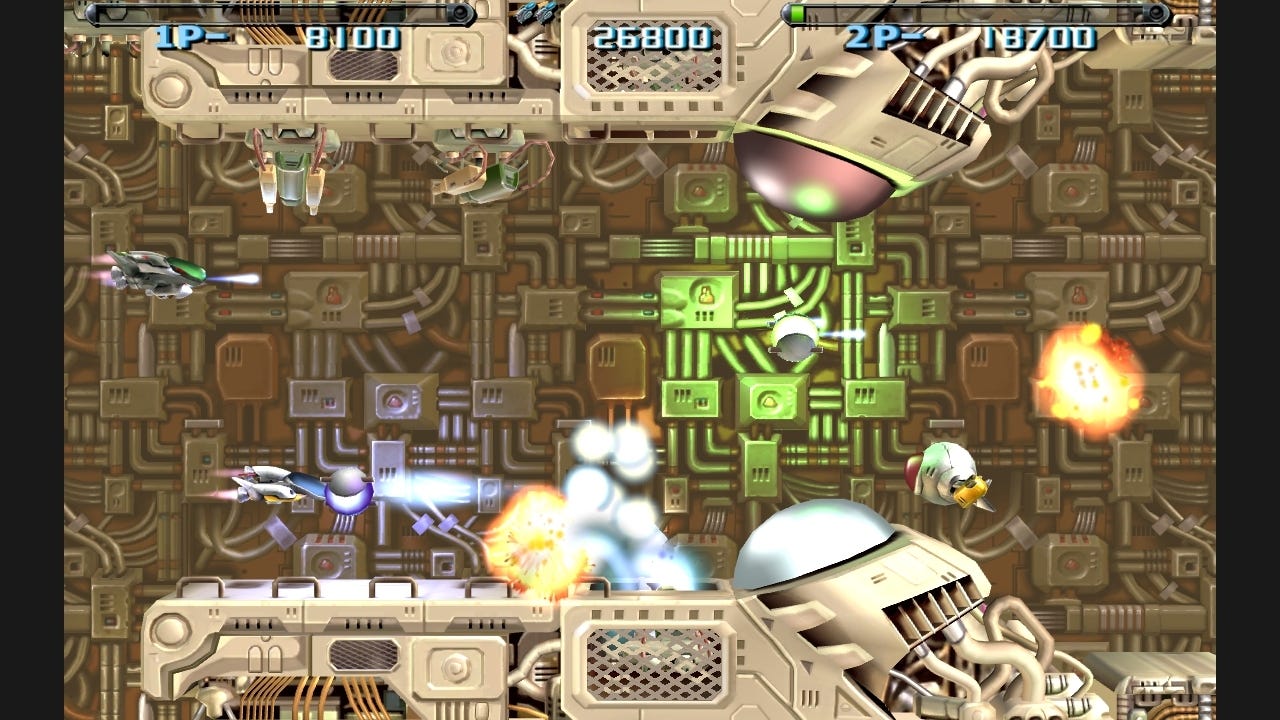
R-Type Dimensions' gimmick is being able to switch between the pixel-perfect 2D sprite work of the original games and SouthEnd's new, R-Type Final-style 3D reworking. The transition between appearances, triggered by the Y-button at any point during play, is smooth and wonderful even if you will probably just settle on a preference after half an hour and stick with it. The game's visuals, whichever aesthetic you opt for, dazzle. Claustrophobic levels funnel the player through arresting HR Giger alien nightmare-scapes, the enemy Bydo race a fearful amalgam of technology and organic deviance. Giant, deformed scorpions click and swipe at your ship while red capillaries heave and pulse in the parallax background. From the start of R-Type to the end of its sequel each level is distinctive and carefully designed, something even younger players will appreciate without the modifier of sepia nostalgia.

As well as its standard pulse gun the ship also packs a plasma cannon, triggered by holding down the A button to accumulate beam energy. In R-Type you release the button when the gauge is filled to fire a powerful plasma beam while, in its sequel, the cannon has two charge stages. As your standard weapon ceases to fire while you charge your cannon the design implication to the player is significant: should you risk pausing your onslaught for a heavier punch or carry on chipping away at your enemies' with pulse jabs?

There are two ways to play both games: standard Arcade mode or Infinite mode. In the former you have three lives with the game ending when they are lost. When you die you lose your weapons and Force and are returned to the nearest checkpoint. If you choose to continue on the Game Over screen then your score is wiped, the challenge being to clear either game with a single 'credit'. By contrast, Infinite mode grants you unlimited lives but records the number used to complete the game on the leaderboard for all to see. Infinite mode is SouthEnd's concession to beginners, allowing everyone to see the games in their entirety without diluting the core challenge for experts and those willing to train for excellence.

There are, however, a few niggling oversights that ensure this rerelease falls short of other top line XBLA examples such as Rez HD and Ikaruga. For one, the lack of difficulty settings, which were present in the original arcade version, is inexplicable. That the update's difficulty seems to be set above the default arcade dip switch setting makes the decision all the stranger. As a result, this is a game that, more than ever, will only reward deep and concentrated player investment.

2

The game's statistics monitor how many of the 14 stages have been completed as well as such minutiae as the number of shots fired and single shot kills.

But the most immediate problem, particularly for those players with deep muscle memory of the original games, is the lack of a button reconfiguration option. The placement of Force on the X button seems strange to my hands and without any option to shift it over to the B button, the default (and only) configuration demands players grow accustomed to its idiosyncrasies. The default auto-fire option is less than the fastest fire rate (achieved by tapping the fire button as fast as you can) so in this regard the game rewards players who use an arcade stick rather than the default Xbox 360 pad.

While there are a number of graphical, MAME-style filters for the 3D game appearance, there are no such options (not even scan lines) for the pure 2D aesthetic, another strange decision. Finally, the lack of an option to download other players' replays, which has become almost a genre standard for XBLA shooters, is a shame, especially as some expert tips would have been a help for players looking to improve their game. The new co-op modes, for both local and online play, are welcome. Both Arcade ad Infinite modes can be played like this with the option to add player collision for added difficulty. Classic co-op allows you to revive a fallen companion with a special power-up or at completion of a stage. Lives are shared and a life is lost only when both ships are destroyed at the same point - a neat idea.

The result is a tough but lovely recreation of two of the greatest orthodox shoot-'em-ups ever made. There's no denying that both titles are products of the genre's formative years and, in terms of both graphical splendour and range of game mechanics they falter next to the likes of Gradius V or even R-Type Final. But what the games lack in breadth they make up for in depth, offering a mesmerising ride through an experience way ahead of its time. To more fully answer Irem's 1987 question then, 'Probably not. But we'll give it a damn good try.'

8 / 10

Read the Eurogamer.net scoring policy

Comments (53)

Comments for this article are now closed, but please feel free to continue chatting on the forum!

  • Loading...hold tight!