Puzzlegeddon
In space, no-one can hear you matchmake.

There must be an area, a gland or a neural network somewhere deep within those quivering grey meat computers in our heads which absolutely revels in the organisation of stuff into groups: a fragment of our reptilian hind-brain which is unnervingly fond of putting things into small sets, delineated by their colour and shape. What evolutionary purpose it might serve, I'm not sure, but it's the only logical explanation for the vast number of games which involve just that.
Puzzlegeddon is one of those games, and despite an over-arching metagame, that's really all it boils down to. The grid of coloured blocks which must be matched is a 6x6 affair, lumped squarely across roughly one third of a planet's hemisphere. Moving columns up or down and rows left and right, with the colours wrapping back around to reappear on the other side of the grid, allows players to align groups of five or more of the same colour before hitting the right mouse button to activate those groups. That pings them off into the ether and grabs the resources which they represent, used to fuel power-ups and defences against enemy attack.
Woah, woah, woah. Planets? Resources? Power-ups? Enemy attack? Five or more? What foul calumny is this? These are not the brightly coloured blocks which build the house of puzzle; these are fiendish interlopers from the rival realms of strategy, shooting and action! To arms! They must be repulsed, returned to the fetid lands of base-building, reloading and cover-taking from whence they came! Which we would, except that it all works rather well, actually.
Puzzlegeddon is an overtly competitive game, in which you must destroy the anthropomorphised towers which represent your enemies as they attempt to destroy yours. None of this takes place on the puzzle board, however. The resources - maximised by clearing multiple groups at once, or scoring fortunate chains - are used to launch attacks and defend against the attacks of others. This all takes place in the atmosphere of the planet, with attacks taking the form of cartoonish, stubby rockets and debilitating lightning strikes which nerf an opponent's abilities. Defences are straight power-ups, which render attacks more powerful or the board friendlier, and an anti-missile defence system.
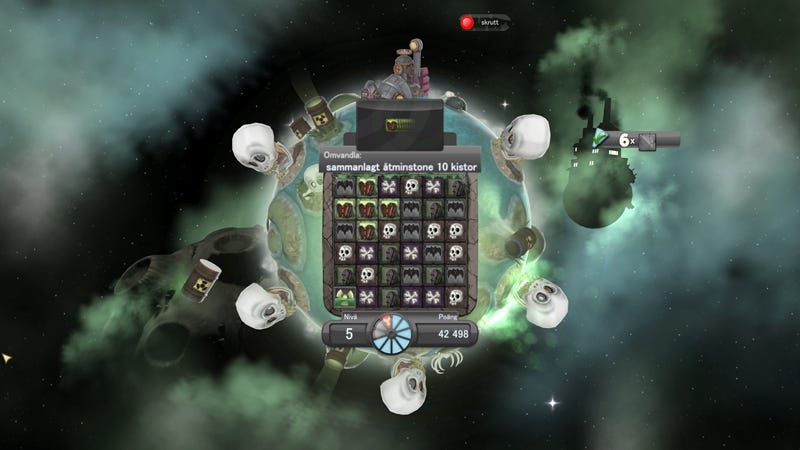
Using them couldn't be easier - a good job considering the hectic nature of the puzzling. To launch a missile attack, right click on your enemy. Lightning strikes are a left click; defences are a left click for power-ups and a right click for missile repellents, but with your own avatar as the focus.
Each resource pool is fed by clearing tiles of a certain colour and has three levels of escalation. Red is offence, meaning missiles become increasingly powerful and harder to stop; blue means power-ups become more effective and longer lasting; yellow makes debuffs more debilitating. The two layers of green missile defence are topped by a shield which bounces attacks straight back at their originator. As more of each colour resource is accumulated, a gauge fills up underneath your island avatar, indicating at a glance what level of power-up is available.
Visually, it's very cute, and extremely polished. The tiny missiles which putt-putt their way though the atmosphere toward your animated tower are straight out of Tintin, via Worms. The planets themselves are somewhere between Mario Galaxy and LittleBigPlanet patchwork. The islands, each of which provides a unique yet mild gameplay bonus, are jollily animated, twitching with dismay and bouncing with bloodthirsty passion. There also seems to be an unhealthy relationship between the musical score and the theme-tunes for Peggle and the bouncy love-disco level of Psychonauts.