The first time David Reeves got up on stage and took a new PSP out of his pocket, it was easy to see why he looked so pleased with himself. The PSP-2000 - or Slim & Lite to you and me and the shops - was considerably smaller and lighter, and upon further investigation was clearly a big step forward, introducing USB charging, external video output, and more onboard memory to improve load times.
When he did it again in August 2008 though, we all wondered if he'd brought the wrong one. The PSP-3000 - another unofficial name - looked identical to the Slim & Lite, and Reeves' declaration that the screen was much better and that it now had a microphone built in didn't exactly cradle our nethers the way a built-in hard drive or Keeley Hawes might have done. In fact, we wondered what Sony was thinking.
The clue, we realised about ten seconds later, was in the name change - or rather the absence of one. "PSP-3000" may be the working title, but when it hits the shelves it will still be called the PSP Slim & Lite, because it's not a sequel to the PSP-2000 - it's a hardware revision that also happens to allow Sony to maintain the existing price point, and generate renewed buzz for the platform. Still, we'd never fall for that.
So, we've been playing with the PSP-3000 since it turned up on Saturday morning, and apart from a red bar mentioning the "enhanced screen and built-in microphone" and a discreet "PSP-3003 PB" designation in the bottom-right corner, the box doesn't make much of a song and dance about its brand new occupant.
Nor, initially, does the unit itself. The old "Home" button has been replaced with a brand-unifying PS-logo button, and the tiny microphone hole is located between the volume controls and the PSP logo itself on the front of the unit at the bottom. The promised curvier edges are so similar that we honestly forgot about them until most of this feature was written and we noticed some shadow gradient on a photograph, and went back and checked.
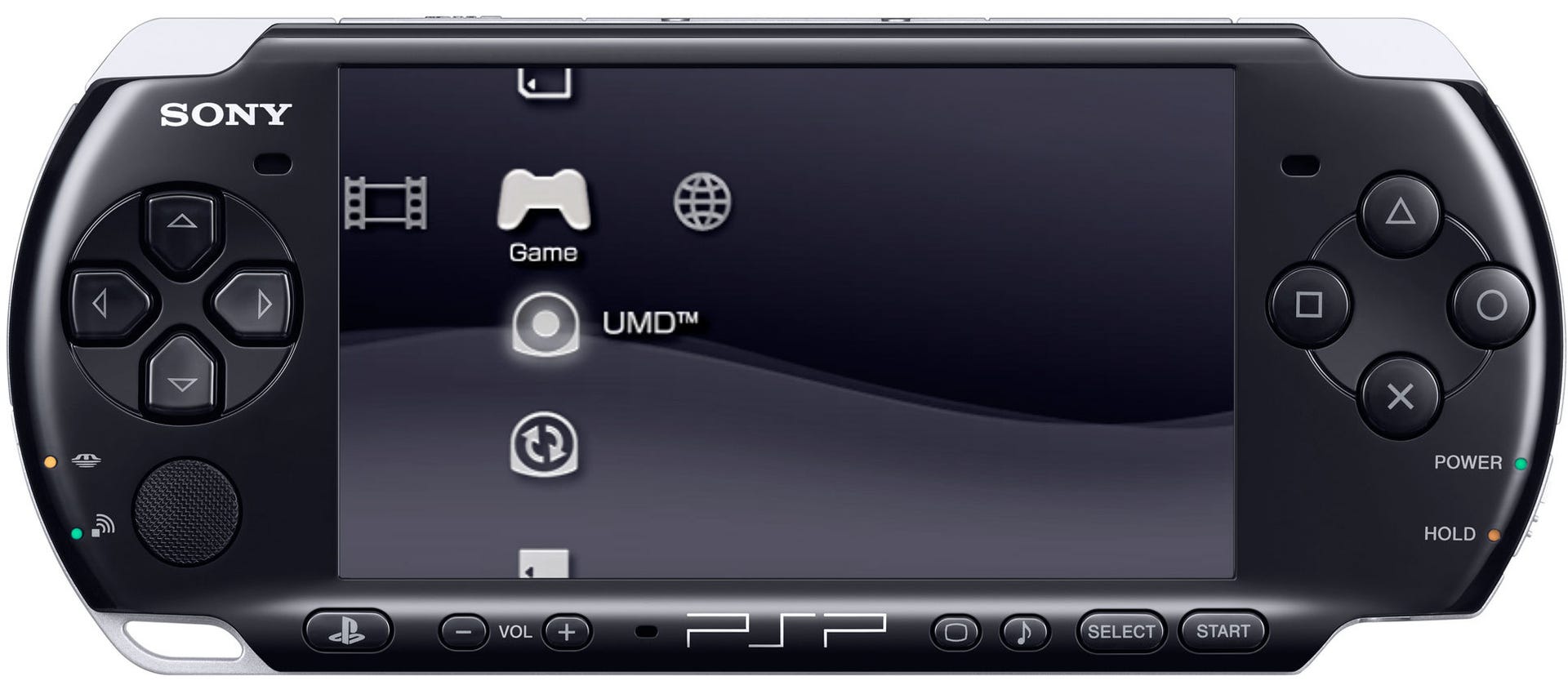
The main superficial changes are the microphone, the PS button and the slightly curvier edges. Can you find them all?
Switching on, the experience is much the same too, with the traditional set-up procedure - picking out a nickname and setting the date - before being plonked on the XMB and left to explore. There's something different about the screen though. In Sony's rather cold words, the colour range has been increased, the contrast ratio is five times that of the old model, the pixel response time has been halved to reduce ghosting, and it should be much easier to play outdoors thanks to anti-reflective gubbins. The "Color space" option on the system menu of the new 4.20 firmware installed on our retail unit is more poetic: "If you set to [Wide], the system's display will appear more vivid."
And it does. The usual four brightness settings are here (three when using the battery, and a fourth super-brightness level when you're plugged into the mains), but the colours at any level are much richer, warmer and deeper than the PSP-2000. As a result, the new PSP's battery-powered third brightness level outshines the mains-powered fourth on its predecessor. If you flick the "Color space" option back to Normal, meanwhile, the colouring reverts to something closer to, though still brighter than, the PSP-2000.
The difference in visual quality between games running on the PSP-2000 and PSP-3000 isn't as dramatic as the difference between games on the original DS and the DS Lite - the last time we found ourselves considering something of this nature, and a good frame of reference - but it's very noticeable when you return to a PSP-2000 running the same game. Lumines II and God of War: Chains of Olympus on the old hardware look pale and sickly after five minutes playing on the updated hardware.
As to whether it's easier to play games outdoors, we recommend not going outdoors because it's cold and miserable. We leaned out of a few windows and sat on a windy station platform for half an hour at the weekend in thoroughly bleak conditions and neither PSP really struggled to cope with the light from overhead. Presumably when (if) the sun shines again, we'll get a better sense of the PSP-3000's anti-glare abilities, but for now we'll have to give them the benefit of the doubt.
Something that is noticeable about the new PSP, though, is that the d-pad and face buttons are slightly more pronounced, and feel a bit firmer under the thumb. However, whether this is because we've been puzzling Tetsuya Mizuguchi's block patterns and singing New Order every time we get on a train for a year, or whether this is a genuine update, is harder to say.
We play fewer games that support use of the microphone, of course, because SOCOM is basically the only one, and Zipper Interactive's third-person shooter is the US cultural equivalent of Monster Hunter in Japan: unfathomable to outsiders. The microphone also works with Skype though, and in our test phone calls to friends they had no difficulty hearing us. A definite improvement for those of you used to lugging an unwieldy headset.
Elsewhere, our side-by-side comparison of the current PSP/PSP-2000 firmware, 4.05, and the new 4.20 firmware on the PSP-3000 reveals a "USB Auto-Connect" option, which promises to automatically switch the handheld to USB mode when a cable is connected. It will do this from anywhere on the XMB, but it won't interrupt gameplay. Nor does the PSP charge from USB during gameplay, although - as of the original Slim & Lite revision - it will do so while in USB mode.
Finally for this instalment of Firmware Detectives, we uncovered a "Flicker reduction" toggle under the "Connected display" settings menu. The new-model PSP also allows you to play games on a TV by hooking it up with a special adapter (sold separately) and a composite cable, whereas the old one would only allow composite cables to display video, with gaming reserved for component output.
Nowhere in all of this, either, has anyone mentioned the new, smarter AC adapter unit, which does away with the figure-of-eight cable and black box arrangement - always rather clunky for something pertaining to be portable - in favour of a Nokia-style one-piece with a small, direct cable, which you can happily chuck in a pocket without trailing cables everywhere.
We haven't got a silver one, so we're going to start a feud between piano and silver PSP owners. Bloody silvers! Go ride a unicorn, dorkface!
The last remaining question mark, of course, hangs over Sony's toing and froing about the PSP-3000's battery life. Originally we were told you lost about 30 minutes to the new screen's excesses; then we were told "engineers in Japan" had reduced power consumption elsewhere in the unit to compensate. Well, the engineers did their job, because we got the same five and a half hours we've come to expect playing games. Apparently that figure is slightly less for people watching UMD videos, so watch out for that. Both of you.
As a sign of things to come for the PSP hardware line, then - and have no doubt about it, we'll see more of these minor revisions, perhaps even annually - the PSP-3000 is noticeably improved in some areas, but none of the improvements is dramatic enough to justify the expenditure to existing PSP-2000 owners. Going forward, Sony will need to think about this, because if it intends to adopt a handheld model closer to Apple's iPod business, it needs sharper hooks upon which to impale our moneyed jaws.
As a simple hardware revision, though, it's a sensible one that gives consumers a better option at the same price point (admittedly instead of a price drop), and will encourage developers to consider voice communication in their online games. We probably wouldn't pay for one, but having transplanted our Lumines habit to the new hardware, we won't be going back, and the PSP is stronger for the change.
The PSP-3000 - look out for the labelling on PSP Slim & Lite packaging - goes on sale in the UK and Europe in mid-October. UK-based gamers will be able to pick it up for GBP 149.99 bundled with games and peripherals.
