Project: Aftermath
Aftermath you can count better.


Sometimes doing the right thing really doesn't matter.
The British indie developers at Games Faction, the studio behind Project Aftermath, have done nothing but the right thing since the release of this, their debut game. They have embraced digital download culture. They have kept in touch with fans through a splendid, open web presence. They have had post-release support to put almost all the majors to shame, adding 20 challenge modes to the game, complete with online scoring. Hell, when I booted it up this morning for some fact-checking I discovered they had added achievements to the bally thing. They have even sliced the price to ten dollars, which is proving a popular place for PC indie games. If more developers showed the passion, professionalism and enlightened philanthropy that Games Faction has displayed, gaming would be a better place.
None of it matters. The game's no good.
It's a squad-based real-time-strategy game, so rather than controlling an army, you control up to four heroes and their associated soldiers (plus a couple more slots for mission-related people). In terms of reference points, the modern one would be Dawn of War II's single-player. In terms of indie games, think Darwinia. In terms of being really old, think Syndicate. As a game, Project: Aftermath is considerably more intricate than any of the above, but shares the key idea: a limited number of pieces that you manoeuvre to beat a level - either the 10-mission story campaign or the 20 challenges.
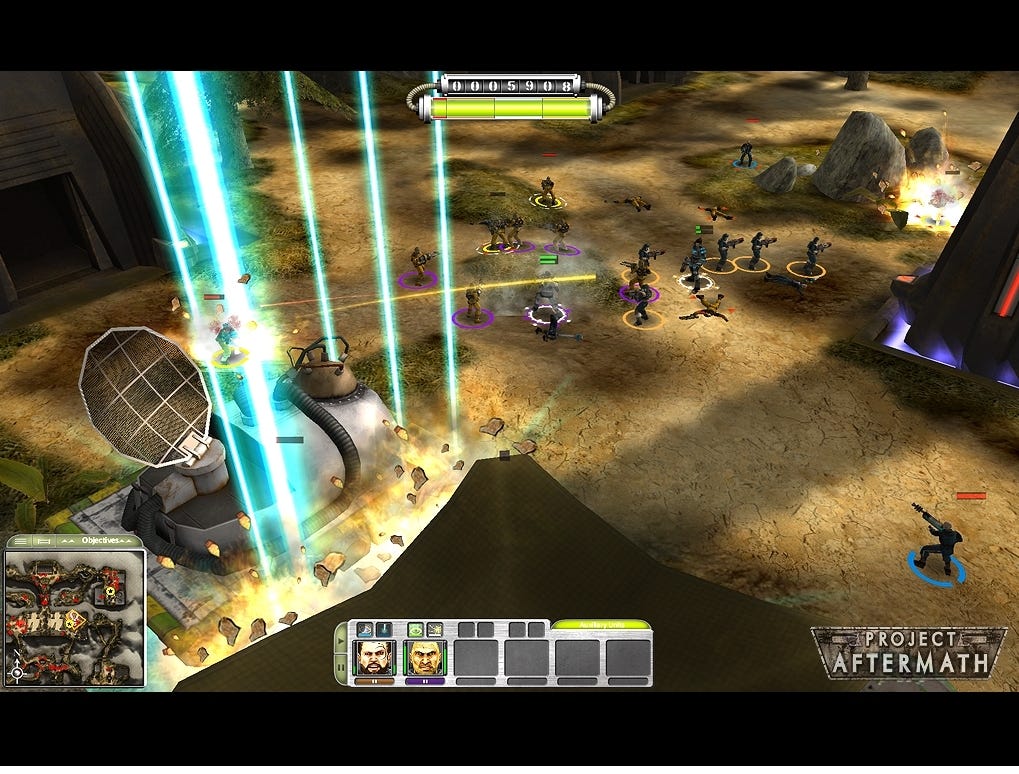
There are a couple of resources of which to keep track. GOOP is the main one - a lovely green gel used as currency for a variety of things, including hero characters' special abilities and resurrecting them after death. The latter means the game initially appears a bit of a walkover - after all, what's to stop you resurrecting all the time? Well, if you complete the level with insufficient GOOP, you fail the mission anyway. In other words, you swiftly start trying to minimise GOOP expenditure, and lean on options that don't rest upon it, like pickups around the level, including ones which add more GOOP.
But the handiest one is the battlefield reinforcement system, where slaughtering the opposition fills a meter. As you hit each of three markers, you gain the ability to call in one of the bonuses for the level. It's an elaborate version of the Golden Axe power-up system transplanted into an RTS, really, with you deciding when's best to cash your chips, and what to cash your chips for. Worth saving for a group of hyper-hard soldiers to back you up? Or should you settle for some manner of defence turret? This is one of the strongest parts of the design, with clean-edged and meaningful tactical impact. For example, on the second tier, there's an immobile turret that sets up immediately, and a satellite-powered thingy that can be picked up and redeployed and is more powerful, but takes ages to warm up. One can turn a single fight, or create a single killing zone; the other can be used repeatedly, but is immune to improvisation. That's neat. I wish there was more of that sort of game design.
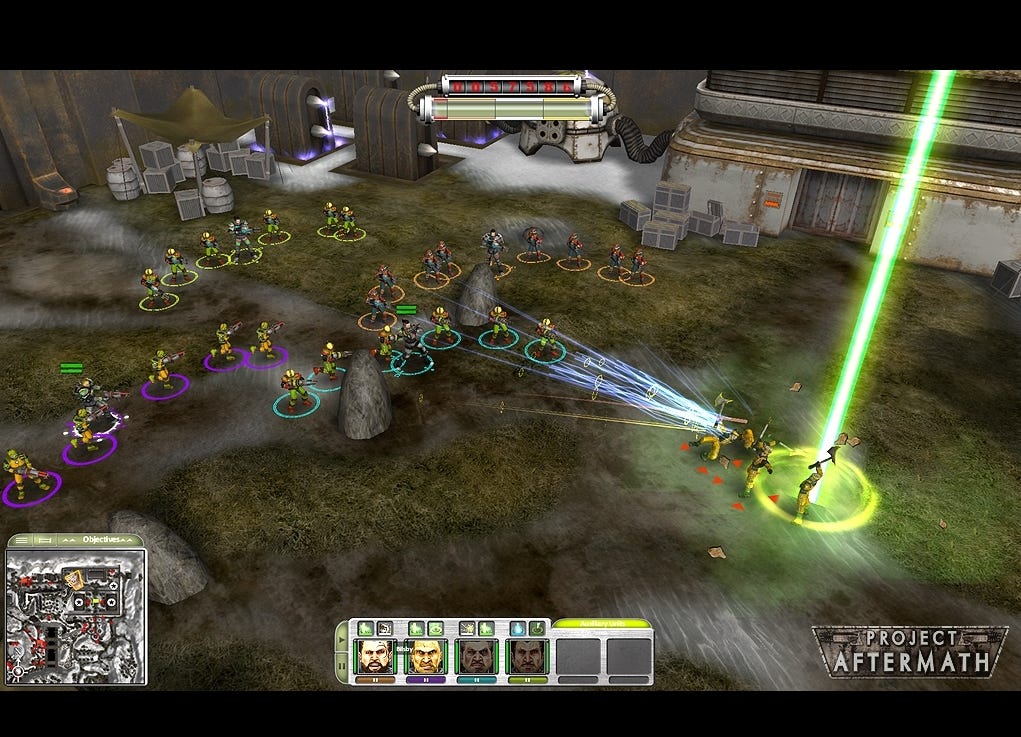
The lower-level abilities mainly tie into the other lynchpin of the combat system, allowing you to swap your squad's armour, weapons or special abilities depending on the situation. This is necessary due to the game's main quirk - four sorts of colour-coded damage. People with red armour are resistant to red damage, so you're better off zapping them with blue, green or yellow instead. The trick is that each hero is only able to carry two sorts of weapons at once, requiring a manual change to the appropriate one. If you've not brought an appropriate one, it's time to use the aforementioned weapon-swapping stuff. Across the campaign, you receive research points which you use to unlock better weapons and armour. The other flourish is that each of the weapons has its own cost, so you're able to make a level harder or easier depending how much you want to spend, which in turn influences your score.
There's quite a lot more fine detail in there, but they are the tent poles. It's the sort of game where there's this filigree of detail for you to explore, which is one of its conceptual problems: there's not much of a framework to encourage you to play with tactics. The turret stuff I mentioned earlier is a notable exception. It has the sense of all the ideas piled into it, and less of a real sense of why.