Pokémon Ranger: Shadows of Almia
Catch and release.


Pokémon isn't really a series you turn to if you demand radical evolution between instalments. The core series has remained largely unchanged for over a decade, with the most obvious differences evident in the ever-shifting Pokédex listings rather than the gameplay.
Along with Mystery Dungeon, 2007's Pokémon Ranger represented one of the occasional attempts to spin off an RPG variation, and the result is mixed. The whole concept of "gotta catch 'em all" is rendered redundant by the focus on Rangers, Pokémon specialists who deal with the critters in their wild state, meaning you'll be collecting for the short term, grabbing creatures whose abilities will get you past a specific obstacle or enemy, instead of looking at a sprawling menagerie of levelled-up Pokémon for long-term competitive success.
The main twist is that you catch Pokémon using a Capture Styler, a device that conveniently works in much the same way as the DS stylus. Draw enough circles around the Pokémon, and they're yours. The Pokémon will fight back - either by trying to run away, in which case contact breaks your line, or by using their abilities. Should a Pokémon attack hit your capture line, the Styler is damaged. If it takes too many hits, you're dumped back to the last save point.
There are some minor changes to the system for this second venture into Ranger country but, while they address some of our complaints from last time, on the whole the capture mechanic still feels underdeveloped. There are slightly more Pokémon available for capture - including new ones from Diamond and Pearl - but the experience remains a mere snack compared to the proper Pokémon adventures.
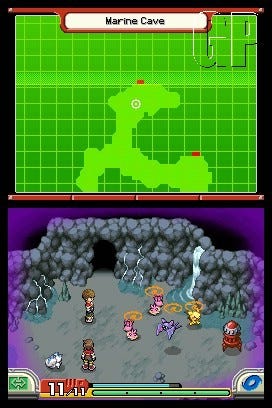
In the previous Ranger game, you had to maintain a constant circling motion to capture a Pokémon, but this rather strict requirement has been relaxed for Shadows of Almia. Each circle you draw now fills up a friendship meter under the Pokémon in question. You can stop circling to avoid attacks, but if you wait too long the meter starts to fall. It's a definite improvement, allowing for some measure of tactical play, but the constant circling still feels repetitive, and is a surprisingly basic use of the DS hardware.
Captures are enhanced somewhat by the return of the Assist feature, since friendly Pokémon powers offer a few extra flicks and scribbles to help subdue their wild brethren, but it's never as deep or varied as you'd hope. Back when we reviewed the rune-based action puzzle game Doodle Hex, it was suggested that the frantic shape-drawing action "would make an excellent combat system for an RPG", and Pokémon Ranger would have been the perfect recipient. Since capturing is the core element of the game, just having a different array of capture styles to draw - squares, triangles, verticals, horizontals, anything but endless circles - would make the experience a lot more engaging over the long haul.