Pokemon HeartGold / SoulSilver Review

The golden days return.

Version tested: DS

Like FireRed and LeafGreen on the GBA, Pokemon HeartGold and SoulSilver are updated remakes of older Pokemon games - in this instance, the original Pokemon sequels, which first arrived in Europe in 2001 on the Game Boy Color. I first played them when I was twelve years old, which, distressingly, was nearly a decade ago. Reaching the stage at which your own childhood classics start getting remade to delight a new generation is a sobering milestone in one's gaming life.

I'm probably a sizeable portion of HeartGold and SoulSilver's audience. We're in our twenties, now, the kids who were playing Red and Blue 15 years ago and taking Pikachu lunch boxes to school. A lot of us have probably failed to keep up with the series in the intervening years and find its ever-expanding menagerie of increasingly weird-looking monsters intimidating.

HeartGold and SoulSilver are artfully designed to draw us back in with familiar Pokemon in a familiar world, wrapped up in updated graphics and gameplay systems and packaged with a new gadget, the Pokewalker. The question is not so much whether HeartGold and SoulSilver are good games - they're excellent, always were - but whether they're good enough to merit buying again, or to draw in a new, nostalgia-immune audience.

Pokemon's innate appeal, certainly, is timeless. Its spirit of adventure and richness of imagination are evident from the second your young trainer sets off into a detailed and vivid world, kept turning by a touchingly symbiotic relationship between the people and the many different creatures that inhabit it.

Essentially, it's about hard work and empowerment. You rise from nothing to conquer the world by virtue of your own hard graft, through investing inordinate time and effort into a team of creatures that quickly come to feel like an extension of yourself. The rhythmic process of collecting, training and learning about the Pokemon is irresistibly absorbing; 15 minutes of exploration quickly turns into an hour of battling, or tinkering with your team, or hunting for an elusive catch.
1

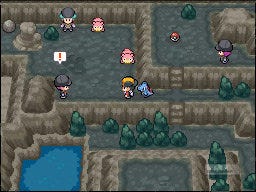
Oddly, Nintendo has yet to release any official screens, but we managed to dig this one up.

Every player's relationship with the game is unique. Pokemon has always understood the importance of personalisation and HeartGold and SoulSilver offer ample opportunity for self-expression, not just in your choice of Pokemon and the way you raise them, but in personalised trainer data cards and Pokegear skins. The games track your investment of time and effort with meticulous detail, and always make you feel that it's worthwhile.

There's a lot of necessary repetition in the Pokemon formula in the form of random battles, but the games are structured to minimise the grind. Rival trainers give the entire team a workout, and you find that your squad develops naturally and evenly thanks to the elegant balance of the battle system. The decade's worth of refinement that the Pokemon series has undergone is not lost on HeartGold and SoulSilver. It implements all of the tiny, incremental improvements to the complex and yet inexplicably intuitive type interactions and battle moves that form the core of Pokemon combat. By now, it is a thing of beauty: intelligent, exciting and never unfair.

Pokemon Gold and Silver always were especially notable for their sheer amount of content. As well as having more than 250 different Pokemon, the pair were also literally twice the length of Red and Blue. After progressing through Johto's eight Pokemon gyms and the Elite Four, you get to do it all again in Kanto before a final showdown.

The games' complexity is incredibly impressive and endlessly stimulating. The intricacies of Pokemon breeding and evolution, mysterious items and the day-and-night cycle unravel slowly over the course of the adventure, but it always feels as if there's more to learn.

Astonishingly, HeartGold and SoulSilver never feel old; they come across as extremely modern. If anything, these remakes highlight how forward-thinking the original games actually were. Pokemon understood sharing, trading and communal gaming before the Internet made it commonplace. Gold and Silver even predicted the smartphone in the form of the Pokegear, the PDA that stores your map and the phone numbers of trainers and friends that you meet on your journey through Johto. It's all intuitively displayed on the touchscreen, along with Pokemon team stats, the contents of your item satchel, the obsessively detailed Pokedex and your own personalised trainer card.

The touchscreen allows for a very clear display of information; this is a vast improvement over the original games, especially as there is just so much information in Pokemon HeartGold and SoulSilver. You can search the Pokedex by everything from a Pokemon's name to its height, weight, location, nature or type. Each individual creature has a different set of stats and personality traits to absorb. Every single move and item has its own chunk of descriptive text. Colour-coding and touch controls make the arcane knowledge and mathematics at the heart of the Pokemon experience easy to digest and simple to access.

Only a few things seem old-fashioned. The map annotation system, which is hidden so well that most people probably wouldn't even know it existed, only lets you choose from preset phrases rather than write your own notes, which feels weirdly anachronistic. The phone calls can get annoying, too; it's all very well for a bug catcher to ring up and offer to share his berries with you when you're getting started, but when he's still doing it twenty hours into the game it starts to grate. Being able to rematch challenging trainers is a great feature, but you'll also get a lot of phone calls from the small-fry kids you were battling back when your Typhlosion was still a Cyndaquil. And for some reason, I felt bad about deleting their numbers from my Pokegear.

2

The Pokewalker: part Tamagotchi, part fitness device.

Pokemon's real achievement is the way it makes you care about the little creatures on the screen, even though they're not really anything more than a collection of numbers and pixels. It's such a personal and involving and comprehensively enthralling experience, and it makes perfect sense that it's managed to hold generations of captivated kids and receptive adults in its spell.

HeartGold and SoulSilver build on the natural bond that develops between the player and his or her Pokemon with little personality descriptions and visual cues; any Pokemon can walk around with you in the world, and they respond positively to your attention. It's amazing how a simple three-line text description of your Bellsprout playing with a twig can become a vignette in the narrative of your relationship with the game. It's difficult to fully understand the magic that Game Freak works, here, but that it works is undeniable.

The Pokewalker pedometer, in theory, enhances this sense of connection by allowing you to carry a Pokemon with you wherever you go, transferring it from the in-game PC to the gadget in your pocket. Walking and playing basic minigames on the wee LCD screen earns your chosen friend experience and in-game currency; they can only gain one level per transfer, so it's not as much of an exploit as it might be. It keeps you thinking about Pokemon, though, as if you needed any encouragement, and though the gadget is hardly a reason to buy the game, it's not just a gimmick, either.

HeartGold and SoulSilver aren't re-releases, they're remakes, and they're more or less perfect examples of how that should be done. They're neither a careless rehash of old material nor crammed with pointless neophiliac nonsense. They combine everything that was best about the older Pokemon games - namely, the more likeable monster designs and inventive spirit - with the much-improved looks and streamlined battle system of the fourth-generation ones. They recapture the energy and imagination of the Pokemon series at the height of its creative and commercial power. And as a lapsed but once-obsessive Pokemon fan, they've recaptured my imagination, too.

9 / 10

Read the Eurogamer.net scoring policy

Comments (79)

Comments for this article are now closed, but please feel free to continue chatting on the forum!

  • Loading...hold tight!