Never mind all that general election nonsense - this year's real battle for hearts and minds is being fought by Sony and Microsoft. The platform holders are going head-to-head, clashing over whether virtual pre-pubescent boys and invisible steering wheels are better than magic colour-changing ping pong balls on sticks. Makes a change from tax breaks and immigration, anyway.
The fight is set to really heat up this June when both parties show off their wares at E3, but the campaign has already started in earnest. Sony laughed in the face of volcanic ash last week and held an event at a swank hotel in London to show off new motion controller PlayStation Move.
The code on display was pretty much the same as what was shown back in March, so read our GDC hands-on preview for the lowdown. Developers there to demo the games included Olivier Banal, European producer on Sports Champions (you know, the one with the gladiators and the table tennis). Eurogamer sat down with him for a chat - read on to find out how the game's coming along and why it's not just another mini-game compilation, honest.
Eurogamer: How would you describe Sports Champions?
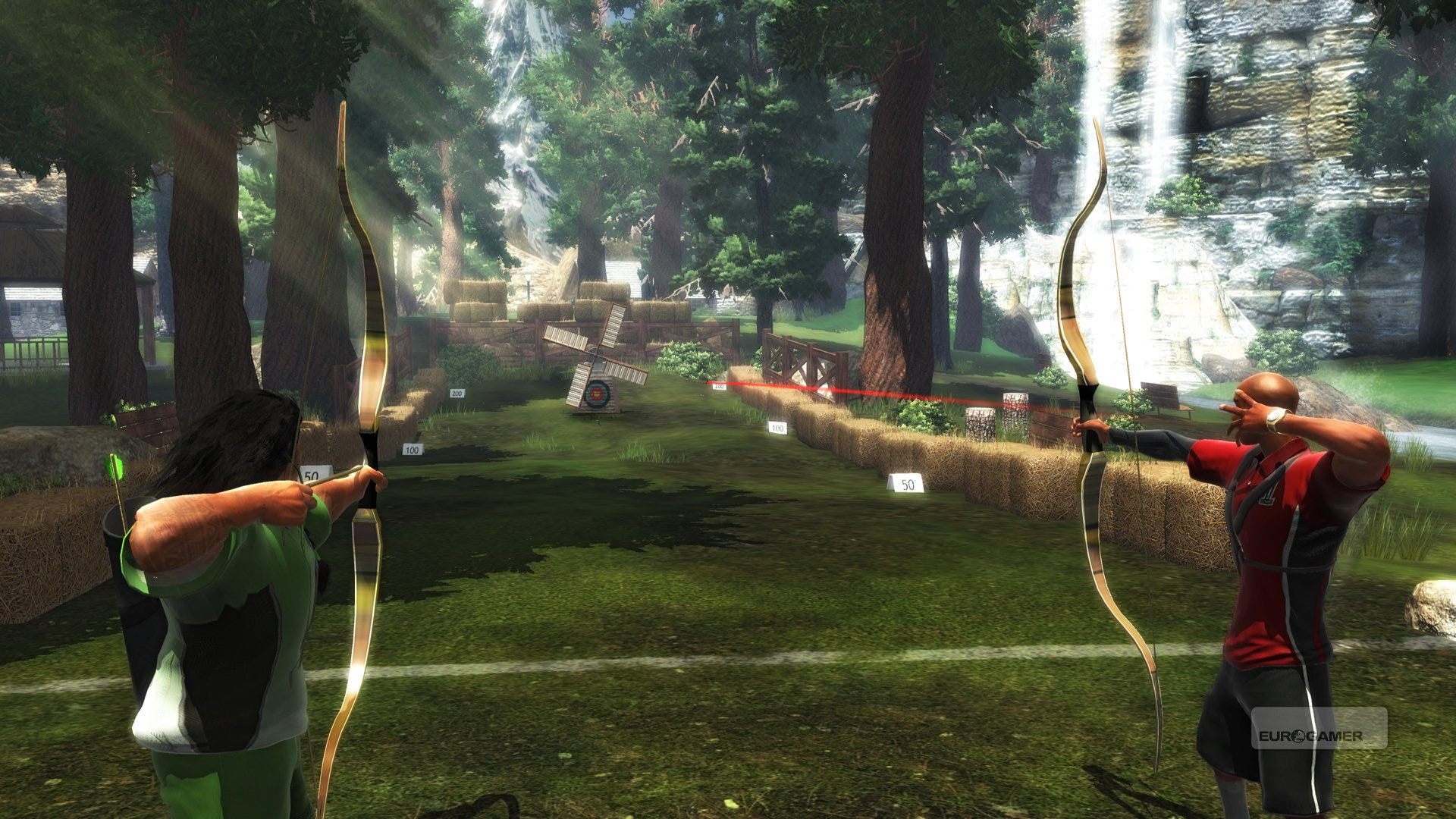
Olivier Banal: It's a sports simulation. It replicates real-life sports as well as not-so-real-life sports, like gladiator duels. You act out the sport just as you would do in real-life, and the Move controller tracks your motions. So throwing a frisbee, swinging a bat, throwing a ball, shooting arrows... Things like that.
Kevin Butler talks movement.
Eurogamer: So it's a collection of mini-games?
Olivier Banal: It's a collection of events. We don't really like the term 'mini-game' because the game mechanics are very accurate and precise. There's a big learning curve if you want to master the events.
But the aim is for anyone to be able to play, whether they've never played table tennis before, say, or want a really accurate simulation. For that we've got different difficulty levels. The aim now is to balance the game so it's more forgiving for players who aren't so skilled, and very accurate for those who get a really good handle on it.
Eurogamer: How do you achieve that? I've played a lot of Wii games, a lot of what I would call mini-game compilations. Often I've found the mini-games are either too challenging for, say, my mum to play, or they're too simple and just involve waggling, which is no fun for anyone. How do you strike a balance?
Olivier Banal: Replicating a real-life discipline with a very accurate motion controller is a bit of a double-edged sword. It's very good at replicating what you're doing, regardless of whether you're doing it right or wrong.
That's where the different difficulty levels come in. The easier levels will fine-tune what you're doing - for example, in table tennis, to make sure you hit the ball back over the net and on the table. At the other end of the spectrum, you get more control over the ball but you're also more likely to hit the net or hit it wide.
You can adapt the difficulty levels to individual players. So if you're playing table tennis with your mum, you can set the level to easy for her and normal for you, and play against each other like that.
Eurogamer: Table tennis makes a good case in point, as there are lots of table tennis games already out there for the Wii. I'm not sure the motion control aspect makes them worth playing, though - I'd always rather play the Xbox 360 version of Rockstar Table Tennis, for example...
Olivier Banal: Move offers the most accurate simulation you can get. With the combination of the gyrometer, the accelerometer and the light tracking, you basically have motion tracking in a 3D environment. If you turn the bat to a certain angle then the physics engine identifies that, and adapts the trajectory of the ball like in accordance with the physics. So you can put in as much spin as you want and replicate what you'd do in real life.
The challenge for the team right now is to make sure that players get into the game and aren't frustrated after five minutes spent missing the ball. Once they're used to that you can move on to a more realistic setting, one which allows players to have more control and get closer to a realistic experience. That's something I believe we can achieve with Move.
Eurogamer: How is Sports Champions structured? Is it just designed for party play?
Olivier Banal: There are three modes. The single-player is called Progression mode because it takes you through the different events, switching difficulty levels up when you complete them in one setting. So you start on easy, move to normal and then hard, which is basically full physics - nothing is forgiven, it's all about how accurate you are. The single-player experience is meant to educate you about the game mechanics.
Free Play is kind of a social mode. You can jump straight into an event, multiplayer if you want, and just play away. Challenge mode has mini-game variations on every event. For example, in table tennis, you'll have a robot hitting different balls to you, in archery there's moving target practice, things like that.
Eurogamer: How does the multiplayer work? Do you need a sub-controller and a Move controller for each player?
Olivier Banal: Sports Champions doesn't use the sub-controller, it uses one or two Move controllers. Some events you can play one after the other, like golf, so you can just share one controller and pass it along. Then you've got split-screen multiplayer for events like the gladiator duel and table tennis, where you're standing side-by-side and swinging away.
Eurogamer: Are there plans to bundle Sports Champions with a Move controller?
Olivier Banal: This is something I can't comment on. I've been told not to say anything about it. And I'm a very obedient employee, so I'll just obey and not say anything.
Eurogamer: I'll take that as a yes, thanks. Have you seen much of Project Natal?
Olivier Banal: I saw a video a couple of days ago. I don't know a lot about it but I know kind of get the idea of how it works and how much of your body it maps, which is immensely different from what the motion controller does... So what do you want me to tell you about Natal?
Eurogamer: What do you think of it? When you saw the video did you think, 'Wow, that's really exciting,' or, 'Wow, I want one,' or, 'Wow, that's not as good as my magical electronic ping pong ball?'
Olivier Banal: It's brave to expand the whole motion control idea to mapping your whole body and then working from there. You can see that it could be good for adding another dimension to the traditional controls. I'm not a designer so I can't think of any ideas off the top of my head, but yeah, it's something that could just add a few more opportunities for smoke and mirrors in games.
In terms of pure motion control, I think it's probably not as accurate as Move is. But then maybe it lets you do more, so I don't know. It's very early days. It will be interesting to see what all the developers do with these technologies.
As far as Move is concerned I'm confident that with the level of accuracy we've got, the new control system will be a definite plus for gamers - whether they're hardcore or not.
Eurogamer: You mentioned that you read Eurogamer earlier. I don't know if that includes the reader comments...
Olivier Banal: That's half the fun of Eurogamer!
Eurogamer: One topic which crops up a lot when motion control is under discussion is the longevity of the Wii. Readers often say they bought one, had a bit of fun at first, but are now watching their machine gather dust. They have come to the conclusion that as hardcore gamers, motion control isn't for them. What would you say to convince them they're wrong?
Olivier Banal: I don't think it's my role to have a go at Nintendo...
Eurogamer: Oh go on.
Olivier Banal: They may have set a precedent here. For some people, the only experience they've got of motion control is with the Wii, so when they first play a Move game they're not really moving around, they're not aware of exactly how much fidelity there is. That's something which needs to be communicated. The best way is to have a hands-on demonstration - grab a controller, see how it behaves and learn what you can get out of it.
For the more hardcore players, it's about the lack of games. Outside of Zelda and a few other titles... Games like No More Heroes bombed commercially.
Eurogamer: Doesn't that worry you? Sports Champions looks like a relatively hardcore game when compared to most of the Wii games out there. Is there an appetite for it?
Olivier Banal: A first step to signifying there is something for hardcore gamers here is by enhancing some of the franchises we've got with the motion controller, like SOCOM. By adding motion control you really change the way the game is played, and it works well.
But the Move is so accurate there will also be more depth to games that are built for Move from the ground-up. So it's kind of the best of both worlds.
The Eurogamer readers will probably make a fist out of anything I say anyway, so I'll just leave it there. I've got great expectations about the comments on this. We'll see what they say.
Olivier Banal is the European producer for PS3 exclusive Sports Champions. A release date for the game is yet to be announced.