It's a self-effacing brand, PixelJunk. "Why, this old thing?" Kyoto's Q-Games seems to be saying. "Oh, it's just some disposable retro frippery I knocked up, don't give it a second thought." And yes, the three titles to date (Racers, Monsters and Eden) do have a certain thrift-store attitude, pinning tiny 2D sprites on mix-and-match, second-hand inspirations like Scalextric and tower defence.
But PixelJunk, especially the life-consuming Monsters, has also made a huge contribution to the ever-growing collection of exclusive games on PSN that match or beat anything on Xbox Live Arcade for style, originality and daring. They sit proudly alongside the likes of Flower, Noby Noby Boy, The Last Guy and the forthcoming Fat Princess. Having played it at last week's Sony showcase in Los Angeles, we're confident that PixelJunk 1-4 (it's a working title) will be no exception.
It's the most nakedly retro game in the series to date; eighties classics Thrust and Exile are obvious influences on this gravitational game of subterranean search-and-rescue. But it's also the most modern PixelJunk yet, flaunting a technical spectacle of physics and fluid dynamics as the player manipulates reservoirs and torrents of water and magma, as well as the rock itself, to solve the navigational puzzle of each stage.
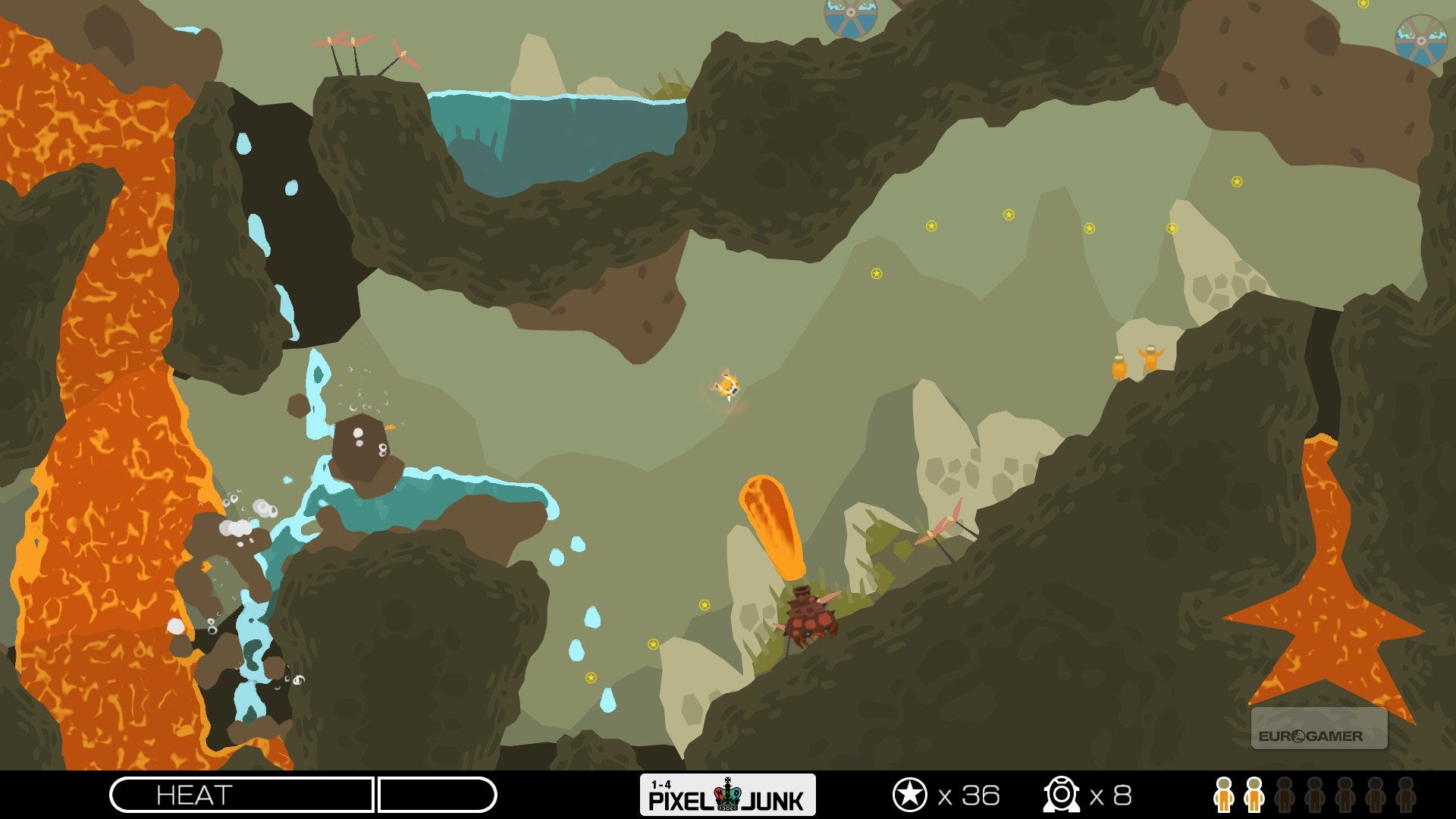
Magma-spewing enemies and volcanoes are tough hazards; proximity is dangerous, but contact kills.
You pilot a tiny yellow capsule through 2D cross-sectional caverns sketched in tasteful Habitat browns. The left stick controls the vessel's movement with thrusters; it has a free-floating inertia and succumbs to a gentle gravitational pull. The right stick controls its orientation through 360 degrees, aiming its rockets, which are used to blast away rock as well as destroy the rather Metroid-style organic enemies and robotic turrets that spit, lunge and shoot from the cavern walls.
There's also a grappling arm, which extends to gather pickups, drag objects and grab the stranded spelunking spacemen who wave cheerfully for help from around each level. You'll need to rescue all of these guys to open a barrier to move on to the next stage - all the living ones, at least, since you can lose them to enemies, rock-falls and lava. Save more to increase your score, which is also boosted by the yellow stars trailed like breadcrumbs around the levels, and released by enemies and rock formations when shot.
So far, so standard twin-stick shooter. But all of this is mere framework for what PixelJunk 1-4 is really about: temperature and fluids, and what happens when you play with them.
Around each stage you'll find great sloshing lakes and waterfalls and rivers of cool blue water, as well as searing red lava in pools, flows, sputtering eruptions and veins in the rock. You'll find them, and you'll create them too - shooting away rock plugs and barriers to direct the flow of each fluid around the level and make the caves navigable in the way you want. When water and lava meet, the lava cools and forms a rock crust which can be blown away.
All this is important because your craft's shields are depleted by heat as well as enemy attacks, so steering too close to the magma for too long - never mind touching it - can cause it to overheat and explode. Conversely, plunging it into water cools it down, effectively restoring your health with an immensely satisfying hiss of steam. You're getting the idea; water is good, lava is bad, and you need to control the flow of both in order to ensure the triumph of good, sweet H2O over all that angry liquid rock, thus clearing passage for your ship to the stranded explorers and the exit.
Using missiles to clear rock and create new paths is the simplest way to do this, but there are more tools than that at your disposal. Huge barrels of water can be found, picked up, dragged and dropped in a violent explosion of cooling liquid. In another level, shooting away a particular piece of rock reveals a giant sponge, which promptly falls into a reservoir and expands as it soaks up the water. The sponge can be grabbed with the grappling arm and trailed behind you, spilling a constant stream of water as it goes, acting as a fire hose that creates bridges of rock across lakes of lava, or dams that you can blast away and reform, and blast away and reform.
Drag one of those waterbombs over to the boiling lava for geothermal fireworks.
It's hypnotic to watch and experiment with, and although there were fairly obvious set solutions for each of the levels I played, the heavy, slow-motion dynamism of the fluids means they never play out exactly the same way twice. There's obvious room for less scripted, more creative play as well, if Q-Games chooses to embrace it.
Regardless, PixelJunk 1-4 is an elegant, exciting and novel game design that looks forward as much as it does back. There's a perfect harmony and balance in the way the clash of hot and cold temperatures is used as both the health mechanic and the principal physical interaction in the game, for puzzle-solving, strategy, navigation and combat. The game hangs together beautifully, is fun to watch and gratifying to play. It's on its way to being the best PixelJunk yet.
All it needs now is a title. Q-Games will be opening this up to fans, hosting a competition to name the game on its website. Good luck. Doing 1-PixelJunk 4 justice in one word won't be easy.
PixelJunk 1-4 is due for release on the PlayStation Network this summer.
