Version tested: PC
Shadowgrounds Survivor
- Developer: Frozenbyte
- Publisher: Meridian4
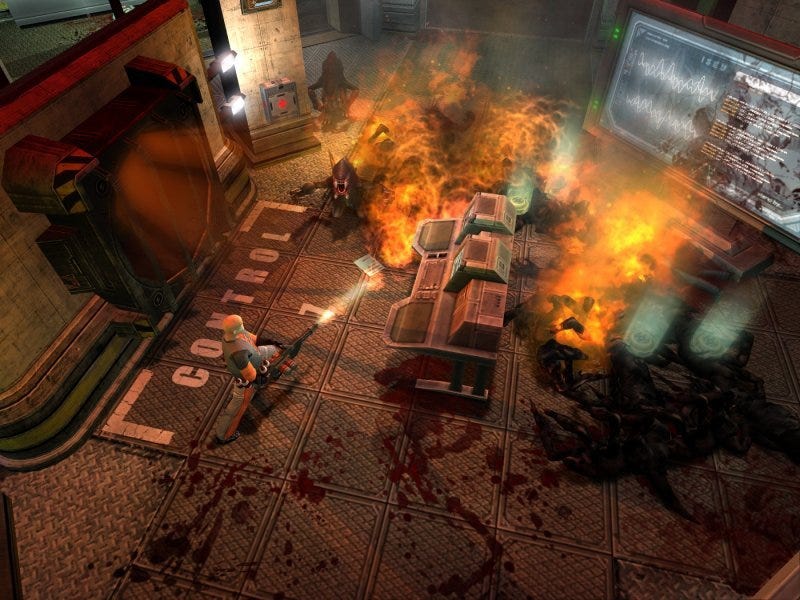
A rather belated sequel to Frozenbyte's 2006 sci-fi shooter, Survivor still does little to mask the debt to Aliens and the many similar titles inspired by James Cameron's militaristic bug hunt over the years. Most notably, it's almost a dead ringer for Team 17's beloved Alien Breed, updated with a slinky graphical makeover and a light underlay of RPG levelling. This alone should make it of interest to many gamers of a certain age.
Set in the aftermath of an alien infestation at a human colony on Ganymede, you work your way through a streamlined story mode which sees you trekking from point to point in linear fashion, pausing only to grab as much ammo as you can carry before the next onslaught of snarling extra-terrestrial beasties appears.
It may not be intellectual, but it is ferociously satisfying thanks to a small but effective arsenal, which feels meaty and powerful as you bam-bam-bam shots into the advancing monsters, sending them staggering into bloody heaps. There's a tangible physicality to the combat which is more visceral than the top-down viewpoint might suggest. The physics are solid and dependable, giving each item of debris in your path its own sense of weight and momentum. It also gives you a small element of strategy, since short alternate paths can sometimes be found by wading through the lighter piles of trash. The lighting is great as well, resulting in a game that's atmospheric, especially when you bust out the flashlight to poke around in dark corners.
"The sausages just need a few more minutes," called Dad from the patio.
The upgrade system is simple, but just enough to make it more than a mindless fragfest. Each kill inches your EXP bar slightly higher, and each new level achieved gives you the option to spend your points on new skills or items - a motion tracker, for instance, or the ability to grapple with the larger boss aliens and try your luck at putting a bullet straight into the brain. Similar progression is applied your weapons, which can be improved by spending the tokens occasionally dropped by dead aliens. The skill tree is nicely paced, offering enough in the early stages to hook you, but ensuring that the really good stuff will always require some careful saving to attain.
The trouble is that Shadowgrounds was a game bursting with unrealised potential, and this sequel still leaves too much of that potential untouched. The continual lack of online play leaves a particularly obvious hole in the game's score sheet, since with some larger maps and more complex campaign objectives it has all the makings of a major cult hit. There are new features here - three characters to play as, some additional weapons - but despite marginal improvements the game is essentially the same as two years ago. Instead of taking things up a notch, it seems the developer seems happy to tread water. Shame.
7/10
Mount & Blade
- Developer: Taleworlds
- Publisher: Paradox Interactive
I wanted to like Mount & Blade more than I eventually did. I love the concept behind it, I applaud the attempts to shake up a genre that is rapidly settling into tired habits, and I'm drawn to its take on open-ended gameplay. But I'm getting ahead of myself...
Although it sounds like some new wonder product from Gillette, Mount & Blade is an RPG. Despite superficial similarities to other third-person role-players, it offers an admirably different brand of dice rolling. There's no story, for instance, or at least no pre-defined main quest to form the backbone of the experience. You create your character, set their base stats, and are dropped into the world of Calradia with a horse, basic weaponry and some goods to trade. What happens from there onwards is entirely up to you, not some scriptwriter.
Calradia is a feudal medieval world of the sort familiar to most RPG players, but there's another key difference here. There's no magic. No monsters. No fantasy elements at all. This is a realistic depiction of a fictional Middle Ages land, the sort of thing Tolkien would have come up with if he trimmed away all the orcs, dwarves and elves. There's an authenticity here, a maturity even, that suggests the genre may be ready to move on from adolescent monster mashing and into something with a bit more historical heft.
Classes and combat are also areas where expected systems fail to transpire. You choose a rudimentary backstory for your character, which helps to shape your initial abilities, but it's really up to you how you develop in the future, with no rigid class system telling you what you can and can't learn. Likewise, combat doesn't just rely on backstage stat rolls. A simple, effective mouse system puts a variety of offensive and defensive moves at your fingertips, which are realised with no small amount of swashbuckling flair. Damage dealt and received depends as much on the angle and speed of the attack - your skill, in other words - as the character's core statistics. You can also fight just as easily on horseback. Taking a galloping swipe at a bandit as you thunder past him or planting arrows in a pursuing soldier is immensely satisfying.
Two big horny brushes on your helmet - a sure sign of social status.
In concept, then, Mount & Blade has much to recommend to the RPG player looking for something different. In reality, these bold ideas are undersold by a poor game engine, which makes basic exploration and interaction an often thankless task. NPCs parrot the same lines of text, and although there are hundreds of towns and villages, most end up feeling like copies of the same place. Even something as simple as dismounting from your horse becomes a fiddle, as you shuffle about finding a spot of terrain that will let you get down, while the frankly terrible graphics engine does little to entice you deep enough to discover the game's robust trading opportunities and the epic battles that come when you build up your own army.
There are foundations here for something really quite special, but in its current state the game is nowhere close to delivering on its promises. With an enthusiastic community of mod builders and some shrewd patches from the developer, Mount & Blade could evolve into a game more deserving of your time. Right now, it's only suitable for those willing to make the best of a flawed experience.
5/10
Sherlock Holmes: Nemesis
- Developer: Frogwares
- Publisher: Ascaron
I always get a warm glow whenever Frogwares returns to 221b Baker Street. The indie developer has a long and fruitful history with Sherlock Holmes, and a proven knack for taking turn-of-the-century fiction and turning it into above-average adventure gaming. The results may never be superlative software, but it's always worth the effort.
This sequel to the Lovecraftian mystery of Sherlock Holmes: Awakened pits the legendary sleuth against another literary character of the era. Arsène Lupin is a brilliant gentleman thief, made famous (in France at least) by author Maurice Leblanc through a series of wild escapades. Making him butt heads with Sherlock is a minor stroke of genius, as the playful French burglar challenges Holmes to prevent him from mocking the English establishment through a sequence of audacious raids.
Quite apart from the cultural frisson provided by the rivalry between the English detective and his fancy French quarry, having Holmes on the trail of a master thief who delights in flaunting his daring makes for some great puzzles set in memorable locations. The game takes you through all manner of famous London landmarks, and the puzzles never feel arbitrary because of Lupin's flamboyant character.
Sherlock was very proud of his carpet, the first in London to come with an epilepsy warning.
The game uses the same 3D engine as Awakened, and Frogwares seems to have refined it somewhat since that fun but flawed effort. The game is better designed to work in three dimensions and, while pixel-hunts remain, investigation and deduction feels much more logical. The game also retains the sudden tests, where you must prove you've been paying attention by answering a question related to the mystery. It's still a rather crude interruption, but at least now if you get the answer wrong you can go back into the game and check your notes and clues.
Frogwares stumbled slightly with its recent Dracula adventure, a rather generic effort that lacked the usual period flair. Nemesis too is not without its rough patches, but still represents a return to form of sorts, another solid Sherlock adventure that showcases better understanding of character, narrative, structure and pace than most of its genre peers.
7/10
Belief & Betrayal
- Developer: Artematica
- Publisher: Lighthouse Interactive
Assuming you read everything in order, and don't just flit about between reviews like some wanton Bolshevik, you'll have just seen me praise Frogwares for their understanding of character, narrative, structure and pace. These are important elements for an adventure game and they're almost entirely lacking in this howlingly stupid point-and-clicker.
Little attempt is made to hide the fact that Belief & Betrayal would very much like to be seen as the unofficial, bargain basement version of The Da Vinci Code. Unfortunately, with a plot that involves secret Vatican spies and a lead character who is unbearably smug and unpleasant, the end result feels more like Hudson Hawk.
FIND OVEN. INSERT HEAD.
The plot is barely worth mentioning, which isn't good news for an adventure game. Our main character is Jonathan Danter, a glib journalist who discovers that his dead uncle wasn't really dead at all, but was an undercover agent for the Pope. Except now his uncle is dead - for real, this time - and with only an unidentified phone call from someone who claims to be a detective claiming his life is in danger, he jumps on a plane and embarks on a quest filled with mindless dialogue, inane puzzles and the oft-repeated exclamation "Cat's whiskers!"
Poorly translated and badly acted, there's little here to distract from the terrible gameplay. Dialogue is overlong, yet in all its prattle very little of substance is conveyed. The sole glimmers of interest are the ability to eventually swap to two other characters and advance three (stupid) plot threads at once, and the concept of including the character's thoughts as inventory items. This means, in theory, you can combine their ideas with the relevant items to solve problems. Of course, you're playing the game and have thoughts of your own, so while it's a nice gesture, it's ultimately pointless.
4/10
Pro Cycling Manager Season 2008: Le Tour de France
- Developer: Cyanide Studio
- Publisher: Focus Home Interactive
If you're surprised to learn that there's a sports management game based around cycling, imagine how surprised you'll be when you discover that this is the latest entry in a series that has been belching up yearly updates since 2001. This surprised.
You'd assume that a series which has been going for this long would have arrived in 2008 as a fairly well polished product, bristling with refinements and features accrued over years of development. Given that the 2008 model is an ugly and often impenetrable slog, with graphics that would look outdated on a 1994 educational CD-ROM, you have to wonder what it looked like eight years ago - and who the hell keeps buying them.
The aim is to manage a team of international cyclists through various events around the world with particular focus on the Tour de France, this being the officially endorsed game of the race. All the usual management sim options are here - all orbiting around the calendar that tells you which events are coming up and your inbox, where incoming messages update you on your team's status. Scouts can be sent around the globe to spot new upcoming talent, while riders can be encouraged out of their contracts to join your pedalling crew.
It's all presented through bland menus, bristling with opaque options. You really shouldn't need to refer to the instructions in order to understand the basic functionality of a management game, yet at all times Pro Cycling Manager feels more like a spreadsheet than entertainment software.
Still, the races themselves should brighten things up - or so you'd think. Events themselves take an age to load, with the loading bar dutifully informing you as it prepares terrain, textures and riders. Quite what it's actually doing during these long loads must remain a mystery, however, since the sight that awaits you on the other side is so laughably poor that it can't possibly justify all the hard-drive chugging.
The "no stoppies" rule was strictly enforced.
A featureless grey strip slices through a grubby green expanse. This is your countryside. From your aerial viewpoint, hundreds of identical cyclists bunch together, clipping through each other and generally merging into a weird bike-themed optical illusion. You can change the camera angle, but that just reveals their weirdly-shaped heads and torsos in even more grim detail.
Icons for all of your riders clutter the left of the screen, while tiny buttons across the bottom can be used to give them orders. You can set their effort as a percentage, getting them to move up the pack, and then tell them to hold their position or react to an aggressive overtaking manoeuvre. Heart rates must be monitored, water can be dished out, and yet it's all so...uninvolving.
If you're so deep into professional cycling that you'd want to play a game where you navigate sterile menus and tell other people how to ride bikes, then there may be some small morsels of enjoyment to be found here, provided you accept that your own enthusiasm will be picking up the slack for a drab and technically sloppy game.
3/10