PC Roundup • Page 2

Hard to be a God, Lost Empire, Europa Universalis: Rome, Crusaders.

Hard to be a God

  • Publisher - Akella
  • Developer - Burut Entertainment

Damn straight it's tough to be a deity. Universes aren't built in a day. The typical estimate says six, and those are some long shifts. Immaculately kept, pearl-white beards don't trim themselves, either. But never mind being a God. It's hard to be a game developer if this RPG is anything to go by. Or at least this lot makes it look hard going.

As a gaming experience, Hard to be a God stings. This isn't mana from heaven, it's acid rain. There's pain on every front. Badly translated English? Check. This isn't just the odd typo and misused word; some of the dialogue makes very little sense full stop, and the storyline suffers as a result. Which is a shame, as the plot has some interesting ideas, and twists from standard role-playing fare into a sci-fi setting.

Sluggish controls? Check. Movement is stilted - as are the game's animations - and it's easy to get stuck on bits of scenery, especially when galloping (or indeed not galloping) around on your horse. Directing your attacks in the click-and-slash combat isn't intuitive, and it all feels a little clumsy, although there is some fun to be had here.

There are many different combat styles, and it's entertaining to duel-wield a couple of fast blades, striking multiple opponents with multiple blows. Plus you can fight on horseback. Riding vagabonds down, hacking at them as you speed past gets the old juices flowing, although steering your steed about is an exercise in frustration more often than not.

1

Yikes! What the hell is that? A hat with a feather in it?

The enemy isn't up to much either - poor computer AI? Check. To say the monsters behave like lemons would be an insult to citrus fruit everywhere. At one point I ran through a bandit camp, chased by six of the beggars, and then into a building. They didn't follow me in, and just reset to their positions. I stuck my head out - they came running again. Duck back inside - they reset.

What made this scenario even more pathetic was when I worked out I could shoot my bow at them from the doorway, as the real problem, it turned out, was that they couldn't negotiate the couple of steps up to the door. It didn't take long to make six pin-cushioned bandits. The leader did try to block my arrows by holding up his shield, except he was facing away from me at the time.

This wasn't the only example of daft AI. A farmer I was busy extorting threatened that him and his men would sort me out, but luckily his men were dumb yokels who didn't notice me drag him away from the village and give him a good pasting in a nearby clearing.

Between the obvious chinks in the artificial intelligence and glaring clipping anomalies (with characters walking through walls and floating down staircases), only a truly hardy adventurer will persevere. Did I say hardy? I meant foolhardy.

3/10

Lost Empire: Immortals

  • Publisher: Paradox Interactive
  • Developer: Pollux Gamelabs

Lost: one empire. Answers to the name of Rome. Last seen a couple of millennia ago, running around near the Mediterranean dressed in a charred toga. It's pretty careless to lose an entire empire, but hey, these things happen. Especially in space, because after all, it's a big place.

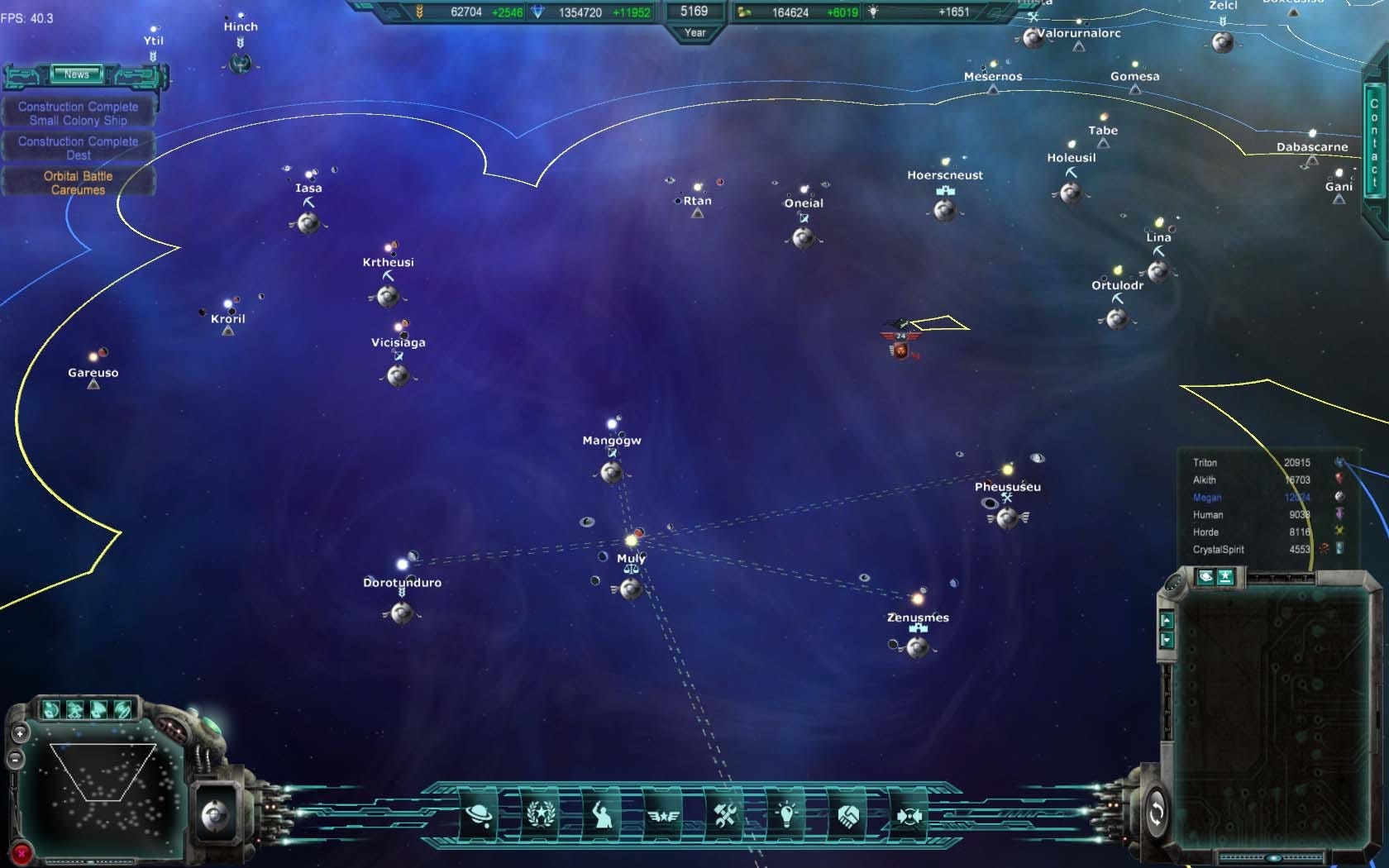
Lost Empire invites you to assume control of a fallen race, and rebuild their civilisation in a turn-based strategic opera that pans out over a vast galaxy. There are multiple layers to the game; exploration and colonisation of the large map, economic fiddling, fleet building, scientific research, diplomacy and of course good old-fashioned war.

It sounds complex, and it seems so at first glance, because the tutorial is quite vague and you're left to figure out quite a lot by yourself. The mineral slider determines the percentage of resources that are either stockpiled or spent on planetary improvements, but you're not told what those planetary improvements are, or what they do. In actual fact, the mechanics are fairly simple and it's not difficult to work it all out after a few hours play, but still, the tutorial could certainly use some polish.

As could the interface, which is pretty rough around the edges. When a fleet is near a planet, for example, it can be fiddly to differentiate between them. And some of the menu text is microscopically small. There are also bugs in evidence, even after the latest patch (1.03), with custom-named fleets reverting to their old names, and ships just plain disappearing after being produced. There's a definite slightly-unfinished vibe.
2

Bonus points are awarded if you can get your empire's outline to resemble a sheep.

Initially, there is an engaging element in setting up your empire and switching the function of planets to generate different resources, while researching technology, and both designing and building ships. However, once you've got the basics running smoothly, expansion across the huge map starts to become a little dull. The spice should come in the form of diplomacy and war with the other races, but it doesn't.

The minor races you encounter are annoying, relentlessly demanding tributes, and although there are diplomatic options to use with the major races (your opponents in the quest for galactic domination), there's not a huge amount of influence you can exert. When war does erupt, the space battles are flat and disappointing. Your fleet has its tactics preset and upon encountering an enemy, the result is simply flashed up: "You lost". A 3D view of the battle can then be viewed, which is useful tactics-wise, but it's rather anticlimactic already knowing the outcome.

A storyline and missions are thrown in to jazz things up, but the missions are rather tedious; you've got to deliver some minerals, or build a couple of ships. It's hardly spacesuit gripping stuff. While there are promising facets to Lost Empire's simple yet expansive empire building, ultimately it feels unfinished and uninspiring, and more of a lost opportunity than anything else.

4/10

Europa Universalis: Rome

  • Publisher: Paradox Interactive
  • Developer: Paradox Interactive

Speak of the Roman Empire (see the previous review), and it turns up on your doorstep as the latest incarnation of the Europa Universalis veteran strategy series. The game's been around since 2001, and the third title was out just last year. This time, the historical warfare clock has been turned back considerably further than the late medieval and Napoleonic eras, to the sapling Roman Empire in 278BC.

As is usual with Europa Universalis, you're free to play any minor or major nation, not just Rome. There are no hard and fast scenario rules, but depending on your choice of country and exact timeframe, there'll be different types of political, economic and diplomatic challenges to deal with.

EU: Rome is all about balance. Spend too much time at war, and the nation and its armies will end up exhausted. Periods of peace are needed to recover and reform, while letting the diplomatic dust settle. Any country that's too fond of marching across borders will gain a reputation, becoming feared, hated and likely attacked on multiple fronts. The game has a realistic ebb and flow of conflict and consolidation.

Peacetime also gives the player a chance to concentrate on internal empire dynamics. New buildings can be constructed in cities to provide various boons, research has to be prioritised and technological directions chosen, faith in your national religion fostered, and trade routes laid between provinces to generate extra income on top of taxes. But the biggest management task is that of dealing with your leaders.

The country's powerful ruling class family members are all rated in various statistics, and must be allocated jobs as researchers, province governors, generals or diplomats. There are tough decisions to make, as often the stats overlap: a chap with a good martial rating should be in charge of an army, but if he has a high charisma as well, he might be better-placed as the governor of a newly conquered province on the edge of your empire. Here his martial score will help keep stability, and his silver tongue will persuade the people that their new ruler and culture really benefits them.

3

Rome if you want to... Rome around the world.

There's a lot of emphasis on man management, with characters having various personality traits. A cruel and corrupt governor won't be popular, but will squeeze more tax out of his province (although he'll pocket a fair bit himself). Loyalty levels have to be watched, and the spectre of possible civil war guarded against. When a hugely successful general lets it all go to his head, there's every chance he might come knocking at the capital city gates, with a load of freshly polished pikes ready for some heads.

EU: Rome's mechanics are deep and fascinating, but there's a great deal of monitoring to be done. Not just of your own staff; there's also the changing politics, attitudes and trade needs of nearby countries to consider. Unfortunately, the interface doesn't make this easy, generally burying information in menus and making the player do a lot of clicking around.

For example, there's no easy way to monitor possible trade routes that become available with foreign powers. You've got to painfully trawl through the bulky diplomacy menu to locate new opportunities. There are other unfriendly facets, such as finicky army movements - it's difficult to time a two-pronged assault so both forces arrive simultaneously.

But despite these issues, there's no doubting that EU: Rome is another largely enjoyable offering from Paradox, and the fresh personnel management aspects add an interesting new twist to the series.

7/10

Crusaders: Thy Kingdom Come

  • Publisher: Virgin Play
  • Developer: Neocore

Religious debate was much more straightforward in the brutal old days. If you didn't believe, a plate-mail-clad zealot turned up on your doorstep and lopped your head off. Which wasn't particularly pleasant, but at least it was quick. Rather than the modern-day alternative, where some smartly dressed gent and lady come knocking early on a Sunday morning, force their way in for a cup of tea and then try to talk you to death while waving around a copy of The Watchtower.

Crusaders is a real-time strategy wargame with a tactical emphasis, and obviously it's based around the crusades. The player can select one of five knights, each with different advantages and weaknesses, before heading eastwards to spread the gospel of pain. A character's boons can be useful in battles - such as a squad of heavy cavalry bodyguards - or they can be handy in the inter-mission army management.

For example, a wealthy knight will have the resources to more easily recruit troops to his cause. Not only are armies recruited during the management phase, but existing squads can be levelled up and given upgraded equipment, and your hero can don relics to grant extra bonuses (or send them to the Pope to increase his faith score, which helps enlistment prospects). However, the really intriguing choice comes when picking one secondary objective for the upcoming scenario.

There are several different factions offering these, and completing them gains you fame points with that power-bloc, in turn allowing access to goodies such as new types of specialised units and abilities. Some objectives will be harder than others, offering greater rewards, and some involve you backing one side against another, so you'll lose fame with the latter. It's an interesting approach to spice up the missions and it works very well.

Out on the battlefield, Crusaders plays realistically. Terrain type and height advantage are vital considerations, and troops have stamina levels which drop badly if forced to march, or if they're left fighting too long, so careful manoeuvring and planning is necessary. When your own squads intersect, matters can get a little fiddly, but generally the interface is smooth and does a good job of letting you dictate the battle free from annoyances.

4

Hack them all to kingdom come.

In fact, there are some thoughtful touches, such as icons that show when a unit is under fire from enemy archers (in fact if you mouse-over an enemy longbow squad, their range is automatically shown). Formations are very effective tools, as it's easy to understand which should be used and when, and it's simple to switch between them.

Crusaders is, by and large, a pretty slick wargame. However, the artificial intelligence is somewhat erratic. At times it acted quite cleverly, and at others it was easily conned by something ridiculous such as a decimated cavalry regiment with just one horseman charging a full unit of archers and making them run off. Yes, a bowman's melee is weak, but 48 of them would have slaughtered the lone ranger; yet the AI reacted as if it was a full cavalry charge. The game also makes use of some obvious event triggers, which is unimaginative and can be exploited on your second play through a battle.

Nonetheless, Crusaders remains pleasantly absorbing. The battles play out smoothly with the streamlined interface, and there's a lot of flavour added between missions with historical facts being imparted, and a bunch of decisions to be made on which factions to support, and how best to shape your army. The campaign is certainly replayable, and this is a worthy strategy title.

7/10

Read the Eurogamer.net scoring policy

Comments (32)

Comments for this article are now closed, but please feel free to continue chatting on the forum!

  • Loading...hold tight!