Nintendo DSi

Bright young things.

"For mobile phones and digital cameras, manufacturers have been increasing the number of pixels in order to appeal to the consumers," Nintendo president Satoru Iwata pointed out when the DSi was announced. "However, we have taken almost the opposite approach. We cannot boast about the resolution, as the camera for DSi has a 0.3 megapixel resolution."

Iwata's justification, speaking to the Japanese press, was that the DSi can apply around a dozen special filters to change colours and add effects. "We would like to propose with DSi the entertainment value of playing with and enjoying visuals and sounds by using these functions in more proactive and fun ways in your daily activities," he said.

For those still struggling to comprehend a 0.3 megapixel camera - even though there are actually two - it's worth returning to something Shigeru Miyamoto told Channel 4 on a recent visit to London: "Nintendo's mission is to take advantage of improving cheaper technology to create reasonable and affordable entertainment."

As we observed at the time, 'the lateral thinking of withered technology', espoused by Game Boy creator Gunpei Yokoi, is the inspiration for much of Nintendo's current success. The GameCube may have been withering technology, but it was the lateral thinking part that got Nintendo out of trouble with the DS and Wii, and the company hasn't forgotten it.

In other words, it's not surprising to see a small, cheap camera - two small, cheap cameras, in fact - attached to the new DS handheld, because Nintendo isn't trying to compete with digital cameras and mobile phones. Like the two screens, the stylus and the microphone before them, the cameras are there for playing with.

For that, we get a cute, chunky photo package that allows you to switch between the two cameras, take still snaps and play around with them, framing people in hearts, kaleidoscoping heads, and storing images on a Brain Training-style daily calendar to build up a picturebook. Like PictoChat, it feels like an example of what can be done, rather than the beginning and end of the process.
1

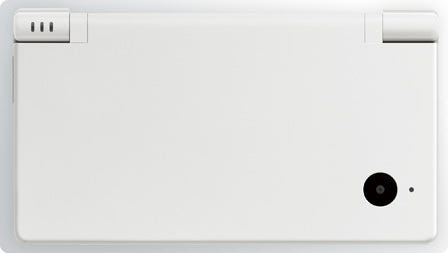
The DSi is slightly thinner and longer than the DS Lite, but the DS Lite is ever so slightly wider.

Likewise, the music player software allows you to record 18 voice samples, and watch visualisations as you listen to AAC files. Again, it's about playing with sounds. The absence of MP3 support is limiting, and limited compared to mobile phones and other music players - but Nintendo would argue, again, that it isn't competing for that money, and perhaps even that it needs to make that clear.

One of the surprises that greeted DSi buyers was the 256MB of onboard memory, onto which you can flash over 400 of the cameras' 640x480 photographs (there's also SD card support). But the other thing the memory's for is storing stuff from the DSi Shop. Like the Wii, data is counted in "blocks" - 1,024 of which make up the 256MB - and for now you can download the free Opera web-browser to occupy the first 85.

More software will follow at the end of the year, when the DSi Shop starts to host original, downloadable games, in the same vein as WiiWare - something that has already sparked enthusiasm among developers. If the cameras are Nintendo at its most craftily backward, the shop is the company's concession to the brave new world.

That said, it still gives Nintendo the chance to look back, and we would love to see Virtual Console compatibility rolled out at some point. Different control inputs would get in the way for N64 games, but surely the Super Nintendo, Mega Drive and others are possible.

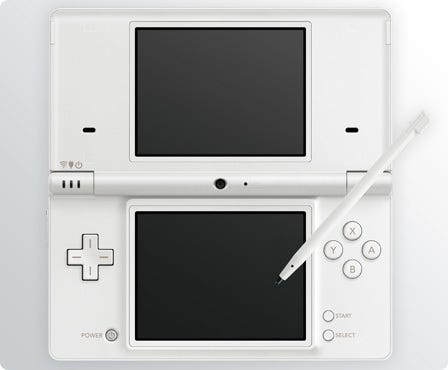
In the meantime, existing DS games benefit from a pair of slightly larger (8 per cent) screens, and a new higher brightness level (5) that noticeably outshines the DS Lite - gorgeously in the case of vividly colourful games like Elite Beat Agents.
2

The brightness difference isn't as stunning as it was between DS and Lite, but it's still very appreciable.

Whether the additional screen space makes any tangible difference to gameplay is harder to gauge. Logic dictates that slightly bigger icons and text will be beneficial, but we didn't feel any less comfortable playing EBA or Phantom Hourglass on either the DSi or the DS Lite. The screen on the DSi has the same slightly rough finish that holds up the stylus tip, and the stylus itself is slightly longer, although the tip is the same size.

But there are subtler changes than the screens, of course. The new chalky matte finish, inside and out, reduces thumbprints, and with sharper corners gives the DSi a functional, Wii-like low profile.

The slider power button has gone from the side, too, replaced by a clicky circular power button on the bottom-left side of the lower screen, so you'll no longer switch the DS on or off by accident in your pocket or bag. When the DSi is on, a quick click takes you to the new Wii-inspired dashboard, while holding it switches off. The power and battery LEDs move to the left side of the hinge, too, and there's a new blue one for Wi-Fi activity, since Wi-Fi can now be disabled to conserve battery. Each has an accompanying icon on the inside of the top-screen. Elsewhere, the DS Lite's six pinholes for each speaker are replaced by a pair of horizontal slits.

The other buttons are different, too. Start and Select are small, mini mint-style clicky circles, and the volume control has been relocated from the bottom of the unit to the left side, and transformed from a slider into a clicky +/- control. More significantly, back on the inside, the d-pad is clicky and the face buttons are shallower.

Build quality is something we'd be daft to judge yet, but the unit's been robust enough to survive a week in my bag, the SD card slot where the DS Lite's power slider used to be is a sturdy flap that seems unlikely to come loose, and the cameras - one in the middle of the inside hinge next to the microphone, and one in the bottom-right corner on the outside of the top-screen - have no raised profile to snag anything.

It's also worth noting the AC adapter is also new. The voltage input is apparently 4.6 rather than 5.2, but the switcheroo is another inconvenience for anyone upgrading. If you're interested, the only other device that uses the same AC adapter is the Japan-only Nintendo Wi-Fi hub, as far as we can tell, so if you break yours, that'll be the thing to buy off eBay or YesAsia, since Nintendo doesn't seem to sell ACs separately.

Disappointingly for importers, switching on reveals all the menus are in Japanese, and there's no English language option hidden in the settings menu. The more expansive, Wii-style settings menus also reveal parental control settings and a system update option for acquiring new firmware. Network settings still appear to be WEP-only (boo, Nintendo), and the rest is consistent with the old DS functionality, albeit a bit more navigable than the weird slidey skyscraper system of old. (UPDATE: Upon closer inspection, it turns out that the DSi does support newer Wi-Fi security standards, including WPA and WPA2, via an advanced settings panel. Yay Nintendo!)

Away from the system menu, the dashboard is a row of horizontal icons that you can drag and scroll left and right using d-pad or stylus - a bit like the iPhone, really, except not so self-consciously smooth-scrolling - with icons for game card, camera, music player, DSi Shop, download play and PictoChat. The latter duo are lifts from the old OS (they haven't even updated the interfaces), so don't expect online Friends-list PictoChat or anything. At least neither requires you to switch off the DS when you're done with them.

Nintendo presumably also has the option to upgrade these - and add new features, as it has done with things like the voting, news and weather channels on the Wii - through the firmware updates, of which there's already been one. We also suspect that the firmware tweaks will be used to clamp down on the infamous R4 and other piracy devices.

3

The SD card slot is beefy.

As you probably know by now, the internets have noticed that the DSi doesn't load the R4 or any of its cousins, and it's no secret Nintendo would like to crush the devices. A Sony-style loophole-fixing approach to firmware, to stay ahead of the hackers, would make sense. (However, Nintendo might want to watch out for collateral damage. We often get development carts with review code on them, but they don't work on the DSi, and developers won't be happy to hear that.)

One unexpected bonus of the new DSi and its fancy new menu - to which you can return at a tap of the power button, as mentioned - is that you can now hot-swap game cards. In the old days, popping out a cartridge and replacing it with the power running was a recipe for minced battery backup save-games, but apparently it's all fine now, and in practice as soon as you insert a DS card it shows up on the menu. SD cards, poked in through the sturdily-flapped slot on the right, don't notify you once inserted, but you can see them highlighted for access in the photo and music apps.

There's a darker side to all this card support though, and that's region-locking for DSi-specific software. We don't know when this will occur, or to which games it will apply, but we can happily report that the European, US and Japanese DS games we tested all worked, and looked jolly nice on the new screen.

4

This is basically the same as the picture on page one, but in a different colour. We might as well own up.

The one exception, of course, is Guitar Hero: On Tour, and that's because of the one really big thing left to discuss: the loss of the Game Boy Advance slot. It means that Guitar Hero's GBA-slot peripheral no longer fits, and it will be interesting to see how Activision responds. Or rather, it will be interesting if we ever find out that it already has. The European and US release timings for the DSi are still undecided, and we wouldn't be surprised if the success of On Tour and the impending launch of Guitar Hero: Decades had something to do with it.

As for why the GBA slot is gone, we can only assume there wasn't room in amongst all the other gizmos, because the unit's profile suggests it would physically fit. Or perhaps the GBA has withered beyond the point of lateral thinking.

Either way, the DSi is one to watch rather than import now. Whether it's worth replacing your DS Lite with further down the line will be a question of how much good stuff ends up on the DSi Shop, and how much developers get out of the camera with DSi-specific releases. In the meantime, it's another interesting, attractive piece of handheld hardware from Nintendo, that embodies traditions rediscovered and embraced in recent years while quietly sweeping up a few loose ends.

The Nintendo DSi is out now and Japan and will be released in Europe next year. Special thanks to friend-of-Eurogamer Jonti Davies for his help with translation.

Comments (51)

Comments for this article are now closed, but please feel free to continue chatting on the forum!

  • Loading...hold tight!