New International Track & Field never strays all that far from the old International Track & Field. It's a game where you hammer the buttons (or flick the stylus) as fast as possible to win, occasionally breaking up the action with events that call for timed button presses to jump hurdles or take breaths. Launching to celebrate the 25th anniversary of Track & Field, the new version is a DS-only title that's been put together by the chaps at Sumo Digital - the Sheffield studio responsible for OutRun and Virtua Tennis arcade conversions in recent years - so there's another reason to take an interest, as we did when Konami asked us to jog to Yorkshire for a look.
Right on track
It is remarkably faithful to the original Track & Field. From the title music - the iconic Vangelis piece from Chariots of Fire, which featured in all its 8-bit glory in the arcade game - through to the gameplay, Sumo has been careful to replicate the things people liked about International Track & Field. The developers happily admit that a key goal was to create a DS title intense enough that you'd feel physically sore and exhausted after playing - and we can report, with spasming forearms, that it is a success in this regard.
Basic gameplay is deceptively simple. For most events, it's a matter of scrubbing the stylus across the screen frantically to build up speed, with a button press (either on the face buttons or on-screen) to do things like jumping hurdles or breathing in the swimming events. Other events are more complex - marginally. Jumping events see you pressing the button to choose an angle for take-off, while the clay-pigeon shoot has you scrolling the stylus around to lock on to targets as they pop up.
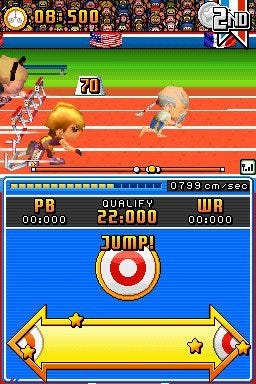
The hurdles, a classic Track & Field event. The lower screen tells you everything you need to know about the controls.
Nothing terribly challenging, then, but as with the original Track & Field the events seem to be finely balanced enough to let players develop their own style of play (you can use the buttons rather than the stylus if you like, for instance) and to compete against other people's times effectively. The addition of a special boost, triggered once in a race by blowing or shouting into the microphone, is another twist on the formula, and the point at which you choose to use it can be an important tactical decision.
The game also offers a variety of single-player modes - there's a Career Mode, as well as the ability to run through various of the 24 available single events and so on. Eight original characters, designed by the wonderful artists at Udon (best known for their superb art based on Capcom beat-'em-ups like Street Fighter and DarkStalkers), can be selected from the outset, and in keeping with the beat-'em-up look and feel, they're all "voiced" by Japanese actors who have done the voices for things like King of Fighters.
Additionally, there are a host of unlockable Konami characters - from venerable types like Frogger and Rocket Knight Adventures' Sparkster, through to a worryingly cute super-deformed version of Pyramid Head from Silent Hill 2. Each of the characters does have their own strengths and weaknesses, but the developers are adamant that only players who are really good at the game will notice them - and that they will balance out nicely over the course of a multi-event series.
Outstanding in the Field
The meat of New International Track & Field, though, lies in its multiplayer component, which is fair enough; Track & Field is a multiplayer game (a competitive, blistered-thumbs, throbbing-wrists kind of multiplayer game), and its implementation of this goes further than anything else we've seen on the DS. As you'd expect, it supports four players in single-cart multiplayer, using Wi-Fi game sharing. However, it's the Nintendo Wi-Fi Connection online play that's most impressive. Again, four players are supported, and broadly the same range of options are available - the really clever stuff is the way that New International Track & Field handles things like friends, notifications and tournaments.
When you start up, you're given the option to connect to WFC on the main menu. Unlike every other DS game we can think of, you actually stay connected even when playing single-player events - and, in a manner rather similar to Xbox Live, you get on-screen notifications of events that happen online while you're playing. Friends logging in, your high scores being broken by your friends, world records being set - all of them appear in a news ticker along the bottom of the screen, which should make setting up a game with your friends remarkably easy.
Another interesting idea is the game's implementation of a "Rivals" list to go alongside your friends list. Friends, of course, are people who have given you their friend code either online or in real life - but Rivals don't have to do any such thing, and you can simply add them after playing a game with them online. You can't send messages or anything like that to Rivals, but you can challenge them to games when they log on, and check out their high scores as they progress.
Six of the Konami unlockable characters have their own special challenge stages to play through - here's Simon Belmont's.
It all links up to a community website which will play host to an array of challenges and events. The site also carries live statistics on global rankings, forums and all the other stuff you'd expect from a community site, with Sumo hoping that it'll become a regular haunt for the hyper-competitive types who seem most entranced by Track & Field's simple but infuriatingly addictive charms.
Carefully tracked
The Sumo chaps themselves are adamant that Track & Field is a tongue-in-cheek experience - a game which, unlike many of the console titles that have subsequently borne its name, doesn't take itself too seriously. That spirit is evident here in the fantastically over-the-top bonus costumes you unlock, in the cheerfully ridiculous character designs, and even in the special Easter Eggs hidden in the levels. The ability to spear a Martian by throwing the javelin straight upwards with sufficient force remains - and each event has its own special animations that are unlocked by meeting certain strict criteria, just as a special treat to dedicated players.
Our big concern? Well, longevity might be an issue, but mostly we're worried about our DS screens. Can all that frantic scrubbing really be good for them? Sumo Digital claims it's not a problem - showing off one of its own units, which has apparently been used to test the game since the start of development without incurring any harm. We've been ever so gentle with our DS while playing the beta code, all the same. At least, until the blood gets up, the finish line is in sight, and the old Track & Field madness that's claimed so many blistered thumbs kicks in.