Version tested: Wii
Monster Hunter is, fittingly, quite the behemoth - a massive game in terms of both content and, elsewhere, popularity. To extend that analogy, it's also a game which has always tended to either consume people entirely, or frighten them off before they've really had a chance to engage with it.
It's seen tremendous success in Japan, being a massive system-seller for the beleaguered PSP, but a steep difficulty curve and a lack of sensible online options have always relegated it to the status of a niche classic in the West. It makes sense, then, that its appearance on Wii with Tri is an attempt to address those issues.
However, Monster Hunter is in the awkward position of seeing many of the same points on both sides of its love/hate balance sheet. To some extent, ameliorating the concerns of the haters would mean alienating an incredibly dedicated and loyal fanbase.
Happily, Tri has done an excellent job of juggling these concerns, shaving the thin edge of the wedge enough to bring new players into the fold without trivialising the satisfaction and sense of incredible achievement which the tougher challenges in the endgame provide.
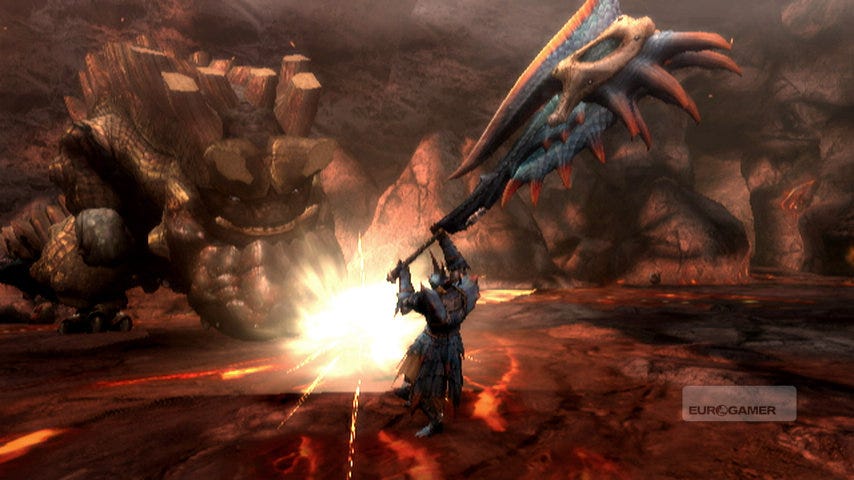
Weaponry is just as preposterous as ever, with the new Switch Axe performing well.
For anyone who's played a Monster Hunter game before, this is immediately apparent in the opening stages. Freedom Unite, the previous title, had a 'tutorial' section which lasted hours, with sudden difficulty spikes and viciously unforgiving battles waiting just beyond to drive off all but the most determined. Tri's beginning is a totally different affair, introducing the game's mechanics in easily digestible chunks without asking the same leaps of faith in deferred gratification.
It's still about eight hours before players will find themselves involved in the real meat of the game - whittling down the towering bastards who stalk the various environments and making them into weapons and armour - but everything leading up to that has been streamlined and explained in a far more enjoyable way.
Monster Hunter, you see, isn't just about hunting monsters. Getting to the stage where your hunter is well-equipped enough to take on one of the big boys is a hugely involved process of gathering, crafting, and honing technique. There's no experience, no levelling up - the only things you'll be improving are your equipment and inventory, from your weapons and armour to the huge array of potions, philtres and buff items.
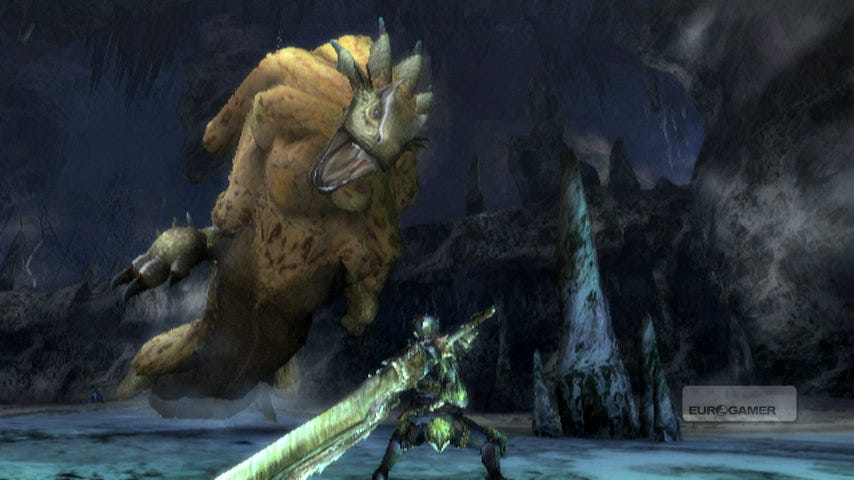
On a big screen, Tri's detailed graphical approach can get a little blocky, but you're usually too busy being crushed to notice.
Monsters drop unique materials, which combine with more mundane items to produce themed armour sets and weaponry, usually with some of the qualities of that monster imbued within them. Head out and collect a few basic ores and you can visit the blacksmith to furnish yourself with a basic sword or breastplate, but to make anything more interesting you'll need to get out there and kill some stuff, carving skin and bones from the still-warm corpses to craft with. Now you're tougher, so you can go and kill some bigger stuff, meaning you can make better kit. Repeat, ad infinitum.
It makes for fantastically well-balanced and compulsive progression, each round of improvements bringing new challenges and advantages as you build your stockpile. As well as being crafted from scratch, weapons and armour can also be improved further from existing pieces, with the weapon trees in particular branching into wonderfully involved and inventive new forms across the seven classes. However, collecting materials also necessitates a lot of grind, repeating quests to slay the same monsters again and again as you harvest bulk materials and seek out elusive rares.
In many ways it's similar to an MMO's crafting mechanics, farming missions until you can make the kit which lets you go on to bigger and better things. The scope for experimentation is immense, with no clear 'best' sets to collect, instead encouraging the preferences and play-styles of individuals.
The single player begins in Moga Village, the colourful hub of operations where all of the vital preparation occurs between quests. To begin with it's a sparsely populated place, traumatised by recent earthquakes and monster infestations, with only basic shopping amenities available. Over the course of the next few hours, successful questing will see the introduction of the various different support systems and facilities which make the mutually dependent network of harvesting, crafting and hunting possible.
Like Freedom Unite, there are shops for basic provisions, as well as a forge, quest givers and a kitchen serving stat-boosting cuisine. Where Tri diverges from previous titles is in its new system of resource points and commodities.
Attached to Moga Village, and the only available area to begin with, are the Moga Hills - a varied and relatively timid environment where you can gather basic resources and encounter a few of the less lethal creatures. Questing here isn't like the traditional mission structure, with a set goal ending your session. Instead, it's free-form, allowing the player to wander indefinitely, as long as health, stamina and inventory space allows. Take a BBQ spit for roasting monster meat and everything else you'll need to survive can be gathered from Tri's newly regenerating resource points.
Poster-boy Lagiacrus isn't the most dangerous beast in the game by a long shot.
When you do decide to return to the village, the monsters you've killed and some of the items you've collected can be converted to resource points. These are the currency used to perform various village functions, notably the dispatch of the fishing boats and duties on the farm.
The farm will be familiar to fans - it's basically a way of cutting much of the grind out of essential resource production, allowing players to automatically maintain levels of basic materials without heading out on specific gathering quests. Meanwhile, pick a destination for the fishing fleet, fuel them with resources and special items and they'll trundle off and gather materials for you, many of which can't be picked up anywhere else. These fishing trips, and the growth of crops on the farm, take time, incorporating Tri's new day/night system. Each time a quest is completed, or a substantial Moga hills excursion undertaken, half a day passes and these systems all advance.
For players of the previous games, it's a system which takes some getting used to, but for newcomers it's a great way to encourage the proper time and resource management which makes a good player.
The two-player arena quests can be played in local co-op, facing off against small groups of monsters or single titans.
As for the quests proper, not a great deal has changed on the surface. Generally it's still you against both a set of monsters and the clock, with gathering quests and hunts for smaller enemies giving breathing space between the more involved missions to kill the bigger beasties. Tougher enemies still invariably involve several attempts, learning attack patterns, behaviours and weaknesses. They're still unforgiving and demanding - although perhaps a little less so during the earlier stages.
There are some significant changes in the subtleties, however, which have added a great deal to the experience. Sub-quests, for example, now prod the player in the direction of advanced techniques, rewarding hunters for cutting off tails or using traps. They're not mandatory, but you'll reap greater financial and material rewards if you do complete them, and they're often there to help point out the best way to go about a mission.
Your band of Felyne companions no longer accompanies you, sadly - replaced by the mildly annoying but ultimately more useful Cha-Cha. This little chap, introduced a few hours in, offers support in a number of ways, from buffing dances to direct melee attacks, as well as helping with gathering. His weird, quasi-Shakespearian childish patter grates, but he's more flexible and customisable than the Felynes were, with changeable masks and dances fine-tuning his combat style. Plus you can still batter him with a great sword if he rubs you up the wrong way.
The Wii's extra processing power and freedom from the PSP's small screen mean that even more enemies can now pile in simultaneously, with encounters with three large wyverns at once far from unusual. Obviously, when this happens it's basically time to show them your backside; even Tri's much-improved camera still gets stuck behind monsters sometimes, especially when there are a lot of them kicking around.
Multiple monsters do give players the chance to see the ecology system in action, however. Ecology might be a bit of an overstatement for the occasional bit of monster-on-monster action it produces, but the addition of (hidden) stamina gauges for large beasts mean that they'll sometimes need to nip off for a quick snack to recharge their energy. Prevent them from doing so and many of their attacks will start to falter and fail, making them far easier targets.
Beguiling little touches like the ridiculous pig costumes and the grilling music lighten the mood now and then when it all gets too much.
In terms of big changes, though, it's the addition of water environments which is most notable. Swimming is easily controlled and feels natural, with a generous oxygen bar refillable from numerous streams of bubbles from the sea or lake floor. Fighting underwater takes on a more measured, gradual pace - albeit no less exacting for that. In fact, some of the underwater enemies and battles are real highlights, the three-dimensional manoeuvrability and pacing they offer a welcome change from the generally chaotic land encounters.
What really stymied Freedom and Freedom Unite for many people was the difficulty of arranging online meetings, even with the PS3's Ad Hoc party system. Rest assured that, whilst Tri's online lobbies are a little antiquated, the system works extremely well. Players can warp to each other once they have the requisite IDs, names or friend codes, and four-player instances within the larger online areas mean that groups are easy to form and maintain. Obviously the servers weren't particularly thriving during my visits, two weeks before launch, but the impression was that once things get busy there's potential for a fantastic atmosphere. Pick yourself up a WiiSpeak and the experience steps up another notch, especially given the frantic nature of the game's battles.
Torches can be used to light dark areas and fend off some enemies.
There's so much more to talk about, but it's almost impossible to do justice to the scope of Monster Hunter without getting tiresome. If you've played any of the games before, and enjoyed them, then you'll find very little to fault here. Many of the frustrations and much of the wilful obfuscation are gone. Tri is noticeably slicker, smoother and more polished than any of its predecessors. Newcomers will probably be divided; Tri has certainly kept enough of its niggling peccadilloes and moments of tooth-shattering unfairness to annoy the less patient, but Tri is definitely the best way to introduce yourself to this incredibly involving and rewarding series.
Just remember, the bigger they come, the more likely they are to crush you mercilessly into a greasy pulp. But you'll go back, again and again, because what Monster Hunter does best is enrage you just enough. To prick your ego right to the point where it's about to burst, before suddenly rolling over for you to tickle its scaly belly with a 14-foot lance. Once it has its claws in you, you're over.
9 / 10
