Lost Cities
Have you checked under the sofa?

A game in which you mount expeditions into the depths of five ancient ruined cities should, you'd think, be a gripping experience fraught with peril, adventure and boundless opportunities for daring escapes and bold acts of heroism. While Lost Cities is nominally based on the idea of such quests, it's actually a card game. Not really a hurdle - there are plenty of card games packed with excitement - but then Lost Cities is an incredibly sedate card game. It's not bad, but nor does it live up to its title.
There are five cities to "explore", each one colour-coded - yellow, blue, white, green and red. The deck contains 60 cards, separated into five suits of the same colour as the cities. Each suit contains nine number cards, from 2 to 10, and three face cards, or Investments. You can only place a card on the city of the corresponding colour, and cards must be placed in numerical order - though not necessarily in sequence. So you could, for instance, place the White 6 card on the white city, but then you wouldn't be able to place the cards marked five or lower. Place the 8 card after it, and you won't be able to use the 7. As soon as you place the first card on any city, the available score for that city drops to -20, the cost of starting the expedition. If you want to finish up with a positive, you need to build the amount back up by placing the number cards, which score according to their value.
Investment cards add an extra layer of strategy. These must be the first cards placed on a city, and you can have up to three. Each one multiplies your score for that city further - x2, x3, x4 - but at a cost of an additional 20 points off your initial score per card. In other words, placing all three Investment cards starts you off with a -80 score deficit, but quadruple the points for any card you do place. If you have the number cards to make it pay off, the results are impressive. Fail to get the numbers you need, and you're left in a hole you can't climb out of.
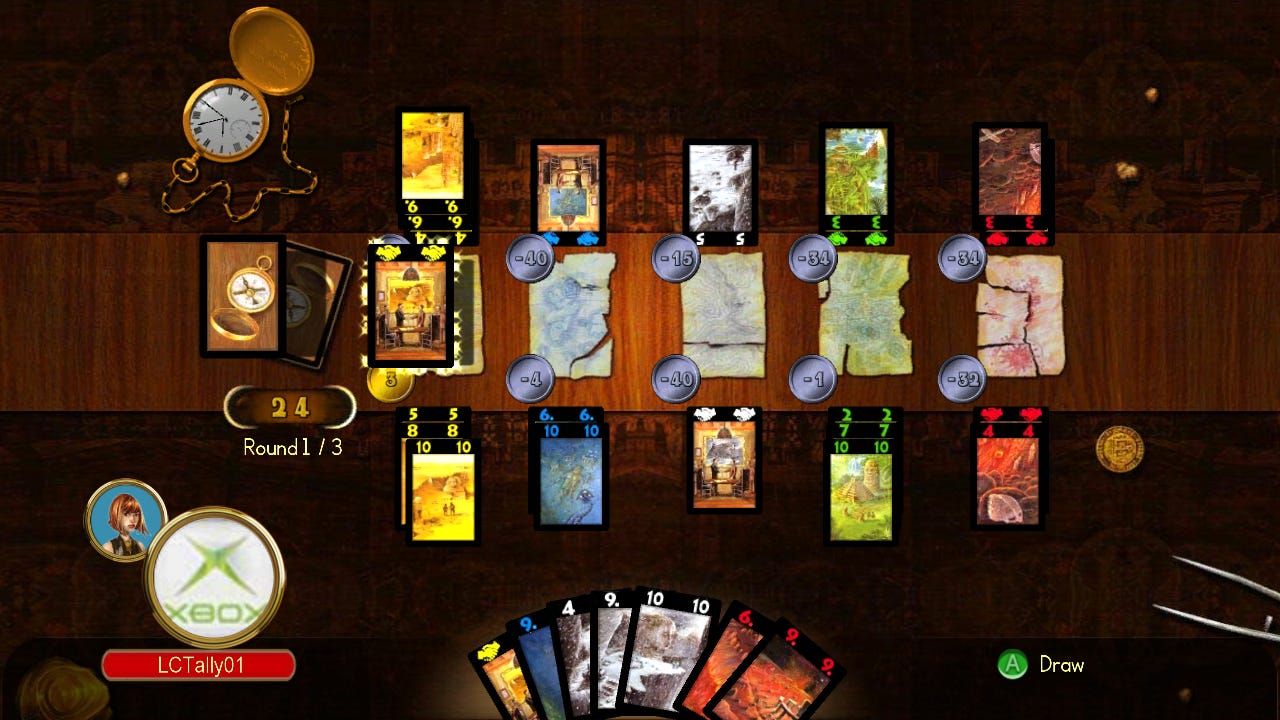
As you're doing this, your opponent is doing the same on the other side of the board, drawing from the same deck. The game ends when the deck runs dry, so gameplay becomes a question of weighing up the risks and rewards of playing Investment cards, stockpiling the higher numerical cards and keeping a mental tally of the cards in play. Every hand you play renders more cards obsolete, and you can discard those you can no longer use - although as your opponent can then pick up these cards, you need to make sure they're not of tactical value to them before tossing them aside.
Like most games of this type, it can seem a little complicated when described in stark text, but the brief tutorial soon makes it clear and what you discover is a game of commendable depth. However, it's also fairly uninspiring, and the bargain basement presentation does little to sell you on the experience. Beat the CPU opponent and you get a message saying YOU WIN while some feeble fireworks splutter in the background. Then you start again. As each three-round game can take less than ten minutes to play, and there's no tournament or long-form mode, it leaves the single-player side of things feeling a bit thin. The archaeological theme is underdeveloped - little more than a visual hook really - and with no solo options beyond endless standalone matches you'd be forgiven for opting for an old-fashioned deck of playing cards instead. It's not exactly a challenge, either, with only the Hard level providing the sort of AI opponents you'll actually need to out think.
The online modes supply a little more flavour, though not enough to add any real spice. The most interesting is the four-player team mode, which plays a little bit like Bridge, as you exchange cards with your partner to develop deeper strategy. Apart from that, all you're really getting is the knowledge that the other cards are being drawn by a person rather than some computer code. Hardly a thrill.
The Live Vision camera is supported, and there's been an obvious attempt to ape some of Uno's addictive multiplayer fun, but Lost Cities just isn't designed for that sort of play. This isn't a fast-paced game of reversals and Draw 4 traps. There's no direct competition here - your choice of cards can impact your opponent's options, but it's not the sort of game where the camera makes sense. There are no outraged reactions worth savouring, just furrowed brows and quiet contemplation. It's more like playing two games of Patience from the same deck, so seeing your opponents face adds little of value.
As bland as it looks, Lost Cities is a well-designed card game with more depth than most, but this version does little to justify the leap from deck to joypad. There's an inevitable air of opportunities missed, but provided your tastes are simple and your expectations low, there's some amusement to be had. Its gentle distractions are not without their charm, but at 800 Microsoft Points it's at least twice as expensive as it needs to be.