Version tested: Xbox 360
LEGO Harry Potter is enormous, which is no mean feat given that the title character is two centimetres tall. And plastic.
By the time I finished the sizeable story mode, encompassing the first four years of Harry's life at Hogwarts, I'd put more hours on the game clock than most "adult" action games demand, yet I was still at just over 45 per cent completion. I'd not completed any of the Hogwarts crests hidden in each of the levels. I'd unlocked a fraction of the game's 160-plus characters. I'd found only six of the secret red power bricks, rescued a mere 20 of the 50 imperilled students and earned less than half of the golden bricks which add up to unlock more bonus levels.
So, for a game built from tiny pieces, LEGO Harry Potter builds into a seriously epic undertaking. This has been true of all the LEGO games, of course, but this is by far the most impressive and most rewarding iteration of the beloved formula to date.
The basics are much as they were for LEGO Star Wars five years ago. You explore, smash things, build things and earn shiny LEGO studs that can be cashed in to unlock even more content. Famous scenes from the stories are re-enacted in irreverent style, and you swap between characters to make use of their unique abilities.
To some adult observers, this unchanging bedrock represents a series in stagnation. To the kids who flock to these games, it's comforting, familiar and provides a dependable springboard for the ever-evolving challenges that each game asks of them. As with all the best franchises, the key gameplay elements have endured for a reason.
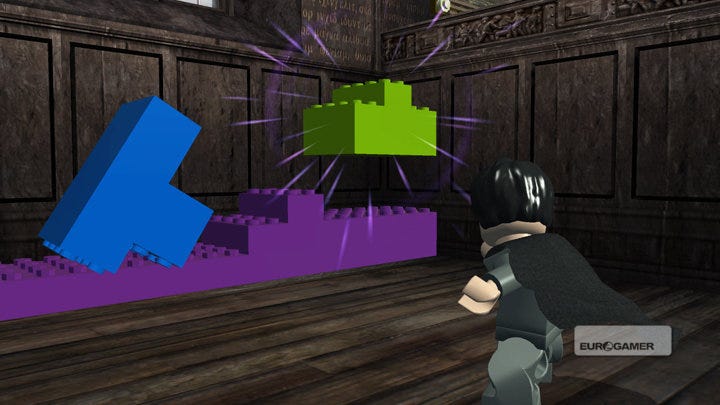
This is a basic block manipulation puzzle. There's no single correct configuration - just whatever you come up with to reach the next area.
To criticise this game for adhering to formula would be a mistake, since the structure now built on top of these reliable foundations is ambitious and daunting, and part of the reason for that lies in the distinct properties of the Harry Potter saga.
Unlike Star Wars, Batman or Indiana Jones, Harry's adventures don't take him around the world, across a city or to other planets. Pretty much everything that happens to him happens in Hogwarts. Rather than allow this restriction to hold things back, TT Games has instead turned it to the game's advantage.
You no longer retreat to a hub area and dip into key set-pieces one by one. Instead, Hogwarts is a gigantic, continuous gameplay area full of living detail. When it's Christmas in the story, everyone wears Santa hats. When the Dementors arrive, looking for Sirius Black, students huddle in corners, terrified. When Gilderoy Lockhart arrives at the school, gaggles of cooing girls follow him around. It's lovely and hilarious.
For the vast majority of the game, you'll be traversing the staircases, corridors and courtyards, triggering story levels as you go, and learning new spells in lessons along the way. Navigating this imposing environment is never a chore, as the house ghosts are on hand to lead you to the start of the next story mission, leaving a trail of translucent studs as a marker just in case you get distracted by yet another intriguing detail and wander off to explore again.
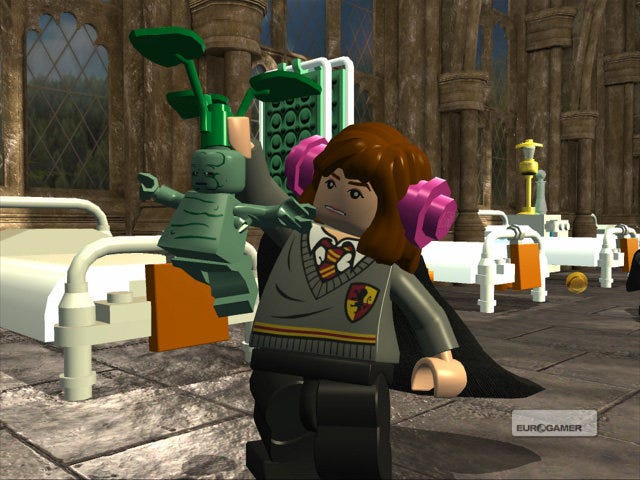
The screaming mandrake roots can be used to shatter glass objects, provided you can find some earmuffs first.
It gives the story mode a seamless feel, since you're never taken out of the game world, while also offering dozens of chances to try out each of your spells and abilities by interacting with secondary puzzles tucked away all over this sprawling location. Pixies, for example, can be found messing with scenery items. Learn the spell that freezes and shatters these pests, and those scenery items will form part of another task that might earn you another character, golden brick or just a lovely shower of studs.
In fact, one of the great things about all the LEGO games, but especially Harry Potter, is that everything does something. There's always some item to blast or levitate or twist, and the result is always useful, funny, or both. Remember how on school trips, the best bits of the museum were the exhibits that had buttons to press and models that moved? TT Games understands that need to fiddle, prod and simply make stuff happen. The developers never let their young audience get bored and the procession of well-placed background gags goes a long way to keeping these neophyte players engaged.
This is also a much more tangible game world than previously seen in the series. There's physics here, and a persistent nature that means changes wrought in a room at one point will remain there when you return. Stacks of books can be knocked over, LEGO blocks shatter and scatter in realistic ways, and there is even a whole slew of new puzzle types where you can manipulate individual LEGO bricks and build your own towers and bridges to reach new areas. These grow in complexity as the stories progress, and while they'll never tax adult gamers, they'll certainly stretch youngsters and force them to think laterally about what their powers can actually do.
In fact, the game as a whole is more intricate and more cleverly layered than before. Potions can be mixed in cauldrons, but finding the three ingredients usually requires three smaller puzzles to be solved first. Time and again, working out how to get from A to B means taking a fun mental journey via X, Y and Z first, always adapting, always using new abilities to get past problems that were previously off limits. If there's one thing the LEGO games do well, it's their fantastic structure, gently coaxing kids to do better each time, to find something new they hadn't done before, and it's never been better than this deep, deep rabbit hole of clever interlocking gameplay challenges.
If LEGO Harry Potter has a weakness, it's that the stories themselves don't always lend themselves particularly well to the silent comedy that LEGO demands. As so much of J. K. Rowling's plotting is driven by dialogue - the one thing LEGO figures can't provide - unless you know your Potter lore inside out, some of the cut-scenes can be sparse of narrative and struggle to match the belly-laugh moments from previous titles.
Hogwarts looks confusing at first, but all those moving staircases and secret passages work to help the player, not bamboozle them.
This problem spills over into the collectables; while having over 160 characters makes for an impressive back-of-the-box bullet point, it doesn't really translate into compelling gameplay. The thrill of finding or earning a new character token deflates when you realise you have no idea who the person is and, since the majority of them are Hogwarts students, they don't offer much variety in appearance or abilities. Hardcore Potter-philes may care who Ernie Macmillan is, or be thrilled at the prospect of playing as Lee Jordan, but it adds little of value to the game beyond rather obsessive fan service. There's also some of the old screen tearing, a consistent problem with the series that hasn't been fixed yet.
It's doubtful that the target audience will notice or care about such adult quibbles. In the past, my son has absolutely loved all the LEGO games, and it's through him that I've been able to appreciate just how much craft and care goes into precisely balancing every tiny aspect of the design in these seemingly silly confections. Recently, however, he'd been lured away by Banjo Kazooie, and although he's read the Potter books and seen the films, he was never particularly infatuated by them. When I told him LEGO Harry Potter had arrived in the post, he only gave a non-committal shrug. I began to wonder if this would be the first LEGO game I'd have to review without his help.
Light is one of your magic weapons. Here's hoping LEGO Alan Wake is next.
But then he saw me playing it, and it was like a moth to a flame. He'd chuckle at the funny bits. Then he'd recognise something from the films. Then he spotted how familiar elements from the old LEGO games had been reworked to fit Harry Potter. Sure enough, about 10 minutes later, he wanted to know when I'd be giving him the disc.
And that's the genius of these games. In the past I've always been cautious with my praise for the LEGO titles, because as fun and as charming as they were, I always felt they could be something more: that there was some as-yet unreached plateau where the great ideas would coalesce into something truly special. With LEGO Harry Potter, they've reached that level. If there's a better kids' game this year, I'll eat my Sorting Hat.
9 / 10
