King Arthur: The Role-Playing Wargame Review

Round table discussion.

Version tested: PC

It's the 5th Century. Or maybe it's the 6th. Nobody can really be sure, and it doesn't matter - the legendary tales of King Arthur might as well have taken place in another universe. Wizards, warriors made of supernatural gas and magical swords knocking about - it's a rich, slightly stuffy slice of unhistory that's been completely owned and dominated for 35 years by a Monty Python movie. At least, in this moron's head - you might be more educated.

Describing King Arthur, the Total War series is the most obvious, well-worn and apt comparison. But in limiting our tale to Britannia, we're presented with a more intimate game, a welcome break from fully-zoomed-out global concerns. A childhood spent playing Defender of the Crown taught me that England and Wales were a manageable prospect for conquest, so this didn't feel daunting. I was wrong to feel confident. My diet for a few days has consisted mainly of my own arse, roughly handed to me.

Arthur's game, as the death of his dad Uther Pendragon nudges him closer to the throne, starts tucked away in the tutorial fields of Cornwall. Excalibur is rusting in a lake in the West Midlands, but this is a nice little pocket of England serves as an introduction to the game basics.

With none of the later game's town or troop management, strongholds, or morality to worry about, say hello to your units - infantry, knights, spearmen, cavalry and archers. Later on we'll discover supernatural equivalents, and fight wolves and giants - but for now, it's strictly human.
1

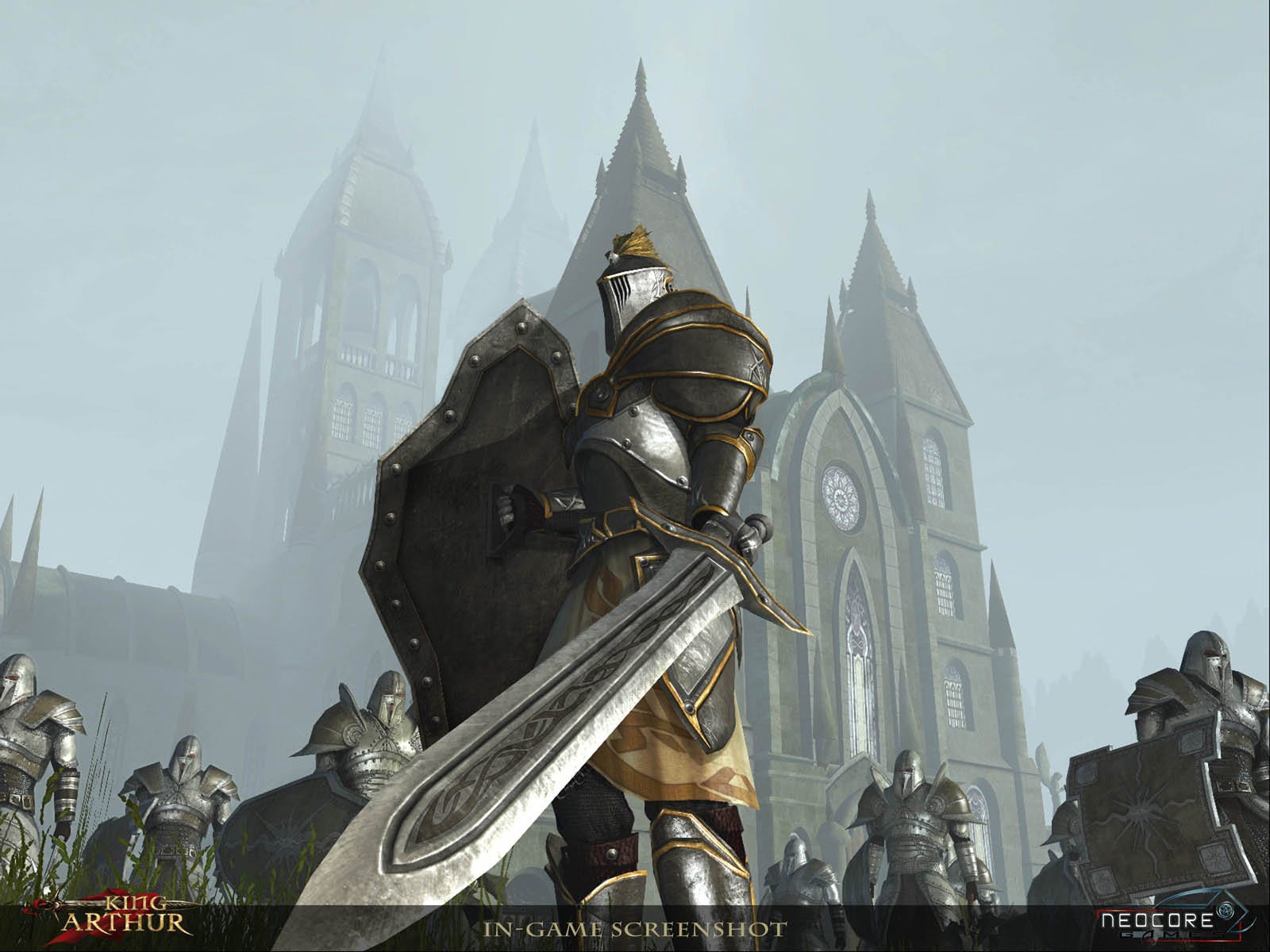
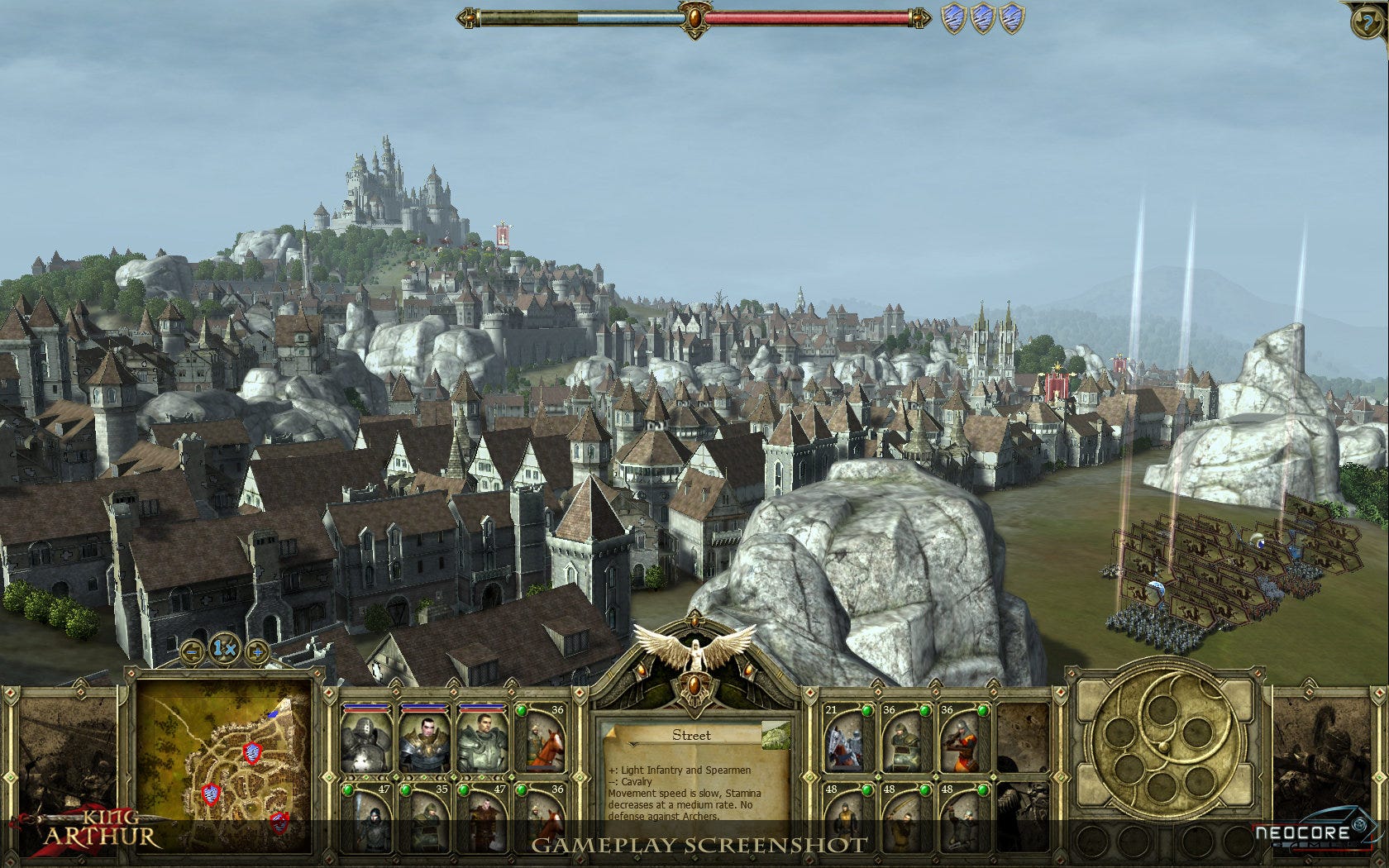
A huge amount of effort has been put into the visual polish of the world and battle maps, and the background music is fantastically well-judged - both pleasant and easy to ignore. This vision of an agricultural and mythical Britain as it cycles through the seasons is clearly the result of dedication. Love, even.

It's a shame that the zoom makes it less pleasurable to roam around - the smaller size of the world map has led developer Neocore to limit the zoom, making it all feel a bit claustrophobic. On the battle maps, however, the changes in zoom level actually move you up and down, which is incredibly unhelpful if you're trying to keep track on a certain unit. Neocore has introduced a keyboard shortcut for tracking selected units, but that feels like a workaround.

So, we set about the slow domination of Britannia, which involves the most controversial aspect of King Arthur. At first release, Arthur's huge RTS battles were a troubling King: punishing and often unjust. There have been tweaks since: the introduction of Beginner difficulty in patch 1.02 was a begrudging concession - they might as well have called it "Canst Thou Changeth My Nappy Mode" - but the overpowered units have been slowly fixed too, with Samhain armies becoming considerably less invulnerable, and archers getting a nerf checkbox.
2

That was an odd approach - giving you the option to fix overpowered units. This is still a very hard game, but if you're patient, a gifted and forgiving strategist, or can stomach playing on the easiest settings, you'll make progress. I won't tell you which one I am, because crap doesn't stop me being proud.

Just don't trust the auto-battle option - Creative Assembly will say that you'll suffer around a 5 per cent penalty for not micromanaging your taxes and battles in Total War, but Neocore is less forgiving in King Arthur. When I declined to take a hands-on role in my troops doings, they were decimated. Replacing troops is expensive and counter-intuitive. In fact, if you feel you've lost too many troops, it's probably best to go back and play the battle again, as the hamstringing effects are felt deep - too deep - into the game.

This is how it works: every map has Victory Points, the importance of which are emphasised by the opening camera, which swoops around them like a dramatic and informative eagle. These points are claimed by simply being around them, and depending on what they are they'll bestow a power on nearby units. A long fence is useful for Archers, allowing you to sling out a rain of arrows. A church, meanwhile, will heal your nearby soldiers, because this is the 5th Century, when religion apparently worked.

Your growing ranks of hero units - Knights of the Round Table - can be attached to a squad, offering the usual range of buffs, attacks and debuffs. And because Neocore is at pains to tell you that this is a role-playing wargame, everything levels up, giving you a single point to spend on a limited range of stats for your units (melee, defence, archery, cost), and a slightly more comprehensive clutch of numbers and abilities for your knights.

It's not immediately apparent what these knights' numbers mean during the early game, so you'll get more immediately visible rewards spending them on battlefield skills. Save the long game for the second playthrough, otherwise you'll be paralysed by indecision.

Owning more of these Victory Points than your opponent drains their morale - as sure and deadly as running them through with ghostly spears. So it becomes an immediate priority not to position yourself on the land, but to split up and dart for the nearest Victory Point. Cavalry is essential for a headstart, and the asymmetrical maps feel, by their very nature, loaded towards one team. It's rarely you. A sound idea in theory, but in practice it's actually quite distracting.

The role-playing aspect of King Arthur is shown on your Morality chart. In the y-axis, your slow progress towards Tyranny or Righteousness is charted. Horizontally, your dedication to the Old Majickal Relijun, or the well-spelled fad of Christianity. Your first such decision comes in Dumnonia: do you help the defending and righteous king Mark, or the expanding, murderous King Idres? You decide with your actions, not by clicking on buttons marked Accept.

3

There's no judgment from the game, naturally - but you'd be well-advised to choose your path early and stick to it. This isn't Mass Effect, where Paragon and Renegade powers are reassuringly independent. Gain one Tyrant point and you've lost one Righteous point. Abilities and units are unlocked by your position on the map, so going one step in the wrong direction is yet another cause for a reload. It's less of a role-playing game, really, and more of an early decision reinforcement engine.

You can squirrel yourself closer to the powerful rim of the morality grid during King Arthur's unexpected text adventure sections. These simplistic but involving conversation trees follow the savage law of the playground - if you're nice, people will take your food and money. However, the teachers will like you, and the troops you pick up will have better morale.

It's not all number-tweaking, though - in the adventure that happens before the battle for Excalibur, exploring all the options will earn you an advantageous position on the map. It's your first but certainly not your last tough battle - you'll need every advantage you can claw.

4

There's a fundamentally old-school feeling of exploration and reward in King Arthur. You're not exploring the game's locations, so much as the quirks of the gameplay. You're constantly second-guessing (and consequently, reloading) your strategic decisions, not your role-playing choices.

I'm certainly not saying that's a bad thing, but it's such a matter of taste that handing out a score feels somehow unfair. This is an exciting, genuine and unmodern way to play a game. Testing out the corners, repeating yourself, and having your expectations undermined by unpredictable quirks is an aspect of gaming that some people will love: it's also one of the things that our era of focus groups and playtesting has surgically removed. King Arthur isn't always intuitive, but in a game with a prominent pause button, that's not necessarily a problem.

Arthurian Legend holds no undue respect for reality - no-one's sure, really, if Arthur even existed. But it's a pleasure to play a game that takes that mythology so seriously, and builds stories into it. It's a game that belongs to a different decade, a more thoughtful decade where we're not being asked to shout and mime at our televisions.

It's complicated, often unhelpful, and engrossing. It's the shy boy your mum told you to make friends with. It's a troubled and stubborn creature, with a funny run. Even the most dedicated King Arthur fan has to acknowledge the faults, and probably love the game all the more for them. For many strategy gamers, this will be the most uplifting, absorbing, and occasionally baffling seven out of ten ever.

7 / 10

Read the Eurogamer.net scoring policy

Comments (43)

Comments for this article are now closed, but please feel free to continue chatting on the forum!

  • Loading...hold tight!