Kane & Lynch 2: Dog Days

Barking up a different tree.

"It was not a nice experience."

So says Karsten Lund, game director for Kane & Lynch 2: Dog Days. He's talking about reading the reviews for the first game in the series. Ratings hovered around the 7/10 mark - which, as we all know, is a decent score but not a brilliant one. Then of course there was The Jeff Gerstmann Incident. Lund says IO Interactive had nothing to do with that. "We were just as much on the sidelines as anybody else. It was a sad story and it shocked us all. Not only did we get mixed reviews, but then all of a sudden, that happened..."

Rather than shrug off the criticisms, or try to get anyone fired for them, Lund says IO sat up and took notice of what the reviews were saying. In fact, he explained, they became a starting point for the sequel - the source for a to-do list of things which needed improving. "The cover system, the aiming, the shooting, the artificial intelligence, the dated art, the lack of online co-op..."

Quite a list, then, but Lund says every one of those items has been ticked off for Dog Days. There have been a few other changes, too. This time around you get to play as Lynch, the crazier, fiercer, balder one, and the game is set in Shanghai. However, IO has done more than tweak the gameplay and throw in a new plot. According to Lund, the aim is to "redefine the experience of the shooter, to make something more realistic, more credible, and more intense to play, because you believe in it that little bit more".

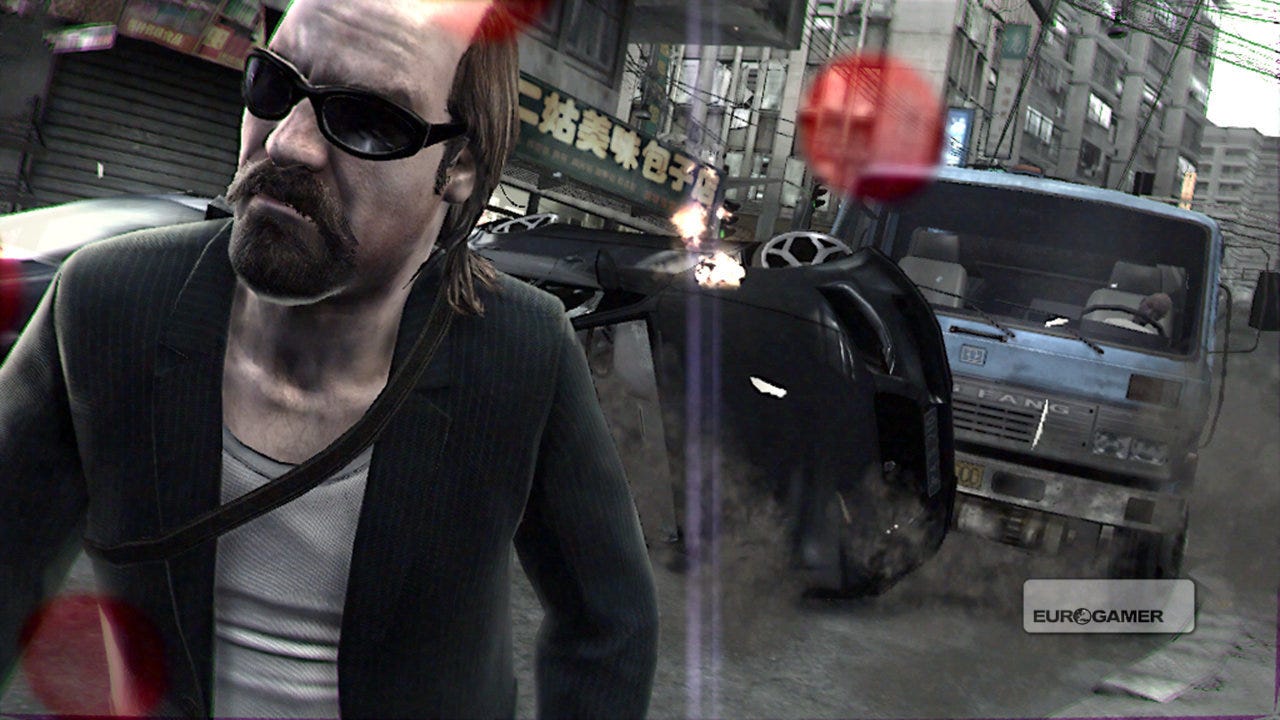
We've all heard that one before, and we all know what comes next - a load of blather about cutting-edge tech, pixel-perfect special effects, visuals so sharp they'll cut your retinas to ribbons etc etc. Except that's not where Lund is going with this. He says IO reckons the best way to make people believe something's real is to present it in the same way they're used to seeing reality presented. In today's world of YouTube videos and camera phones, that doesn't mean super-sharp high-def images - it means awkward angles, poor lighting, pixellation and motion blur.
2

Word is Bruce Willis and Jamie Foxx will star in the movie. Failing that, Ben Fogle and Anthony Daniels.

Which doesn't sound like the recipe for a great gaming experience, and sitting down for a first hands-on playtest of Dog Days, it's hard not to be sceptical. Not just about how the amateur approach will work, but how committed IO is to implementing it - surely it must be hard to resist the lure of pretty visuals and cinematic camera angles?

Apparently not. The cut-scenes being shown today clearly take their inspiration from YouTube rather than Hollywood. We see a conversation in a car as though from the perspective of a camera on the back seat. When the car pulls up and the characters jump out the camera follows, trailing the action rather than cutting immediately to a better vantage point. A hectic shootout between Kane, Lynch and the cops ensues. There's motion blur as the camera tries to keep up with what's going on, occasional pixellation and shakiness, and we even see the lens blurring and refocusing as the scene unfolds.

The soundtrack to all this is the roar of gunfire, the wail of sirens and the shouts of the shooters. "There's no thematic music - it's not, like, violins kick in when the action starts," says Lund. "We do have background sounds, which were recorded directly in Shanghai, to give that emotional impact. But everything we did with this game had to conform to this style."

So how does that work when it comes to gameplay? The level IO is allowing us to play today is set in a restaurant, where Kane and Lynch are enjoying a quiet snack. The restaurant is dingy, all red lanterns, brown walls and wooden partitions, and otherwise empty - until an army of armoured guards bursts in and starts blasting away. Better blast back, then.

The controls will be instantly familiar if you played the previous game, with one notable exception - you now take cover by pressing the A or X button. That's right, no more automatic wall-hugging, and no more confusion or struggling to pop quickly in and out of cover. In short, it's now much easier to take shelter, but that doesn't mean you can camp out for too long. In the restaurant level, the wooden partitions you're ducking behind can't take many bullets before they're smashed to smithereens. Enemies are smart when it comes to working out your location, clever about taking cover themselves, and unafraid to advance if you try just staying put.

All this can make it hard to stay alive for long. Yes, all right, I have to ask to start the demo again on the Easy setting after dying three times in about as many minutes on Medium. But IO recognises that this level of action can provide a challenge even for the non-rubbish player.

3

Good news, multiplayer fans - Fragile Alliance mode is back for the sequel.

"If you want to do a really intense shooter there have to be a lot of bullets in the air, but it's just not fun to die all the time," says Lund. "So we created a sort of second chance. When you take a bullet and get thrown to the ground, you can crawl around, get back into cover and shoot from that position." Like the old 'press A to take cover' gambit, it's not the newest trick in the book, but it's a good one.

Having mastered the cover system and the second chance feature, and yes all right switched to Easy, I dispatch all the enemies in the main body of the restaurant and move into the kitchen. Here there are a group of hostages, bound and gagged and with pillow cases over their heads. Just for fun, I shoot one of them in the pillow case. The head area immediately becomes a blur of pixels, just like you'd see if you were watching some graphic amateur camerawork on the news.

The effect is unnerving. It's somehow more realistic and more disturbing than the cartoon splatter of bright red blood and bits of brain you see in most games. It taps into that part of the psyche which knows that if something's too horrible to be shown, it must be really horrible. Or is this just IO's attempt to get the game awarded a lower age rating?

"No, not at all," says Lund. "This was an idea the team came up with - wouldn't it be fun to mimic that thing about something being too graphic, that documentary style? It's a good way of showing you got that headshot in a new way."

Of course, there will always be those who want their pound of flesh, as IO has found during focus testing. "It's different in the different territories where we test the game. Some people do want more blood and gore, but they can't have it. I just don't think it's very credible to have litres of blood pouring out of every... This just feels right."

Leaving the poor old pixellated pillow case behind, I head out into the city. These are the back streets of Shanghai rather than the bright lights, grey and grimy and full of shadows. Piles of whirring exhaust fans stick out higgedly-piggedly from the sides of buildings, while tangles of telephone wires criss-cross above. Kane and Lynch pound hurriedly through the alleys, but once again there's no dramatic music designed to up the tension - just the whir of those fans and the echo of sounds from the bigger streets.

We emerge onto one of these to find a bunch of parked cars and a big gang of cops. Now it's all about using the cars for cover, and trying out some of the new environmental interactions in K&L2. Lund shows me how you can throw a fire extinguisher into the air then shoot it, causing a huge explosion. Or fire at gas canisters on the wall of a garage, creating an even bigger one.

Once again, the camera style is more over-the-shoulder than cinematic. The motion blur and shakeycam elements are less pronounced than in the cut-scenes, and therefore much less noticeable, but they're still present. There's a menu option to turn these effects off entirely if you want, says Lund, although he feels this makes the game rather dull - and apparently he's not the only one.

4

There's also a new online co-op mode, but IO isn't ready to show that off yet.

"Our consumer testing shows it's not something players get tired of. It's a very exciting way to move forward in the game and figure out what's happening next," he says. "This isn't a low-fi experience, it's actually just as high-res as all the other games out there - it's just a different way of using that medium."

All the same, the fact remains that those blurry, pixellated documentary clips and YouTube videos never go on for long. Will this style work in an entertainment experience that lasts for hours rather than minutes? Will players put up with lower quality visuals over a prolonged period of time?

Our short demo is at an end, so that's a question we can't answer today. To finish up, let's ask Lund another question instead: how confident is he that reading the reviews for this game will be a nicer experience than the one he had previously?

"We're pretty confident," Lund says. "We're testing the game a lot and trying to make sure people enjoy it, that's my main goal. I guess everybody wants to have a high review score, but I really want to make an enjoyable product. And I really think we did it."

Comments (24)

Comments for this article are now closed, but please feel free to continue chatting on the forum!

  • Loading...hold tight!