Version tested: DS
You know, if you're going to choose any clearly-defined videogame stereotype to model your life on, you could do much worse than pick the lonely, down-at-heel yet sassy male teenager who heads up about 95 per cent of JRPGs.
Granted, you'll probably start your adventures orphaned, abandoned and with serious amnesia. But sooner or later you'll be engaged in a rattling narrative encompassing glittering cities, incredible treasures and dozens of combat-specialist bikini models with scant regard for the personal safety of their improbable lady features.
Infinite Space, being a fairly traditional JRPG yarn on DS wearing the fancy narrative costume of a space opera, fits this mould perfectly, and protagonist Yuri's story is compelling, enjoyable and well told. An excellent choice for the vicarious achievement of ambitions.
Beginning on a backwater planet on the edge of civilised space, the game sees Yuri enlisting the help of smouldering space junkie Nia to help him escape his parochial existence and discover the truth behind the "epitaph" - his dead father's final bequest. A quick tussle with some dastardly space pirates later and our hero is happily committing laser-based space atrocities with the worst of them, gathering information, money and crew members on his way to truth, the universe and everything.
What this means for the player is a surprisingly in-depth and refreshing take on the traditional party RPG, an experience whose scope and ambition are sadly marred by some awkward and frustrating design decisions.
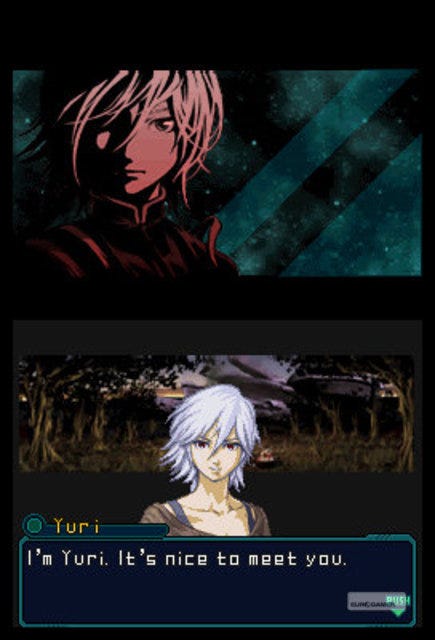
Yuri might start out as a bit of a wet lettuce, but he matures into a tough and believable adult.
Despite an extensive, and generally likeable, cast of 150 recruitable characters, it's actually the ships which are analogous to the party members of most RPGs. Humans are transposed to stat-enhancing accessories when assigned to various roles in your fleet.
You'll be compulsively tweaking your ships' loadouts in response to new threats. Yuri's burgeoning fleet is selected from a dazzling array of drip-fed models, from modest destroyers to mighty carriers with bellies full of fighter squadrons, each of which is internally customisable with a truly impressive array of modules. The minigame which facilitates this customisation is a sort of static Tetris in which the modules are slotted into limited hold space. Awkward shapes and tight restrictions mean that you'll need to be careful with your selections.
Should your flagship bristle with complex sensor arrays and targeting equipment, a pure combat vessel? There are plenty of options for that. Maybe you feel the crew need a bit of comfort, keeping them alert and combat-ready on long interstellar journeys? You'll be wanting the rec-rooms and study halls. Feeling vulnerable? Painfully aware that a fallen flagship means game over? Install some of the myriad shield and defensive enhancements to fortify your light-speed habitations.
It's a satisfying process, balancing space, priorities and cost to achieve perfect poise in combat. Often it's best to settle on compromise rather than specialisation, but the resale value of modules and the proliferation of refitting stations mean that repurposing your fleet is always quick and easy. This allows you to specialise effectively if an area's enemies are posing a specific challenge.
Crew redeployment is equally straightforward, although a thorough study of either the manual or the excellent online help system is a must for a full understanding of characters' stats and roles. These thirty-five jobs range all the way from captain to assistant chef, and all make subtle yet important differences to the way your fleet operates.
Making sure the right person has the right job can often make more difference to your performance than blowing a wad of space cash on a shiny new destroyer, and as such a proper combination of modules and people is absolutely essential to survival. For example, getting the right people on the right bridge will make your combat gauge fill much more quickly, probably the single most important factor in the game's battle system.
Combat begins with opposing fleets at either end of a small section of space, represented at the top of the lower screen by a simple diagram. Movement commands can be issued free of cost at any time, accelerating or reversing your fleet, or leaving it unpowered. This manoeuvring allows captains to bring their weapons to bear, their various range brackets usually allowing a natural sweet spot where all guns can fire.
Attacks are made via a command selection, with dodge, normal and barrage options initially available. Dodge will allow Yuri to evade the more powerful barrage attacks, but will turn normal attacks into criticals if used at the wrong time. In order to ensure this doesn't happen, captains will need to keep and eye on the colour of their enemies' craft on the battle screen as it changes according to their current level of gauge charge. A flicker from yellow to green usually means that dodge has been employed, whilst an extended period of yellow might mean that the opposing fleet is gearing up for a barrage, a powerful one of which could easily take out a ship in a single strike.
For what's essentially a rock/paper/scissors mechanic there's a great deal of subtlety to the system. Enemy captains will often fake out barrages, wrong-footing you with critical normal attacks and leaving you open for a follow-up barrage if they have the upper hand in gauge speed. Likewise, it's possible to negate a foe's dodge with a quick attack and devastate them with a follow-up barrage of your own. By the time the extra commands of launch fighters, anti-air (to deal with fighter squadrons), and melee boarding (handled in a separate mechanic) come into play, alongside two more customisable commands, a fully-formed and satisfying system has taken shape.
Clever use of the customisation system can make encounters too easy, though. Once you've got the measure of a sector's fleets it's not hard to best them every time. Spamming the normal attack once you've worked up a decent gauge speed is also an easy exploit; quickly taking out the weaker ships in the frontline of an enemy formation usually means that the barrage they inevitably charge will come from only one or two ships, making it thoroughly survivable.
In fact, despite the depth and flexibility of everything which goes into battle preparations, the fights themselves can quickly become formulaic. Occasional mission specifics such as individual targets or special enemy weapons switch things up a little, but for a game which requires a hefty amount of grind to fund all of the refitting you'll be doing, there are precious few highlights in the random encounter battles. They're also fairly sparse, meaning that when baby needs new space shoes, you'll spend a lot of time flying along the pre-set navigational star lanes, looking for trouble.
There's quite a bit of this sort of thing.
Another reason you might find yourself doing that is because you've totally forgotten what it is you're supposed to be doing. Incredibly, for a game with so much depth and so many deft touches, Infinite Space lacks the basic provision of a mission log, causing endless frustration when you've left it alone for more than a day.
Some mission threads are easily relocated - flying to hub planets to chat to someone at a bar or base will often refresh your memory - but other objectives are more obscure. Trying to remember that I was after a prisoner from a specific ship, only obtainable by using the otherwise pretty useless melee attack, meant gradually piecing the storyline back together in my head after a good hour of flying pointlessly from place to place. It's certainly not an insurmountable issue - a pen, paper and sense of due diligence should see you through - but why such a basic feature wasn't part of the design is a real curiosity.
At times this old-fashioned approach has its charms, but more often it's an obstacle between you and fun. A few extra usability touches, such as being able to preview the interiors of ships before they're bought, might have won Infinite Space a dearer place in my heart, and it's a shame to see a game I'd anticipated with such excitement hobbled by these unfathomable exclusions.
At 60-80 hours in length, and given the fittingly near-infinite customisability of your fleet, Infinite Space offers a massive chunk of fun for those who can forgive its foibles, but many will find the barriers to real enjoyment too high due to poor usability. A solid game for many rainy afternoons, then, but be prepared to work for your reward.
7 / 10
