The Independent Games Festival awards in 2008 made it seem like the sky was the limit for indie gaming, and so this year's IGF contenders face impossibly high expectations. They are competing with our rather recent recollections of Audiosurf, World of Goo, and Crayon Physics. All brilliant concepts that made fantastic games. How can they hope to match up to that?
Well, by being completely independent. If anything is missing in this latest Grand Prize line-up, it's the obvious contender for commercial success, like Audiosurf or World of Goo, but that doesn't matter. (And should not matter.) What we have here are brave, brilliant experiments. There's a couple of things in the wider IGF that we've already seen plenty of, such as PixelJunk Eden in the technical excellence and audio categories. But what is most intriguing are the five titles nominated for the Seumas McNally Grand Prize itself: Blueberry Garden, CarneyVale Showtime, Dyson, Night Game and Osmos. There is no clear winner, and these five games could not be more diverse. Let's take a look at each one.
We'll stroll into Blueberry Garden first. This is the weirdest and possibly the most wonderful of the five finalists. It's being developed for Xbox Live Arcade, and is a proper bastard to get working in its XNA form. Thankfully my tenacious fiddling brought it to life, and I was treated with a dreamlike, hand-drawn 2D world. The game is being developed by Erik Svendang, and he's been quite happy for it to speak for itself.
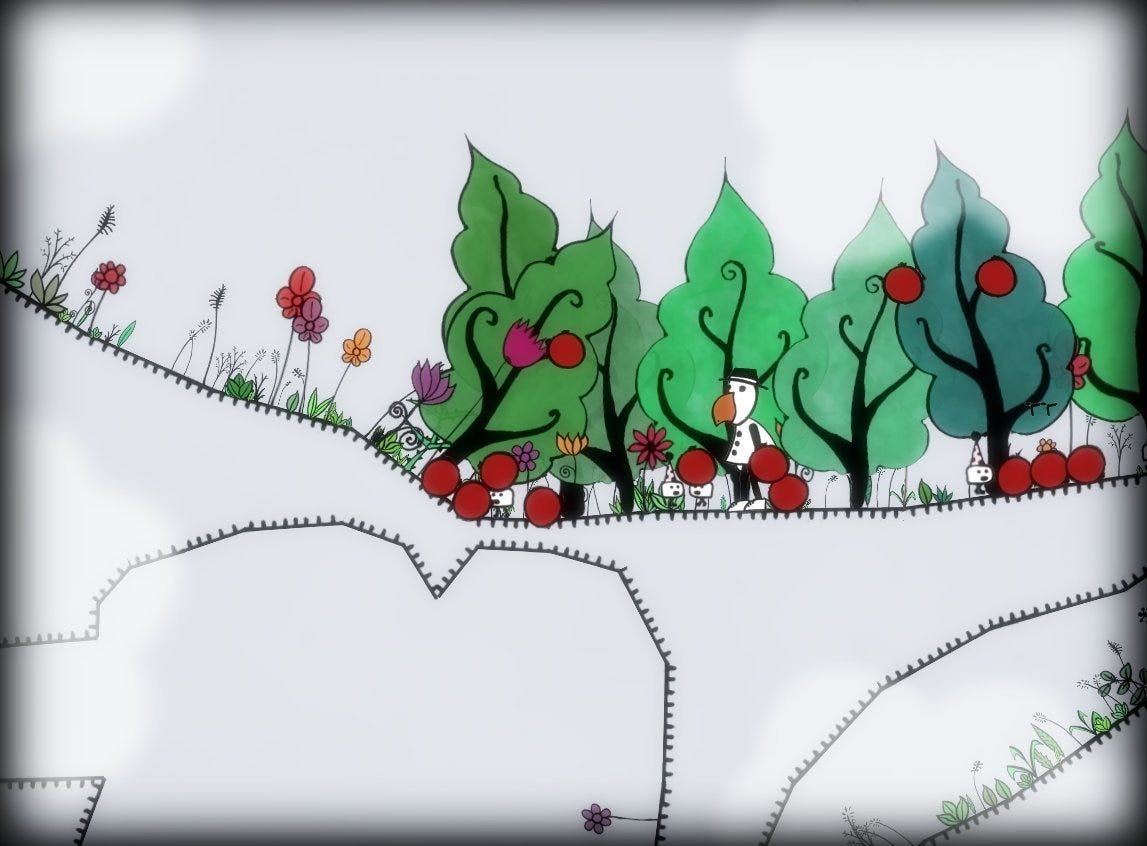
What is the fruit for? You might as well ask what the sky is for.
In it you control a flying birdman character, who must explore a side-scrolling world which appears to have been drawn by a talented, imaginative child. The game too seems to have an innocent, unexplained quality to it: you start exploring and find that things within the world have unexpected properties. As you explore the landscape you encounter giant random objects: books, pencils, pieces of cheese, and so on. Get close to them and they are teleported with you back to your starting point. These collected objects pile up, creating a tower off which you can jump, and then fly, allowing for further explorations of the weird terrain. What does it all mean? I've really no idea. Blueberry Garden, with its hand-drawn animals and bulbous fruits, is a mystifying experience. But perhaps that's kind of the point. Blueberry Garden could well be this year's winner.
The second game on the list is CarneyVale Showtime. This is a kind of ragdoll acrobatics-meets-Peggle versus pinball, in which you control a magical puppet who intends to be the world's greatest acrobat. The levels are a mixture of centrifugal devices and trampoline-like surfaces off which you can bounce. Performing tricks, hitting particular highs, and then completing the level pushes you forward, and opens up increasingly complex acrobatic puzzles.
While it appears straightforward to start off with, it rapidly becomes clear that it's a highly unusual game, blending action timing with some puzzle-solving elements. (Just how do you get through this level, or that? How do you maximise your points with a convoluted route to the final somersault?) The small amount of balance control you have over your tumbling puppet means the game rewards extended time spent with it, as it's possible to become increasingly skilled over many sessions, manipulating your charge through some serious split-second stunts. CarneyVale Studio is fantastically presented, and possibly the most polished-looking of the games on this Grand Prize list.
Then we have Dyson. This is my personal favourite, because I'm both a big strategy geek, and a lover of weird, procedural cleverness in game design. It's a fairly classic RTS in some ways: you build your units, then send them off to exploit resources on the rest of the map. That's about where the similarity ends, however, because your resources are flying seedling things that are half-plant, half-fly, and they are colonising a series of spherical "asteroids", which are spread out across a beige space. Once seedlings penetrate the heart of these and take root, they are able to grow into trees and generate more of your primary unit type - more seedlings. Planting tree types allows you to set up both resource-management, and defence.
As you spread across the abstract constellation you find yourself encountering enemy trees, and seedlings, and they must be destroyed, usually by sheer force of numbers. As the game escalates, so the numbers involved reach astronomical proportions. Timing and tactics soon come into play, and Dyson proves itself to be a very strange, but very beautiful and intriguing, work of strategy gaming. There's something enormously compelling about the huge swarms of seeds you send out to attack an enemy asteroid, and it seems tied into a theme that runs through this year's IGF: one of ambient visuals combined with very traditional game mechanisms to create entirely fresh experiences.
Fourth in our round up is Night Game. This is an astonishingly playable title from Nicklas "Nicalis" Nygren, who is also working on the WiiWare version of Japanese side-scolling action-adventure, Cave Story. Night Game is all visualised in silhouette, with the action taking place in the shadowy foreground, and the background providing the only colours - sombre night-time blues and purples. It's an action puzzle game where you must use the weird physics of a travelling ball to progress. While it moves realistically most of the time, it has a kind of anti-gravity "stickiness" to it, allowing you to pull off feats of inertia to find your way through the game. It's oddly reminiscent of old-school action-adventure Another World, with each single screen posing you with a particular puzzle. I don't expect this to win, but it will doubtless conjure up a cult following on its release later this year.
Do you lust for control over insect-like swarms? Then this game is for you.
Finally, we have the wonderful Osmos. This is a beautiful, organic idea for a game. You are a bubble of (possibly biological) matter on a floaty 2D plane. As such you can absorb blobs that are smaller than you, and increase your size. Bigger blobs will absorb you, and must be avoided. There's a fascinating trade-off, however: to propel yourself you must expel matter, meaning that the faster and harder you move in your viscous, ambient fluid surroundings, the smaller you get. Managing the amount of material you expel becomes absolutely crucial to surviving the tougher levels, because an ejection too far might mean you can't engulf your target, and will lead to your doom.
Osmos is possibly the most classically game-like of the five finalists in its design, but the way in which this is implemented - with pulsing visuals and a soothing ambient soundtrack - makes it the most strange and relaxing. It's probably the most chilled-out game you will play this year, and it would be ideal for falling asleep to, were it not so utterly engrossing.
So let's come back to where we started and stress that this is one of the most intriguing set of finalists in several years. Perhaps the indie gaming scene has been over-hyped in the past few months, and I'm certainly one of those writers responsible for talking up the talents of the independent few. But after 2008 I felt pretty well validated by our faith in the scene. Somehow I can't see any of the 2009 Grand Prize games having quite the impact of last year's finalists, but they're nevertheless enormously intelligent, creative game design projects that give me hope for the ongoing creativity of this basement-level of gaming. Look wider at the awards as a whole and we see PixelJunk Eden, Cortex Command, Zeno Clash and Machinarium - all startling, esoteric works of independent design. Indie gaming is here to stay.